Wednesday, February 18, 2009

Ministry of Defence propaganda and the Afghan drug war

The media today is full of reports about a massive military operation in the Helmand province of Afghanistan, codenamed DIESEL. Closer examination reveals reporting of the operation to have been dramatically propagandized by the Ministry of Defense, with the media acting as their willing - if somewhat confused - accomplices. Somehow a story about less than a £100,000 worth of raw opium has been transformed into a story about £50,000,000 worth of 'deadly heroin'.

Reports of the story in different media are strangely contradictory:

The Sun told us that

“Enough raw materials to produce heroin with a street value of £50million was seized from a sprawling network of compounds.”

The Press Association reported that:

“A daring military operation in Afghanistan has seized heroin and drug-making chemicals with an estimated final street value of more than £50 million”.

The headline in the usually reliable Guardian was

“British troops seize £50m of Taliban narcotics”
with the coverage noting that:

“Troops recovered more than 400kg of raw opium in one drug factory and nearly 800kg of heroin in another.”

From the Telegraph we learnt that:

“British forces have seized £50 million of heroin and killed at least 20 Taliban fighters in a daring raid that dealt a significant blow to the insurgents in Afghanistan."

the Independent told us that:

“Troops seize £50m of Afghan opium”
Whilst the for the BBC it was

“Raids seize £50m of Afghan heroin”


One of the MOD issued action shots: In the Daily Mail this image is subtitled with:

"Operation Diesel: British troops have taken £50million worth of heroin during an attack on a remote Taliban stronghold in Afghanistan"

These are just 7 out of the 100s of reports (600+ listed on Google news), each of the above with a different version of events. They cant all be right, so which one is? Bizarrely enough, a cursory check of the Ministry of Defence's online account reveals they are all wrong.

The MOD website account describes three separate drug finds: one of ‘over 60kg of wet opium’, another of ‘over 400kg of raw opium’ and a third, ‘the largest find of opium on the operation, nearly 800kg’. Along with this opium a “massive supply of the essential chemicals required to make heroin were discovered; sacks of Ammonium Chloride, barrels of Acetic Anhydride and other chemicals that were piled up ready for use”.

So operation DIESEL, in reality, resulted in the finding and destruction of somewhere in the region of 1300kg of unprocessed opium and an a quantity of the chemicals required to process opium into heroin. A few quick sums: According to the UNODC the 'farm-gate' price for opium in Afghanistan in 2008 was $85 a kilo, and these DIESEL stockpiles were presumably not far from the Helmand farms on which they were produced. 1300 x 85 = $110,500, in other words, opium worth approximately £78,000 to the Taliban, at this point in the supply chain.

Were this 1300kg of opium to have been turned into low grade heroin (and we can reasonably suspect that this was what was going to happen), on the basis that it takes around 10kg of opium to produce 1 kg of heroin, it would have produced around 130kg. If the ‘street price’ of a kilo of heroin in the UK is estimated to be around £50- 75,000, then 130 kilos would earn you somewhere between £6.5 and £9.7 million. A very large sum of money certainly, albeit nowhere near £50 million.

The UK street price of a kilo of heroin is, however, vastly inflated above what a kilo of heroin in Afghanistan is worth to the Taliban – the only ‘farm-gate’ price estimate I can find is £450*. But that seems low so lets be generous and put it at a nice round £1000; you are still looking at a Taliban heroin haul worth only £130,000 (and even if the Taliban sold it on the next link in the supply chain at some point in the future for ten times this, the figure only reaches £1,300,000). According to the Independent report the following were found: 5,000kg of ammonium chloride, 1,025 litres of acetic anhydride, 1,000kg of salt and 300kg of calcium hydroxide, which the MOD tells us is exactly enough chemicals to process a conveniently media friendly total of £50million pounds (UK street value) worth of heroin, but this would only be the case if there had been another 5-10 tons of opium seized, which there wasn't. The chemicals themselves are not especially hard to get hold of, or expensive (relative to the profits being made anyway), and processing opium into low grade morphine/heroin for transport is not especially difficult.

None the less, through the prism of MOD drug war propaganda and lazy journalism a story about £78,000 worth of opium has miraculously transmuted into a story about £50,000,000 worth of ‘deadly heroin’.

Defense secretary John Hutton plays this willful misunderstanding for all its worth, quoted extensively (from the MOD report) saying that:

“The seizure of £50 million worth of narcotics will starve the Taliban of crucial funding preventing the proliferation of drugs and terror on the UK's streets.”

So lets be clear; Hutton claims '£50million worth of narcotics' was seized, a ‘fact’ which is demonstrably shown to be untrue by the very same report he is quoted in. Numerous media outlets in the UK and around the world then ran the story that '£50m of heroin' was seized (Daily Mail, Telegraph, BBC etc) – even though no heroin was seized and the 50million figure is pure fiction (one that goes some way beyond the tired old 'make the seizure sound as big as possible by quoting the street price’ trick). The MOD report even opens with the (slightly different) claim that they captured ‘drugs, chemicals and equipment with a UK street value of £50m’ – which is also multi-tiered nonsense.

Worse still, and even if you want to argue the toss over the street value figures, the Hutton quote appears to deliberately imply that the Taliban have somehow been deprived of £50million in funds by this action – when in fact the reality is probably nearer £130,000, and this is assuming that these were indeed establishments entirely in the control of, and serving the profits of the Taliban, which again we have to take on trust from the MOD, and assuming they had a way of establishing it as fact. The Taliban and network of opium farmers also have stockpiles of opium, estimated by the UNODC to run to several 1000's of tons, so it is unlikely this raid will have any serious impact on supply. Moreover, evidence clearly suggests (and indeed the UNODC have argued) that restricting supply serves to increase prices - so the the net impact on profits of sporadic interdiction successes will be even less - potentially even boosting the value of remaining stockpiles.

According to the UNODC’s most recent Afghanistan report the Taliban are making between $250 and $470 million (or £175 - £330 million) a year from the Afghan drug economy (both in taxing poppy farmers and direct involvement in production and export) based on production of between 7 and 8 thousand tons of opium. This rather puts some of the ministers’ grand claims into perspective; this mission prevented maybe £100k in Taliban profits, and destroyed just over one ton of opium (and 20 dead Taliban).

To achieve this triumphant success took 700 troops and veritable fleet of high tech armoury and helicopter gunships (“including RAF Chinooks, Royal Navy Sea Kings and Lynx, joined by US CH53 Sea Stallions”). It will all have doubtless been fantastically expensive, and whilst we are in no position to estimate exactly what the operation did cost (PQ anyone?) we can be sure it would have been many many millions.

This is nothing less than a classic example of war time propaganda – and the madness of the drug war requires more propaganda to support it than most. Reading the MOD report makes this all the more clear. The media were provided with action photos, and action video footage as well as an account that reads like a Boys own war story. The targets are variously described as ‘labs’, ‘drug factories’ and ‘processing plants’ discovered in a ‘chain of compounds’, all sounding rather more like a Bond-villain’s high-tech lair than the mud huts full of dirty plastic bags and rusty barrels we see in the video footage.

The standard issue 'kicking the door down' drug-bust action shot

It has been a quite brilliant propaganda coup for the MOD, with the media uncritically reporting their account, ludicrously inflated statistics and all (and still almost all of them getting even that completely wrong, including the broadsheets). Some of the reporting is extraordinary; The BBC even ran the ‘Raids seize £50m of Afghan heroin’ headline, despite in the body of its report noting that ‘Troops destroyed 1,295kg of wet opium, estimated to have a street value of more than £6m as heroin’.

The need for such propaganda is not surprising. The Afghan conflict is a disaster; despite many billions being spent by the UK, the country is falling apart. The Taliban are resurgent, there is no evidence that the attack on the drug economy is achieving anything positive in the UK or Afghanistan, and the UK soldier casualty list has grown to 145 (one more announced today), not to mention the US and Afghan casualties. The MOD obviously need stories of success like this more desperately than ever, to give the impression they are 'winning' even when the opposite is true. That the operation was 'brilliant', 'daring', 'brave' and 'skillful' is not the point - it does not mean that it wasn't also ultimately futile or even counterproductive. The last thing the Government wants is for people to be told the truth; not just that the Afghanistan drug war is a disaster, but that it is the Government’s complicity in global drug prohibition that gifts control of the completely unregulated opium market to the Taliban insurgents and War lords in the first instance. Half of the worlds opium production is entirely legal and regulated for the medical opiates market (a small proportion of which is prescribed to addicts as heroin) and this legal production is not funding any paramilitary groups, mafiosi, or terrorists. We do have a choice.

More surprising perhaps is that the media, even what we like to think of as the quality end of the market, were so happy to uncritically regurgitate it all. Questioning the Government's account of foreign wars in not a betrayal of our troops – quite the opposite. It is what the media should be doing, and we have been badly let down.

Update 19.02.09:

I have now spoken briefly to the MOD press office. They maintain that the UK street price calculations are based on the heroin being sold at 40% purity. The calculations above are based on the UK street price of a kilo of heroin being sold at £75K. This translates into £75 a gram which is around double the usual street price anyway - so this would not substantially alter the analysis. Even if we do double the UK street price valuation - this still only takes it to a range of £12-20million.

See also:


*The £450 figure comes from this report: Matrix Knowledge Group (2007). The illicit drug trade in the United Kingdom. Home Office Online Report 20/07. London: Home Office. It is a bit confusing - it seems too high to be referring to opium (unless you go back to 2001-2003) but does define farm-gate price of 'heroin' as the price received by the farmer before any subsequent processing’ - any clarification of this or alternative data would be appreciated.

Friday, February 13, 2009

Former Latin American Presidents call for a ‘paradigm shift’


The Latin American Commission on Drugs and Democracy, convened by former presidents Fernando Cardoso of Brazil, Cesar Gaviria of Colombia and Ernesto Zedillo of Mexico in order to evaluate the impacts of the 'war on drugs', has released a statement this week saying that prohibition has failed and calling for a 'broad debate about alternative strategies'.


They argue that,
'Prohibitionist policies based on eradication of production.... [and] criminalization of consumption have not yielded the desired results.'
The statement highlights some of the negative consequences of the 'war on drugs':
  • A rise in organised crime caused by the international narcotics trade

  • A huge growth in drug-related violence affecting the whole of society but particularly the poor and the youth

  • The criminalisation of politics and the politicisation of crime, including the 'infiltration of democratic institutions by organised crime'

  • The corruption of public servants, judicial systems, governments, and those in charge of enforcing law and order

The commission calls for an open and honest debate on drug policy arguing that:

‘Current drug repression policies are firmly rooted in prejudices, fears and ideological visions. The whole issue has become taboo which inhibits public debate….
Hence, breaking the taboo and acknowledging the failure of current policies and their consequences is the inescapable prerequisite for opening up the discussion about a new paradigm leading to safer, more efficient and humane drug policies….
The way forward lies in acknowledging the insufficient results of current policies and, without dismissing the immense efforts undertaken, launching a broad debate about alternative strategies….

They also argue that drug policy must be evidence-based:

‘A new paradigm to address the drug problem must be less centered on repressive measures and more regardful of national societies and cultures. Effective policies must be based on scientific knowledge and not on ideological biases. This effort must involve not only governments but all sectors of society….’
Some serving Latin American presidents have gone further, explicitly calling for decriminalization of possession for personal use (see blogs on Kirchner's call for decriminalisation and Zelaya's statement on legalisation). However the experience of former Mexican president Vincente Fox who was persuaded by US officials to carry out u-turn when he suggested a similar policy may have chastened the authors of this report.

The commission ends on a positive note, saying:
‘The inauguration of the Barack Obama Administration offers a unique opportunity to reshape a failed strategy and engage in the common search for more efficient and humane policies.’
It would have been welcome to see some of those 'efficient and humane policies' explored in more detail. None the less, this is another indication that the policy climate in the Americas is shifting in the positive direction, and even if the longer term answers are not yet fully formed the new tone of pragmatism and critical engagement is all for the good.


Wednesday, February 11, 2009

Drug politics and drug pragmatism - home and abroad.

Interesting times in the drug debate on the national and international front. At home the rather sorry ecstasy reclassification debacle comes to its conclusion with the ACMD recommending a move to B, the Home Secretary saying no, sorry, it’s staying in A, and no debate at all about whether or not the ABC harm ranking/hierarchy of criminal penalties system is a good idea or not. Science has not so much taken a back seat in the debate, it has been forcefully ejected from the car.

It's perhaps not surprising that we rarely find ourselves with serious debating opposition amongst police officers if this is the best they can manage:( Five Live breakfast show the segment you want is 2 hours and 54 minutes in). From the Chief Superintendants' Association, Ian Johnston’s very weak position discounting the ACMD's recommendation to downgrade ecstasy, relies solely on the 'sending out the wrong message' mantra, but he is entirely unable to back it up. It is surprising the pro-drug war authorities still put anyone up for a debate at all. They come across as seriously divorced from reality, looking like ill informed ideologues, or worse, propagandists – then lose. Which is why the Home Office don’t dare debate drug law reform in any live media format, ever – and if they are occasionally caught on the hop, they wheel out a pre-drafted line about debating alternatives being a 'counsel of despair' and telling us, once again that they are 'turning a corner'.


On a more positive front there is a great piece in today's Independent: The Big Question: Do we need a new debate about relaxing drugs policy in Britain?

Labour MP Austin Mitchell has a particularly fine quote that sums recent drug debates and all the classification blather:

"Things have gone from bad to worse, there is no possibility of an honest discussion now. Anyone who sticks their head above the parapet and calls for a rational consideration of the drug laws gets it shot off and kicked around by a horde of lunatics."

On the international front the bigger issues around the war on drugs and its horrendous negative consequences also receive attention in today’s Independent in a comment piece from long time reform advocate Johann Hari: Obama and the lethal war on drugs:

“With the global economy collapsing all around us, the last issue President Barack Obama wants to talk about is the ongoing War on Drugs. But if he doesn't – and fast – he may well have two collapsed and haemorrhaging countries on his hands. The first lies in the distant mountains of Afghanistan. The second is right next door, on the other side of the Rio Grande…”

“Drug addiction is always a tragedy for the addict – but drug prohibition spreads the tragedy across the globe. We still have a chance to take drugs back into the legal regulated economy, before it's too late for Mexico and Afghanistan and graveyards-full of more stabbed kids on the streets of Britain. Obama – and the rest of us – have to choose: controlled regulation or violent prohibition? Healthcare or warfare? “

A slightly different, US-focussed version of this piece appears in the Huffington Post.

Tuesday, February 10, 2009

Ecstasy: truth is the foremost casualty in the war on drugs


On Wednesday 11th Feb the Advisory Council on the Misuse of Drugs (ACMD) will announce the outcome of its review of the classification of ecstasy, and in all likelihood will recommend it be downgraded from Class A to Class B.

A Transform spokesperson said:

“Parliament is reveling in moral grandstanding and populist posturing by eschewing the science on ecstasy. Truth is always the first casualty in any war, including the war on drugs. Given that the Government overruled the ACMD on cannabis classification, and has made it clear that whatever the evidence ecstasy’s classification won’t change, this entire exercise was doomed before it began.

“Drug prohibition is unique in the public health field in using criminal sanctions to reduce social and health harms. It is also uniquely ineffective. There is no evidence that punitive law and its enforcement has more than a marginal impact on levels of drug use or misuse.

“The Advisory Council's job is to reduce the health and social harms associated with the misuse of drugs, so it is a real concern that it is still using a system of classification that was derided comprehensively by the Science and Technology Select Committee less than two years ago. The ACMD’s time would have been far better spent conducting a fundamental review of the evidence underlying the classification system and distinguishing drug harms from harms caused by criminalisation. “

“From Transform’s perspective any reduction in unjust criminal penalties for consenting drug users would have been a positive step. But we remain deeply concerned that regardless of alphabetic classification, ecstasy will remain illegal, its users will still be subject to serious criminal sanctions, and the control of its production and supply will remain in the hands of unregulated criminal profiteers supplying pills and powders of unknown strength made with unknown ingredients.”

“Telling the truth about the harms associated with drug use compared to those caused by prohibition will remain taboo whilst the overarching commitment is to scare the public into supporting an unwinnable war on drugs.”

ENDS

Notes for Editors:
  • Transform staff will be available for comment at the ACMD’s presentation of its ecstasy review at 11.30am Weds 11th February; The Council Room, One Great George Street, London, SW1P 3AA

Transform’s submission to the ACMD ecstasy review

Transform critique of the classification system in Drugs and Alcohol today

Science and Technology Select Committee report on the classification system

2006 Lancet paper on drug harm ranking


See also:

Ecstasy reclassification meltdown: it begins again 21.05.08


Thursday, February 05, 2009

Reefer Madness the musical (and post show discussion on cannabis propaganda)


The Demon Weed! The Past and Present of Cannabis Propaganda

A post-show discussion and Q&A with Ben Goldacre, Mike Jay and Steve Rolles

Come and discover the fascinating history of drugs propaganda and see how it has affected everything from government policy to Daily Mail headlines. The discussion will be accompanied by a screening of highlights from the original, 1936 Reefer Madness and the audience is welcome to field questions. Come along and join in, or just watch the fun!

About The Speakers

Ben Goldacre is an award winning writer, broadcaster, and medical doctor who has written the weekly Bad Science column in the Guardian since 2003.


Mike Jay is an author, broadcaster and historian who has written extensively on history and culture of drug use and appears regularly on BBC TV, Channel 4, Radio 3 and Radio 4.


Steve Rolles is Head of Research for Transform Drug Policy Foundation, a charitable think tank seeking to bring about regulated markets for currently prohibited drugs.


Saturday 28th March, 4.30pm, Bridewell Theatre
Entrance is free of charge for Reefer Madness matinee audience - CLICK HERE to book your matinee ticket and secure a place at this exciting event!

Presented in association with:


Tuesday, February 03, 2009

Addicts’ adventures in wonderland


The following editorial by Danny Kushlick was published in the the journal; Addiction Research and Theory (15(2): 123–126) in April 2007*, and is reproduced here as much of it seems relevant to current debates, both on this blog and in the wider drugs field.


Addicts’ adventures in wonderland

Viewed from a public health and wellbeing perspective, you could be forgiven for thinking that drug policy is developed at the Mad Hatter’s tea party. Huge numbers of legal drug users are effectively ignored, whilst relatively tiny numbers of illegal users have enormous time and resources spent on stopping them using.

I am going to suggest that policy is not rationally based upon sound public health or harm reduction principles, but rather that it is skewed to the point of ridiculousness by the Government’s denial of the counter-productive effects of drug prohibition.

What is the drug problem?

The drugs in the UK that contribute overwhelmingly to public ill health are tobacco and alcohol. Both are legal, with tobacco sales oddly, legally sold to those over the age of 16, as opposed to 18 for alcohol. There are over 10 million regular tobacco users and 40 million alcohol users. Alcohol is implicated in about 40,000 deaths per year, with 120,000 for tobacco. Tobacco products carry a health warning but no ingredients list, whilst alcohol products carry neither.

Cocaine and heroin also contribute to public ill health but at much lower levels of use. Both are illegal and consequently there are no controls on their production, sale or use, apart from the blanket prohibition that aims, fantastically, to eliminate them from society. There are an estimated 340,000 problematic heroin and crack cocaine users in the UK and much of the ill health associated with their use is directly related to their illegality.

Within the national ‘drug’ strategy there is no discussion of the needs of our 10 million plus tobacco users, four million problem drinkers or our one million prescribed tranquilliser users. The reason: our commitment to drug prohibition (and the orchestrated demonisation of illegal drugs that has gone with it) has blinded us to the fact tobacco, alcohol and tranquillisers are drugs. And more importantly, that the use of licit drugs constitutes by far the bigger public health problem.

Messages on ‘Addiction’

What does the Government’s Talk to Frank website say about cocaine and alcohol ‘addiction?’ Under the heading ‘Chances of getting hooked’ it says: ‘Coke is very addictive. It can be difficult to resist the craving and strong psychological dependence due to changes in the brain. Recent evidence suggests possible long-term changes to the nervous system’. And under the same heading for alcohol: ‘For most people, if you drink within the sensible limits for regular drinking, that’s OK. But for some people drinking gradually gets out of control and results either in regular binge-drinking, heavy harmful drinking or alcoholism (alcohol dependence)’. But, note not ‘addiction’ and no long-term changes to the nervous system.

So, different messages for each drug. But what about the response to those who do develop a ‘drug problem?’

Treatment – voluntary and coerced

As a result of our long-standing ‘war’ on illegal drugs, an enormous amount of resources are skewed toward ‘treating’ people who commit acquisitive crime in order to support their habits. One of the consequences of the prohibition of heroin and cocaine is that the price of a daily habit is hugely inflated. Consequently low income dependent users resort to crime to earn money and collectively commit anything up to half of all property crime. A Government that is keen to be seen to be ‘doing something about the drugs problem’ must try to ‘get addicts off ’ their drugs. Because if they don’t, ‘addicts’ will continue stealing things and prostituting themselves in public and generally proving how counterproductive prohibition is. The problem is that we have an apparent crime problem, that appears to be a drug problem, for which ‘treatment’ would appear to be the solution. When in fact, it is a self created prohibition problem (an attempt to eradicate a symptom of lack of wellbeing),underlying which are unaddressed wellbeing problems.

A Drug Rehabilitation Requirement (DRR) is a court-ordered treatment condition handed out for those who are convicted of offences related to their illegal drug use, usually acquisitive crime. But, remember it is our commitment to the global prohibition of drugs that create the high prices, that cause the offending to support a habit in the first instance. Interestingly, there are very few orders given for those whose violent offending is related to their alcohol use. You might wonder if the Government is more committed to addressing problematic drug use that creates property crime than that which creates horrible violence against other people.

Within a prohibitionist paradigm it makes perfect sense for Home Office-led interventions to force heroin ‘addicts’ to overcome their ‘addiction’. Whereas for the Department of Health: ‘Alcohol drunk in moderate amounts in appropriate circumstances is not a danger to health’. Perhaps we need a Drug Policy Rehabilitation Requirement for politicians in denial of the unintended consequences of enforcing prohibition.

Imagine someone walking into his or her local drug project seeking help to get into residential rehab for tobacco ‘addiction’. Why does this seem odd, funny even? The fact is that it even if it were to be possible for them to get funding for rehab, most centres allow residents to smoke tobacco.

Think about the number of smokers you know who are in ‘recovery’ from ‘addiction’, having assiduously gone through a twelve-step programme. (Both the co-founders of AA died of smoking-related disease.)

Our anomalous attitude to drug ‘treatment’ is not unlike the Caucus Race that the Dodo organised in Wonderland:

‘What I was going to say’, said the Dodo in an offended tone, ‘was, that the best thing to do to get us dry would be a Caucus-race’.

‘What is a Caucus-race?’ said Alice . . .

‘Why’, said the Dodo, ‘the best way to explain it is to do it’ .. . .

First it marked out a racecourse, in a sort of a circle, (‘the exact shape doesn’t matter’, it said,) and then all the party were placed along the course, here and there. There was no ‘One two three and away’, but they began running when they liked, and left off when they liked, so that it was not easy to know when the race was over. However, when they had been running half an hour or so, and were quite dry again, the Dodo suddenly called out ‘The race is over!’ and they all crowded round it, panting, and asking, ‘But who has won?’

This question the Dodo could not answer without a great deal of thought, and it sat for a long time with one finger pressed upon its forehead . . . . At last the Dodo said, ‘Everybody has won, and all must have prizes’.


Except that those illegal drug users who are not ‘dry’ after half an hour might well find the Queen shouting at them, ‘Off with his head!’

A public health and wellbeing approach

The recent report from UNICEF put the UK at the bottom of the table of 21 countries for child wellbeing in industrialised countries, with the United States 20th. The UK and US also have some of the highest levels of drug use and misuse in developed countries and both also enforce some of the harshest drug laws on earth. The UK has the highest prison population in Europe, the US the highest in the world. Perhaps this is what is meant by the ‘special relationship?’

These laws conform to neither legislative nor public health norms when compared to other social issues (imagine criminalising tobacco use, gambling or teenage pregnancy). The criminal justice system should be used as a last resort, not a starting point in dealing with public health problems.

A drug policy based on a public health and wellbeing paradigm would be truly comprehensive, cross-departmental and tick all the right boxes with regard to social determinants of health and wellbeing. It might look something like the text below, adapted from Tony Blair’s forward to the Alcohol Harm Reduction Strategy of 2004. I have swapped the words ‘drugs’ and ‘drug use’ for ‘alcohol’ and ‘drinking’. It speaks for itself:

‘Millions of us enjoy drug use with few, if any, ill effects. Indeed moderate drug use can bring some health benefits. But, increasingly, drugs misuse by a small minority is causing two major, and largely distinct, problems: on the one hand crime and anti-social behaviour in town and city centres, and on the other harm to health as a result of binge- and chronic drug use.

The Strategy Unit’s analysis last year showed that drugs-related harm is costing around £20 bn a year,and that some of the harms associated with drugs are getting worse.

This is why the Government has been looking at how best to tackle the problems of drug misuse. The aim has been to target drug-related harm and its causes without interfering with the pleasure enjoyed by the millions of people who use drugs responsibly.

This report sets out the way forward. Alongside the interim report published last year it describes in detail the current patterns of drug use – and the specific harms associated with drugs. And it clearly shows that the best way to minimise the harms is through partnership between government, local authorities, police, industry and the public themselves.

For government, the priority is to work with the police and local authorities so that existing laws to reduce drug-related crime and disorder are properly enforced, including powers to shut down any premises where there is a serious problem of disorder arising from it. Treatment services need to be able to meet demand. And the public needs access to clear information setting out the full and serious effects of heavy drug use. For the drugs industry, the priority is to end irresponsible promotions and advertising; to better ensure the safety of their staff and customers; and to limit the nuisance caused to local communities.

Ultimately, however, it is vital that individuals can make informed and responsible decisions about their own levels of drug consumption. Everyone needs to be able to balance their right to enjoy using drugs with the potential risks to their own – and others’ – health and wellbeing. Young people in particular need to better understand the risks involved in harmful patterns of drug use. I strongly welcome this report and the Government has accepted all its conclusions. These will now be implemented as government policy and will, in time, bring benefits to us all in the form of a healthier and happier relationship with drugs’.

The health and wellbeing approach will become reality within a decade, but for now unfortunately, Mr Blair and his colleagues prefer Wonderland.


References

Danny Kushlick is Director of Transform Drug Policy Foundation**


* note that some of the content is out of date
** Danny Kushlick is now head of policy and commincations


Saturday, January 31, 2009

The Future of Harm Reduction: The US and the countdown to Vienna


The latest on this story from Reuters (including transform quote) and more importantly, given the high level audience in the States, a New York Times editorial ( below).

Update: The Guardian 03.02.09: Rift with EU as US sticks to Bush line on 'war on drugs' (including Transform quote)

from Reuters

U.S. and Europe split over drugs policy

By Luke Baker

LONDON (Reuters) - U.N.-sponsored negotiations on a new global drugs strategy are close to breaking down, with profound divisions between Europe and the United States on key policy issues, participants at the talks in Vienna say.

The problem is that U.S. negotiators are trying to push through anti-drug programmes that were promoted during the former Bush administration but which are no longer advocated by President Barack Obama, they said .

Whereas former President George W. Bush believed in a zero-tolerance approach in the war on drugs, one of Obama's first moves was to back the lifting of a ban on federal funding for needle-exchange programmes. He also gave tacit support to so-called "harm-reduction" strategies that are seen as crucial in the fight against drug-related diseases such as HIV/Aids.

The Vienna stand-off, which threatens to scupper a March summit at which the new drug policy declaration is to be signed, has prompted Democrats in Congress to write to the new U.S. ambassador to the United Nations calling for intervention.

Drug policy campaigners say that without a change in the U.S. position, anti-drug strategies could be set back for the next decade and have a knock-on impact on the spread of HIV/Aids and other diseases.

"We understand that the U.S. delegation in Vienna has been actively blocking the efforts of some of our closest allies -- including the European Union -- to incorporate in the declaration reference to harm reduction measures, such as needle exchange," read the letter, sent to Susan Rice on Wednesday and signed by California Congressman Henry Waxman, among others.

The U.S. delegation should be given new instructions from the new administration, it said.

"Otherwise, we risk crafting a U.N. declaration that is at odds with our own national policies and interests, even as we needlessly alienate our nation's allies in Europe."

Officials close to the U.S. negotiators in Vienna denied that Bush-era policies were being "rammed through" but said instructions from Obama administration had not been received.

"We are currently hearing out proposals, keeping options open and Washington informed. Our new administration will continue to review and develop our negotiating positions," a spokeswoman for the U.S. mission in Vienna said:

THE NEEDLE AND THE DAMAGE DONE

The Vienna negotiations, under the auspices of the U.N. Office on Drugs and Crime, have been going on intermittently for several months but are due to wrap up before a summit on March 12-13 when the new declaration is due to be signed.

While the United States is the chief proponent of a zero-tolerance approach to the estimated $160 billion (111.9 billion pound) illegal drugs industry, it has support from Russia and Japan, neither of whom support 'harm reduction' policies, which can include medication-assisted therapy and drug legalisation.

The European Union's policy position is supported by Australia, Latin America and Iran, among others, all of whom favour policies that include harm-reduction measures.

Drug policy campaigners believe that if the United States could be brought closer to the European position, Japan, Russia and others including China and India would follow, potentially producing consensus on a new global drugs strategy.

"Time is very tight and the race is now on to change the instructions from U.S. officials before the ink dries on the previous administration's line," said Danny Kushlick, head of policy at Transform, a British drug policy foundation.

"The implications of changing the political line is enormous for those who have suffered under the U.S. administration's refusal to support basic harm reduction measures."

U.S. sources said that while it was not impossible that the negotiating position could be changed, it would only happen once new instructions were issued from Washington.

At the same time, while the Obama administration differs from Bush, it does not advocate all 'harm reduction' strategies, which can include drug consumption rooms, safe-injecting rooms, and providing heroin and needles in prisons.

(Additional reporting by Mark Heinrich in Vienna)

(Editing by Angus MacSwan)


from the New York Times:

Time lag in Vienna

"Programs that give drug addicts access to clean needles have been shown the world over to slow the spread of deadly diseases including H.I.V./AIDS and hepatitis. Public health experts were relieved when President Obama announced his support for ending a ban on federal funding for such programs.


Unfortunately, Mr. Obama’s message seems not to have reached the American delegation to a United Nations drug policy summit in Vienna, where progress is stalled on a plan that would guide global drug control and AIDS prevention efforts for years to come. The delegation has angered allies, especially the European Union, by blocking efforts to incorporate references to the concept of “harm reduction” — of which needle exchange is a prime example — into the plan.

State Department officials said that they were resisting the harm-reduction language because it could also be interpreted as endorsing legalized drugs or providing addicts with a place to inject drugs. But the Vienna plan does not require any country to adopt policies it finds inappropriate. And by resisting the harm-reduction language, the American delegation is alienating allies and sending precisely the wrong message to developing nations, which must do a lot more to control AIDS and other addiction-related diseases.

Some members of Congress are rightly angry about the impasse in Vienna. On Wednesday, three members fired off a letter to Susan Rice, the new American ambassador to the United Nations, urging that the United States’ delegation in Vienna be given new marching orders on the harm-reduction language. If that doesn’t happen, the letter warns, “we risk crafting a U.N. declaration that is at odds with our own national policies and interests, even as we needlessly alienate our nation’s allies in Europe.”

Thursday, January 29, 2009

Should caffeine be a made a class B drug?

The week before last witnessed the first decent media drug panic we’ve had in a while, although unusually this one was not about cannabis, ecstasy, or cocaine. It followed the publication of a paper (from Durham University’s department of psychology) titled ‘Caffeine, stress, and proneness to psychosis-like experiences: A preliminary investigation’ in a fairly obscure Journal called Personality and Individual Difference. The papers key finding was that heavy caffeine users were slightly more prone to hallucinations, but not to feeling persecuted.

Somewhat strangely the story received massive cross-media coverage, in almost all the UK daily’s, news agencies and major media outlets across the world. A google-news search finds 285 media hits ranging from Fox news (Lots ... and Lots of Coffee Linked to Hallucinations), and the Times of India (coffee can lead to hallucinations), to The Australian (Drink coffee, see dead people) and even Reuters with the ridiculous invent-a-quote headline 'Coffeeholics wake the dead'. But as so often with drug panics the actual research findings are rather underwhelming when compared to many of the shock headlines of the stories covering them.


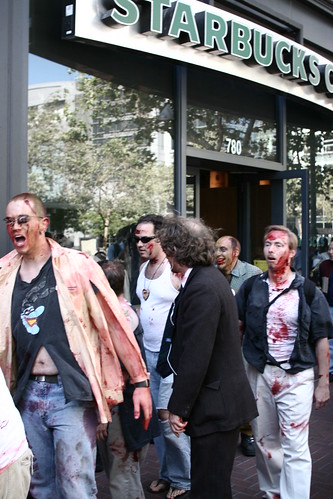
Some dead people spotted outside Starbucks yesterday*

As deconstructed in the Guardian’s unfailingly brilliant Bad Science Column by Ben Goldacre (and the excellent NHS 'behind the headlines' page), the paper's findings, in actuality, showed a statistically significant but very weak correlation between high caffeine intake and proneness to hallucinate (different from actually hallucinating). Moreover The findings were based on weak observational data from a self selecting sample of students (who did an online questionnaire of often strange and ambiguously worded questions), confounding variables were not considered, and much of the media coverage quoted the finding that 7 cups of coffee a day is associated with a three times higher prevalence of hallucinations, a fact that emerged from the Durham University press release but is not supported by the actual research findings. There was also nothing in the paper about coffee making you see ghosts or dead people – a headline that evidently emerged by a process of Chinese whispers between the published paper (which mentions sensing people who were not there), the departmental press release, news agency coverage, and lazy headline writers.

So here, in the finest tradition of drug stories in the media, was a piece of not especially good research being very badly reported; a rather dull and ambiguous research finding sexed up by the headline writers to either fill up space on a quiet news day or shift units, depending on how you want to see it. You may well ask; So What? Nothing new here really.

But this rather sorry and un-illuminating tale does raise some more interesting issues when viewed alongside the longer running but not completely dissimilar cannabis panic. They are alike in key respects – journalistic hype, poor science reporting, the theme of young people in peril, drugs and mental health (specifically psychosis) and so on. But there are also some dramatic differences. The fact that the caffeine story revolved around the discovery that high levels of consumption could lead to psychotic-like symptoms notably failed to provoke any comment from any of the legions of politicians and opinion writers who pounced on every new research paper that mentioned ‘cannabis’ and ‘psychosis’ in the same sentence, before pontificating ad-nauseum about ‘sending out the wrong message’, ‘a mental health time bomb’, 'lethal skunk' (perhaps responsible for all the dead people seen by the coffee drinkers?) and all the rest.

Where was the Home Secretary telling us how the coffee young people are drinking today, the Starbucks' triple shot mega-chinos, are nothing like the innocent cups of Maxwell House that their parents used to drink in the 60s? Where was Melanie Phillips rallying against the moral depravity of Government-sanctioned caffeine-crazed child-zombies prowling our streets? Where was the Independent on Sunday reversing its support for caramel lattes because of the ten-fold increase in ghost sightings? Caffeine panic just doesn’t seem to fire up our legions of drug warriors. There’s no political mileage in it and of course, most of them spend much of the day drinking it. Even more than alcohol, its one drug that it’s OK to consume. A nice, safe drug. Our drug. Not really a drug at all.

Further highlighting this peculiar conceptual dis-juncture that exists in the minds of the media, public and politicians alike, between illegal and legal drugs, some of the media coverage was unintentionally hilarious; like the interview on the Radio 1 website with a woman, who after drinking several bottles of diet cola, says that: "I can act weird and I talk weird, as if you are high on drugs". And notable in the media coverage was the almost complete absence of the word 'psychosis', even though it was in the title of the research paper being reported on, and psychotic symptoms were the paper's primary subject, and indeed primary findings. Did the uncomfortable echoes of the cannabis/psychosis media narrative lead to the word being unconsciously deleted from the coverage?.

We shouldn’t forget that the key stated motivation for the recent reclassification of cannabis from C back to B was the potent new strains of ‘skunk’ cannabis and its effects on mental health , specifically the danger of inducing psychosis (the widely misunderstood and rarely explained word, endlessly repeated in the media). Compared to the caffeine story there was certainly a wide array of political forces marshaling behind the skunk/psychosis panic; the tabloids and opposition politicians trying to score points by hyping the panic to make the Government look irresponsible, and a new Prime Minister wanting to assert his moral credentials with a few judicious policy U-turns on third-rail type issues. There is more and arguably better research too, both on increasing potency and mental health risks of cannabis, but in the froth of hype, panic, moral grandstanding and political posturing, any grasp on reality or objective science and harm assessments was lost (chronicled on this blog in almost gruesome detail over the last couple of years).

Another lesson then, from this latest caffeine mini-panic, is that the media clearly doesn’t even need the sorts of partisan politics and culture-wars tedium that swilled around the cannabis debate to fall back on bad science reporting of drug stories. They will evidently do that completely unprompted. Understanding of and reporting on statistics in the media is almost universally poor. Combine this fact with the need to produce sexy drug-shock type headlines (usually produced by generalist, crime or home affairs reporters with no science or stats background) and you have a recipe for a seemingly endless tide of poor drug coverage. It may give bloggers something to sound off about, but in policy terms the impacts of this phenomenon are almost all bad.

By way of epilogue consider some of the recent coverage of caffeine in the Daily Mail, the long time standard bearer for hysterical bad-science drug reporting. A Mail story from the 26th of January is headlined: ‘Coffee may raise child cancer risk: New evidence that caffeine could damage babies'' DNA'. With this effort the Mail threatens to become a self-parodying laughing stock, so luminous is its idiocy. Behold; they have managed to conjure a drug shock headline of classic DNA-melting drug-baby vintage, reporting on scary ‘new evidence’ from research that is not only unpublished, but has yet to even begin.

Is this the beginning of a Daily Mail push for caffeine to be classified as a Class B drug? Are they groping around for something new to be outraged about now the cannabis 'problem' has been solved with an additional three years on prison sentences? Probably not, but I almost hope it is – it would expose the contradictions and hypocrisy in the media's drugs reporting.

See also:
the caffeine wikipedia page
NHS caffeine advice


*photo thanks to
ioerror


Tuesday, January 27, 2009

When rats were placed in an environment ideally suited to their needs, they no longer showed interest in puhsing levers for rewards of morphine.


'The globalisation of addiction' by Bruce Alexander

review by Mike Jay

Bruce Alexander is best known - though deserves to be much better known - for the 'Rat Park' experiments he conducted in 1981. As an addiction psychologist, much of the data with which he worked was drawn from laboratory trials with rats and monkeys: the 'addictiveness' of drugs such as opiates and cocaine was established by observing how frequently caged animals would push levers to obtain doses. But Alexander's observations of addicts at the clinic where he worked in Vancouver suggested powerfully to him that the root cause of addiction was not so much the pharmacology of these particular drugs as the environmental stressors with which his addicts were trying to cope.

To test his hunch he designed Rat Park, an alternative laboratory environment constructed around the need of the subjects rather than the experimenters. A colony of rats, who are naturally gregarious, were allowed to roam together in a large vivarium enriched with wheels, balls and other playthings, on a deep bed of aromatic cedar shavings and with plenty of space for breeding and private interactions. Pleasant woodland vistas were even painted on the surrounding walls. In this situation, the rats' responses to drugs such as opiates were transformed. They no longer showed interest in pressing levers for rewards of morphine: even if forcibly addicted, they would suffer withdrawals rather than maintaining their dependence. Even a sugar solution could not tempt them to the morphine water (though they would choose this if naloxone was added to block the opiate effects). It seemed that the standard experiments were measuring not the addictiveness of opiates but the cruelty of the stresses inflicted on lab rats caged in solitary confinement, shaved, catheterised and with probes inserted into their median forebrain bundles.

Yet despite (or perhaps because of) their radical implications for the data that underpin addiction psychology, the Rat Park experiments attracted little attention. Alexander's paper was rejected by major journals including Science and Nature, and eventually published only in the respectable but minor Pharmacology, Biochemistry and Behavior. Although the experiments have subsequently been replicated and extended, they still inform the science of addiction only at its margins. The Globalisation of Addiction is Alexander's attempt to draw out their full implications for our understanding of addiction, and to chart a course towards forms of treatment that can transform their findings into practice.

His analysis begins with a radical reconception of addiction itself. Throughout the 20th century, as the science and treatment of addiction have developed into vast academic and professional industries, its underlying nature has stubbornly refused to coalesce into any sort of consensus. Is it a physiological condition marked by metabolic responses such as tolerance and withdrawal, a condition produced simply by exposure to 'addictive' drugs? Or is it a psychological affliction, the product of an 'addictive personality' - or, alternatively, a moral weakness, a failure of willpower and abrogation of social responsibilities? And how do these clinical views of addiction relate to the ever-expanding meanings of the term in the wider culture?

For Alexander, all these seemingly disparate accounts are united by their focus on the individual addict; but even a cursory historical and cultural survey reveals that the incidence of addiction is essentially a social phenomenon. Many historical and indigenous cultures have lacked even the concept of addiction - but many of these same cultures, once their traditional structures have been disrupted by conquest or colonisation, have been destroyed by it. All across the Americas, the Pacific and Australia, hundreds of 'demoralised' cultures have descended into vicious spirals of addiction, usually to alcohol, in many tragic cases wiping themselves out entirely. The root causes of addiction, then, must run deeper than any individual pathology: they must be sought in a larger story of cultural malaise and 'poverty of the spirit' that forces individuals, often en masse, into desperate and dysfunctional coping strategies.

Once addiction is recognised as a consequence of broader social currents, it becomes clear that the problem is far more widespread than the professional focus on drugs allows. Uncontrolled and chaotic appetites are extensively diagnosed across our culture not merely for illicit drugs, alcohol and nicotine but for other substances (food), other consumer activities (shopping, gambling), and other sources of emotional support such as romantic love. 'Addictive' is a slogan of enticement used to sell online gaming, exercise programmes and women's magazines. Even successful and high-functioning individuals can often be accurately described as addicted to money, power or status. Throughout the 20th century, these extensions of the concept of addiction were typically marginalised on the grounds that, unlike illicit drugs, these were mainstream activities that generated dysfunctional behaviour only in a minority of subjects. But alcohol has always been both mainstream and addictive, and it is increasingly clear that illicit drugs are used widely without necessarily generating addiction. Any attempt to get to the root of the problem must recognise that addiction is rampant not merely among a subculture of problem drug users but across society at large.

Alexander's search for the drivers behind the modern explosion in addiction leads him to consider the parallel spread of free market societies. Along with their obvious economic benefits, free markets also bring a widespread increase in what he terms cultural 'dislocation'. What were once elaborately reciprocated cultural transactions are reduced to simple commercial exchanges, and 'the competitive marketplace becomes the matrix of human existence'. Social fabrics are loosened as economic winners and losers polarise into their respective ghettoes, and traditional networks of trust are replaced by often brutal demarcations between neighbourhoods and social classes. It is our now endemic culture of competitive, zero-sum individualism that has, in the phrase of Alexander's title, globalised addiction over the last 50 years.

It is, he acknowledges, too simplistic to blame capitalism itself: the fundamental problem, dislocation, can equally be generated by feudalism , communism or any other political system. Nevertheless, a consumer society systemically erodes the sovereign remedy against addiction which, following Erik Erikson, Alexander terms 'psychosocial integration'. This has long been recognised as a necessity for social functioning: even Charles Darwin, whose theory is typically used to support competitive free market ideology, insisted that generating 'social and moral qualities' was a crucial factor in human evolutionary success. Psychosocial integration eliminates the hyperfocused pursuit of individual gratification that manifests as addictive behaviour, and balances individual autonomy with social belonging. Dislocation, though its effects are concentrated among the poor and socially excluded, has pervasive effects on society as a whole, which is why levels of happiness and wellbeing stubbornly refuse to rise in proportion with purchasing power. The greatest modern triumph over drug addiction, in China during Mao's Great Leap Forward from 1949-1955, took place against a background of material poverty but intense social cooperation in rebuilding a shattered society.

This analysis has helped Alexander to understand the successes and failures of treatment programmes in his professional world in Vancouver, where alcoholism and violence remain an intractable problem among many native Canadian Indians. Dislocation, rather than poverty, is their ultimate cause: communities resettled on unfamiliar land can be subsidised to the point where a 4x4 sits in every drive and a satellite dish on every roof, but still manifest higher levels of addiction than those which are allowed to remain in their homelands and follow their traditional subsistence strategies. In the arresting motto adopted by British Columbia's successful aboriginal community projects, 'Culture is Treatment'.

Once addiction is reconceived as a symptom of the dislocation embedded in modern cultures, the practical measures required to manage it become vast in scope. Treatment of addicts needs to become more holistic, and interwoven into a far wider spectrum of social programmes. Education and treatment need to lose their narrow focus on illicit drugs and alcohol, and to encompass addiction in all its forms. Although the prohibition of drugs is a major contributor to social dislocation, legalisation is far from a panacea: the majority of addictions, after all, are to legally available products. (The greatest benefit of legalisation, perhaps, would be to allow communities to determine their own drug policies, thereby providing a crucial lever for increasing psychosocial integration.) Faith-based treatments, whether Christian or more broadly spiritual, have an important role to play: St. Augustine's Confessions remains a powerful template for the addiction recovery narrative, and membership of faith groups can provide an effective antidote to dislocation. Political activism, both global and local, is a tool of social empowerment that can benefit addicts and addiction professionals alike.

All these strategies are eminently sensible, but remain hard to patch into the treatment of addiction as currently constituted. We may accept Alexander's persuasive case that drug addiction, properly understood, is a scapegoat for broader social dysfunction, but it is by no means obvious how to respond effectively. Like it or not, treatment remains focused on individuals, for whom his analysis holds limited explanatory power. Alexander does not deny the existence of personal tendencies to addiction, which may include genetics and neurochemistry, but maintains that they are often marginal factors and poor predictors of individual risk: overall, interventions are more effective at the social level than the personal. But these underlying causes are far easier to identify than to address. Our societies are profoundly structured around the need for individual autonomy; and personal freedom must, on some levels, always include the freedom to become addicted.

The Globalisation of Addiction is a considerable work, highly ambitious in its scope, impressive in its multidisciplinary scholarship, clear in its structure and generous in its references. It is both its strength and its weakness that it integrates addiction so convincingly into broader issues of social and political reform. Like Rat Park, it offers a fundamental critique of the 20th century view of addiction, but also demonstrates how dominant are the processes and structures that drive it.


Published with permission from Mike Jay. Mike is a writer and historian (See Mikejay.net ) and a trustee of Transform Drug Policy Foundation.

Originally published on
www.nthposition.com
Article copyright 2009 Mike Jay

The Globalisation of Addiction is available on Amazon with a readable excerpt.


Thursday, January 22, 2009

Lords debate alternatives to drug prohibition


update: debate transcript below

Transform Drug Policy Foundation

Media release 20/01/09

No embargo

Lords to debate alternatives to drug prohibition

The House of Lords will be debating ‘the United Nations Declaration on countering the world drug problem’, in the Main Chamber, January 21st at 11am. The debate is led by Baroness Meacher (cross bench) who will call on the Government to follow the recommendation of the 2002 Home Affairs Select Committee to debate alternatives to prohibition at UN level (see notes to editors below) at this year’s upcoming 10 year review of UN drug policy in Vienna.

Baroness Meacher said:

“Criminalising drug users has clearly not reduced the problems we face, and has only served to exacerbate the harm caused by drugs. It is time for policy makers at all levels, including the UN drug agencies, to move away from the failings of drug war ideology and embrace a new approach guided by sound evidence and public health principles. There is now an urgent need for and mature and balanced exploration of policy alternatives, including the potential legal regulation of some or all currently illegal drugs”.

ends

Notes to editors:

Home Affairs Select Committee Report: “The Government's Drugs Policy: Is it Working?”

Recommendation 24:

"That the Government initiates a discussion within the Commission on Narcotic Drugs of alternative ways - including the possibility of legalisation and regulation - to tackle the global drugs dilemma."

----------------------

Read the debate transcript here

Media coverage:


Guardian news in brief

Wednesday, January 21, 2009

Obama lifts federal ban on funding needle exchanges

The Obama White House has launched its new website, www.whitehouse.gov. Under the header "The Agenda - Civil Rights", the site highlights various relevant issues including; homophobia and its affect on HIV/AIDS, contraception (including in prisons), the need to empower women to prevent the spread of HIV, and notably: needle exchange. The relevant text is below. Aside from a small mention for drug courts and eliminating the cocaine/crack sentencing disparity there isn't much else about drug policy yet, but lifting the disgraceful needle exchange funding ban is a good start considering we are only in day one - and the generally pragmatic tone bodes well. Can we be cautiously optimistic? Yes we can.

"*Promote AIDS Prevention: In the first year of his presidency, President Obama will develop and begin to implement a comprehensive national HIV/AIDS strategy that includes all federal agencies. The strategy will be designed to reduce HIV infections, increase access to care and reduce HIV-related health disparities. The President will support common sense approaches including age-appropriate sex education that includes information about contraception, combating infection within our prison population through education and contraception, and distributing contraceptives through our public health system. The President also supports lifting the federal ban on needle exchange, which could dramatically reduce rates of infection among drug users. President Obama has also been willing to confront the stigma -- too often tied to homophobia -- that continues to surround HIV/AIDS.

* Empower Women to Prevent HIV/AIDS: In the United States, the percentage of women diagnosed with AIDS has quadrupled over the last 20 years. Today, women account for more than one quarter of all new HIV/AIDS diagnoses. President Obama introduced the Microbicide Development Act, which will accelerate the development of products that empower women in the battle against AIDS. Microbicides are a class of products currently under development that women apply topically to prevent transmission of HIV and other infections."


See also:

Monday, January 12, 2009

Mexican Drug War – El Paso raises debate on prohibition

As the UN member state delegations gather their forces for the upcoming UN drug strategy review, it is vitally important to recognise the value of local activity in raising the debate on alternatives to global prohibition.

In response to the Mexican drug war taking place on their border, El Paso City Council, Texas, has taken the courageous step of calling on Congress to discuss drug legalisation as an option for ending the damage caused by prohibition.

Last Tuesday the Council voted 8-0 on a resolution drafted by the city's Border Relations Committee, outlining 11 steps the U.S. and Mexican governments can take to help El Paso's "beleaguered and besieged sister city."

All city representatives also supported an amendment by South-West city Rep. Beto O'Rourke that added a 12th step: the encouragement of the U.S. federal government to start a "serious debate" on the legalization of drugs.

See O'Rourke in action in this video, making a hell of a lot of sense.

Followed by more coverage:here, here, here, and here

Why not send a message of support to the Council.

The El Paso initiative shows how a city-wide initiative can impact internationally. This was the case when London Borough of Camden Council recommended legal regulation to the Home Affairs Select Committee drugs inquiry of 2001:

"Given the failure over several years, and across numerous agencies and countries, to have any significant effect on the supply side of the drug market, we feel it is time to consider seriously the option of undercutting the illicit market with a regulated legal market."
And, given that the drug war is creating havoc everywhere, why not contact your local council representative and try and start something like this near you. Here is one of our trustees, Gary Wallace, doing just that in his local paper: The drugs debate

Camden Council's was one of the submissions (that included Transform's), that influenced the Committee in making its final recommendation, calling for a debate on legalisation and regulation. And is worthy of note in the run up to the UN drug strategy review in March this year.
"We recommend that the Government initiates a discussion within the Commission on Narcotic Drugs of alternative ways—including the possibility of legalisation and regulation—to tackle the global drugs dilemma."
David Cameron, perhaps our next Prime Minister, then a back bench MP, was a member of the committee and voted for this recommendation. You may want to drop him a line too...

The El Paso initiative is in advance of talks that will take place between President-elect Obama and Mexican President Calderon that will focus on the Mexican drug war. For more on the way that the drug war horrors have escalated in Mexico over the last few months see:

Experts and public figures in the U.S. and Latin America offer a range of views, from stepped-up policing to legalization. And drug war created havoc continues as the knock on effect takes place:


And, just to bring the story home to us, here in the US of England, Lily Allen told the Mail: 'Drugs won't kill you', insists Lily Allen ('and yes, I've given up')
"Lily Allen was condemned last night for suggesting that the risks of cocaine are overstated. The 24-year-old singer said: 'The only story is that drugs are bad and they will kill you - you will become a prostitute, a rapist or a dealer. But that's not true. 'I know lots of people that take cocaine three nights a week and get up and go to work everyday, no problem at all."
I was called for a comment on the Lily Allen story. I suggested that the furore was about a culture clash, whereby drug use is normalised in certain subcultures. Whilst, to the outsider this behaviour appears aberrant and worthy only of condemnation. I went on to say that the most important point was to accept the reality that millions use drugs and that the priority was to keep users safe. Predictably they preferred Dominic Grieve of the Tory Party and David Raynes from the National Drug Party Prevention Alliance.

Tuesday, December 23, 2008

Stop Press - they've only gone and won the war on drugs

STOP PRESS:

'Outgoing U.S. President George W. Bush proudly announced today that the United States has won the war on drugs and all illegal drugs have been eliminated from the country.
"None of our efforts have been in vain", the president declared during a televised news conference. "The war on drugs has ended and we, the American people, have proven victorious!"'

Bush's War on Drugs Ends With Success

Seriously though, as we approach the New Year, it's good to know that one day our work will be over because the war on drugs will have ended...albeit for slightly different reasons than this article and on a slightly different time scale...

For now though, thank you to all those who are supporting our mission and no thanks at all to those who make our work necessary in the first place. A merry festive season to all (why shouldn't drug warriors have a nice Christmas?) and a wonderful year for our supporters.

Thursday, December 18, 2008

Send out the right message to young people - I'll drink and smoke to that!

As reported in The Sunday Times last Sunday ‘Drinks industry says no to link with drugs plan’

“An Irish government plan to include alcohol in its national drugs strategy is being opposed by the drinks industry.”
Rosemary Garth, director of the Alcohol Beverage Federation of Ireland (ABF), said: “It is the abuse of alcohol that causes difficulties but it is the [mere] use of drugs that is a problem. They are different issues.”
Well now, there's a surprise from the ABF - turns out alcohol isn't a drug at all...

Transform has been calling for all drugs to be included in the drug strategy for many years now, together with a truly cross departmental approach.

As reported in The Times (30 Nov), ‘Planned curbs on smoking to be axed’

“Ministers have decided they cannot justify some of the more draconian measures to reduce cigarette and alcohol sales during the economic downturn. A proposed ban on shops displaying tobacco, and steps to force tobacco manufacturers to remove logos from cigarette packs are expected to be abandoned, along with proposals to stop supermarkets discounting alcohol. The U-turn follows pressure from backbenchers and trade groups, who argued that there was little evidence to show the steps would have health benefits.”

And: ”It is understood, however, that ministers have reluctantly conceded there is not enough evidence to support the tobacco proposals and have concluded it would “not be in the nation’s best interests” to press ahead. Some in the cabinet feared the crackdown, which included packaging cigarettes in plain “vanilla” boxes with no branding, would jar with the key message about shoring up the economy. Senior Labour sources say the legislative programme is designed to appeal to “white van man”; that is, working-class swing voters who are more likely to smoke and drink.”
Well now, there's a surprise from the Government - they're more committed to populist posturing for political advantage, than protecting their voters' health...

..although, to give them some credit, some of the "less draconian" measures did go through

And from the Mail (25 Nov): 'Rate alcohol and tobacco like illegal drugs, says top scientist'

"The harm done by tobacco and alcohol should be rated on the same system as illegal drugs, a leading scientist said today. Professor Sir Gabriel Horn who chaired a special committee on drug use, warned that dependency on drink and cigarettes was spiralling out of control and urgent measures were needed to curb their misuse. Professor Horn told the Government's drug advisors in London that many people believe alcohol is more harmful than heroin or cocaine.
He told the Advisory Council on the Misuse of Drugs: 'It's been recognised that [alcohol] is the most harmful recreational drug you could use. The risks are very similar to illegal substances."

The Mail article appeared the same day that the Lords made their final valiant attempt to delay the reclassification of cannabis back to Class B.

Doesn't it restore your faith in in our glorious leaders reliance on science and joined up governing? Give me strength...oh, and a "happy hour" bottle of alcopop...

Monday, December 15, 2008

White power, anti-semitism, anti-prohibitionism and Peter Hitchens

It's an old thread (April 2007), but you don't get to watch the White Power guys at Stormfront.org perform in the drug policy arena too often. Thankfully too, I don't come across many forums where I see the phrase "Danny Kushlick = Jew".

You can see the full thread here Some excerpts follow.

On the war on drugs:

"If the 'war on drugs' requires Britain to have the world's highest per capital execution rate then I am not squemish about that prospect."

Peter Hitchen's wisdom on crime:

"I have mentioned this book several times - A Brief History Of Crime by Peter Hitchens demolishes every single argument spouted by the legalise drugs rabble I urge everyone to read this book."

Legalisation:

"I tend to favour legalizing all drugs. I don't take any narcotics myself but if people want to do so then let them. Prohibition didn't work for alcohol in the 1920's and prohibition on drugs isn't working now. All it does in ensure the huge profits from drugs go into funding criminal gangs and the very people our troops are fighting in Afghanistan.

It is crazy for us to allow the profits from heroin to go to fund the Taliban in Afghanistan who were are fighting. By allowing British farmers to grow poppies we would striking a huge economic blow against the Islamists.

Currently drug dealers have a huge economic incentive to peddle drugs to kids so as to set up the drug consumers of the future. If people could simply go to a government run supplier then there would be no alternate economy for drugs. Plus there would be no problems with cutting and impurity.

An incredible amount of crime these days is fueled by drugs. It would be far cheaper for insurers to pay for these drugs than to shell out for all the break ins which currently go towards financing drugs.

Either that or we fight the war on drugs to win. Shoot every single person found with any kind of illegal drug on them as we would any collaborator in a war."


The value of draconian deterrence:

"Put it this way, if you told me I could be shot if caught drinking, I still wouldn't think twice about having another beer."

Crop eradication:

"Several years ago scientists developed a genetically modified virus which could wipe out heroin poppies. The virus could be spread by aeroplane - as the Americans used 'Agent Orange' in Vietnam or surruptitiously introduced by special forces troops.

Instead of just getting on with the operation the government consulted environmentalist groups who - incredibly objected to the plan !.

So thanks to a handful of green cranks thousands of people, addicts and their victims have to suffer."


My Jewishness:

"'Danny Kushlick, director of the pro-legalisation Transform Drugs Policy Foundation, said the new study backed his view that attempts to discourage drug use were pointless. 'We know from evidence that misuse of drugs is related significantly to social ill-being and social deprivation. You cannot deal with that stuff with education and prevention or through teaching younger and younger children. You deal with it by redistributing wealth and improving wellbeing.'

What a load of tosh.

Danny Kushlick = Jew - merely using this issue to argue for transferring Whites' hard-earned money to useless Blacks."


And finally the recognition that Aryanism is not a panacea and that it might need a little liberalism too:

"Are you happy for Aryan people to harm themselves with Alcohol and tobacco? Fast cars? Risky sports? Sounds like the road to a nanny state (though well intentioned).

I certainly think Kushlick has half a handle on the issue. Some people do turn to drugs as a way out of dealing with certain life issues or circumstances. A generally healthier society would lessen this.

Take blacks out of the equation - drugs will be there when they're gone. An all white Britain will still have to deal with the issue."


The problem is that it's a very slippery slope and no one should be taken out of the equation by a discriminatory and unjust law on drugs. And we look forward to our political leaders saying as much in public...

Sunday, December 07, 2008

The mystery of the missing Impact Assessment

On Tuesday of last week I got a call from The Times asking me to comment on a story showing that the Home Office anticipate that cannabis reclassification (back to B) would have significant negative consequences including hundreds of extra incarecerations, a disproportional impact on the black population, and tens of millions in extra CJS expenditure - some diverted from heroin and crack provision in the drug strategy. All this and more appears in an impact assessment they undertook; for the detail see Derek Williams's comprehensive post on the UKCIA blog.

What struck me was that, whatever the source of the information, it ought to have been in the public domain, at the very least informing the debate in the House of Lords specifically on cannabis classification the week before.

The story didn't run in The Times, but a few days later I got my email alert reminding me of Parliamentary Questions (PQs) to Alan Campbell MP, Home Office drugs minister. It turned out that Paul Flynn MP had received a reply to his PQ asking "what assessment the Home Secretary has made of the effects of the reclassifying of cannabis on the number of people receiving a custodial sentence for offences relating to the drug each year". He had been given a holding answer on 20 October, the whereabouts of the Impact Assessment not given to him until 26 November, (the day after the Lords Debate).

Yet the Impact Assessment had actually gone online on 13 October, when the draft Order to reclassify cannabis to a Class B drug under the Misuse of Drugs Act 1971 was laid. However, no one in the drug policy field nor those at the forefront of the debate in Parliament, knew that it was publicly available - the Home Office had made no attempt to alert interested parties to its existence.

Now, the question is, whether this is SNAFU or deliberate hiding of evidence? Either way, it's a coincidence and a little odd.

I wonder how pleased the Lords will be to find out that this key document existed, (highlighting the anticipated and significant negative consequences of the move), but that they needed PQ's and bloggers to make them aware of it, all some time after the crucial debate on the issues it concerns itself with.