Showing posts with label Lancet. Show all posts

Friday, February 01, 2008

Drug classification blah blah blah

everyones talking about it so this seemed like a good moment to flag up an article on the classification I had published in Drugs and Alcohol Today in October, that, because of the long run in on these sorts of things, had managed to slip out into print unnoticed by the usually foolproof Transform blog media scanner.


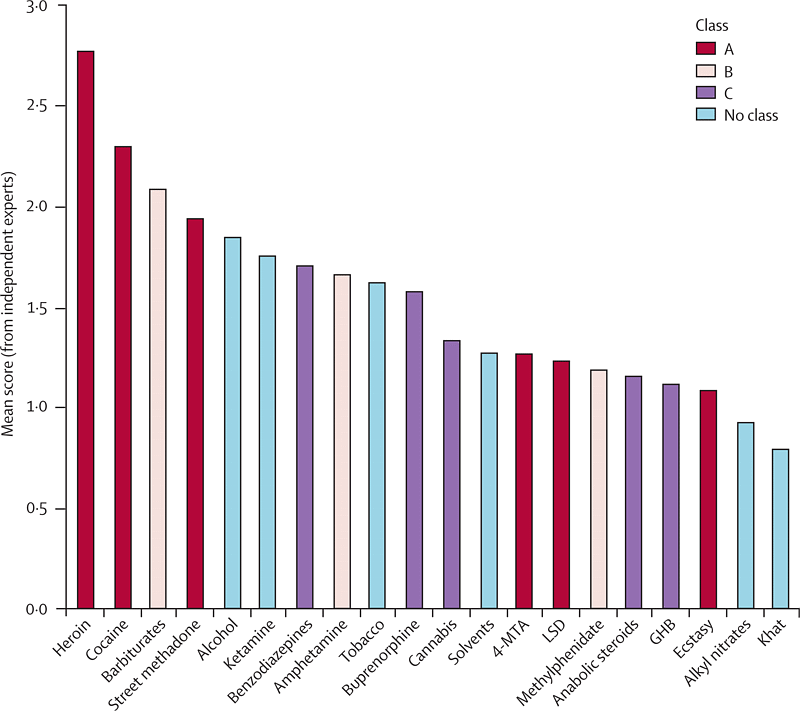
Published in the 'policy forum' section the article it is billed as an 'exchange of views' on the subject of drug classification (aka 'drug scheduling') between myself and Ted Leggett from the UN Office on Drugs and Crime in Vienna. We have engaged in the policy forum previously on the subject of cannabis potency but on this occasion we both adopt critical positions; Ted considers the methodological problems with attempting to rank drug harms, with particular reference to last year's high profile Lancet paper, and that graph, whilst I make a more wide ranging critique on the entire intellectual, ethical and empirical basis of a harm based hierarchy of criminal penalties. Worth a look.


you know, that graph

Wednesday, June 20, 2007

Canada: Free speech goes up in smoke at school


Below is copied a story chronicling just the latest installment of drug war madness in North America, this time from Canada. Discussing the relative risks of illegal drugs alongside legal ones in the wrong environment, a school for example, and apparently you are sending out 'pro-drug' messages. So another triumph of misplaced moral posturing over science and reason then. It is admittedly worse over there than here in the UK, but not by much if the recent furore over cannabis reclassification and 'sending out messages' is anything to go by. I wonder how the distinguished authors of the recent Lancet paper, that made the same point as young Kieran regards relative drug harms, would feel about this?

Young people need to know the risks and dangers of all drugs they may encounter, regardless of legal status. Actually, now I think about it, arguably illegal status is one of the potential harms they need to be warned about aswell, as a criminal record will often cause more harm than the use of the drug itself.

The free speech issues in this story also echo the very wierd 'Bong Hits for Jesus' saga, which recently reached the US supreme court.


Free speech goes up in smoke at school

Saskatchewan student's marijuana research spurs lock down and suspension

JOE FRIESEN

From Wednesday's Globe and Mail

June 20, 2007

WINNIPEG — It started months ago when Kieran King's high-school class heard a presentation about the dangers of drug use.

Kieran, a 15-year-old Grade 10 student in tiny Wawota, Sask., population 600, thought the presentation lacked credibility, so he did some research on the relative health risks of alcohol, tobacco and cannabis.

When he told some of his fellow students that cannabis seemed the least hazardous of the three, he set in motion a series of events that led to a school lockdown, a threat assessment involving the RCMP, a suspension and failing grades on his exams.

"It's all a bit overwhelming," his mother, Jo Anne Euler, said. "It's just totally bizarre."

She explained that her son is a compulsive researcher who tends to go on at length about what he reads on the Internet.

One student at Wawota Parkland School didn't want to hear Kieran's thoughts about marijuana, and complained to principal Susan Wilson.

The principal then called Kieran's mother because she was concerned he was advocating drug use, Ms. Euler said.

Ms. Euler told the principal her son is an A student who doesn't go out, doesn't smoke or drink, and isn't pushing drugs on other kids.

"She said 'Well, if he talks about it again, I will be calling the police,' " Ms. Euler said. "I told Kieran that and he said 'Mom, all I'm doing is sharing the facts.' "

Kieran felt his right to free speech was being trampled, so he enlisted the help of the Saskatchewan Marijuana Party.

Together they planned a school walkout for free speech, scheduled for 11 a.m. last Tuesday, where free chocolate chip hemp seed cookies would be handed out.

But just before 11 that day, the principal announced that the school was a closed campus and that no one was allowed outside.

When several students tried to leave anyway, teachers barred the doors and ordered them back to class, Ms. Euler said. Kieran and his younger brother Lucas defied and joined a ragtag group of five protesters standing across from the school holding placards.

The principal then ordered a lockdown to ensure the safety of students. The RCMP raced to the scene, only to find a small, peaceful protest.

Kieran's mother was again called to the school and told that both her sons had been suspended for three days. Later that day, the school conducted a threat assessment on Kieran with the help of the RCMP and school division counsellors, Ms. Euler said............

read the rest of this sorry tale here

------

Monday, April 16, 2007

Independent on Sunday and cannabis - on it goes


In March we posted two detailed blogs responding to the Independent on Sunday's two-week long canna-pology and retraction of support for their 1997 campaign for decriminalisation of the drug.

How the Independent on Sunday got it horribly wrong on Cannabis

The Independent's born-again war on drugs: Round Two

To summarise: the basis for their new stance was the new evidence they 'revealed' about the increased potency of cannabis today, and its terrible toll on the mental health of Britain's youth. The blogs highlighted how the claims they were making were bad science: exageration, cherry picking and good old fashioned lazy sensationalist journalism, and also how there new editorial position totally misunderstood the issue, confusing the debate around drug harms with the debate around policy responses to those harms. (look, just read them).


The IOS has argued itself into a corner. After making such a big deal of retracting their support for progressive law reform there is no way they can back down now without considerable embarrassment and humiliation (it would certainly prove a poser for the headline writers next time around, although they could arguably reuse the first 'Cannabis: an apology' ). On the other hand, to support their case for prohibition – on the basis of the dangers of cannabis – they now feel obliged to produce a constant stream of shock-horror cannabis coverage which, given that they have very clearly nailed their franken-pot colours to the mast, will inevitably be un-bothered by scientific or journalistic objectivity. And, surprise, surprise, this is exactly what we have seen over the last three of weeks. Here's a quick guided tour:


The April 1 edition saw a front page teaser apparently borrowed from their tabloid colleagues:

Skunk: my son turned into a monster

Inside we learn, from Jonathan Owen, that:

“Academics and doctors say potent skunk is the cause of soaring psychiatric problems in the young; pro-drug campaigners sniff anti-cannabis conspiracies and claim there is no proof of a link”.

I responded to the, now repeated, cheap 'pro-drug' name-calling in the Round Two blog, and despite extensively trawling the extensive blog/web coverage of the IOS canna-panic I haven't seen a single mention of 'conspiracies' anywhere. I believe the key accusation was the one made above regards bad science, reefer madness sensationalism, failure to grasp the realities of public health and drugs policy, and lazy journalism.


What then follows is a depressing and tragic anecdote about a teenager getting into serious problems with drugs – that is then illogically and, Im sorry to say, shamelessly used to bolster the IOS's new cannabis-users-must-be-criminlised editorial position. It's not a review of the published evidence on drug harms, its a single case, one that would probably be more appropriately published in Take-a-break magazine than the news section of a nominally serious Sunday paper.

The son who 'turned into a monster', we also learn, was smoking an eighth of 'skunk' a day from the age of 15. This skunk, apparently, 'can be up to 10 times stronger' than 'conventional cannabis' – down from 25 time stronger as reported on the initial skunk potency panic front page report from two weeks previously. By the time he was 18 he was dealing to fund his use of 'LSD, cocaine, heroin and ecstasy'. So not really a typical teenager then, even of the casual cannabis using variety – and hardly the basis for extrapolating the threat of cannabis to mental health across an entire population of young people.

  • Could it possibly be that there was more at play here than the occasional cannabis use that describes the vast majority of users?

  • Do we get any discussion of how the policy of prohibition - the criminal justice approach the IOS now supports - under which this sad tale unfolded, prevented it happening? (No. because it clearly didn't)

The same week we also had a classic bit of old-school reefer madness, also from Jonathan Owen, on cannabis and lung cancer, dressed up as news on the basis of some new un-referenced research apparently being published 'later this year' in New Zealand. Nowhere does Owen mention that almost all cannabis in the UK is smoked with tobacco, or the obvious fact that smoking anything will increase the risk of lung cancer because inhaling burnt stuff of any kind is clearly not good for your lungs. Nor does he mention, as you might hope for responsible reporting, that such lung damage risks can be avoided by users if they either use vaporisers, or consume cannabis by eating it, for example in cookies (I seem to recall the orginal 1997 IOS cannabis campaign providing a recipe). A quick search for 'cannabis lung cancer' on pubmed (the serachable archive of medical journals) may provide you with some more balanced information from peer reviewed academic journals. Something Owen apparently didn't bother with.


The following week, April 8th, Jonathan Owen, again, reports that 'Cannabis is wrecking lives, says public school head' . This rather odd piece of 'news' is based on an interview with Dr Anthony Seldon, the Head of 'leading public school' Wellington College. His Wikipedia entry informs us that he is known for his biographies of recent prime ministers, but he doesn't seem to have any qualifications as a medical doctor, statistician or drug policy expert. None the less we learn:

The decision to reclassify cannabis from a class B to a class C drug was a mistake and should be reviewed, Dr Seldon, author of a biography of Tony Blair, said. He added: "The reclassification was unhelpful because it sent the signal that it is OK.

The change "emboldened" thousands of young people to try the drug, with many paying a high price, according to Dr Seldon. "What about all the children whose lives have been wrecked because they have developed psychoses or been unable to cope?" he said. "What about those who have died or reside in mental hospitals? Or the teachers who have had to endure apathetic or aggressive pupils high on dope? The message must be total prohibition."

Both the IOS and Dr Seldon seem unaware that over the last few years, including since the terrible signals sent out by reclassification, reported prevalence of cannabis use, the holy grail of Government drug policy targets, has actually fallen (according to the BCS):


Thanks to Clive Bates at Baconbutty

Could it be that, Government policy, classification, and levels of enforcement do infact have little or no impact on levels of cannabis use? This comparative study of drug use three very different cites would suggest so - but that sort of analysis is far too nuanced for the IOS's overt new drugs-can-be-dangerous-therefore-criminalise-the-sinners-who-use-them editorial line. And who can blame them? Why wrestle with all those pesky ambiguous research findings, that conflicting epidemiological evidence, and confusingly complex multi-variable socio-economic policy analysis when you have the clear cut certainty of an ideological drug war:

drugs are bad > BAN THEM!


Oh thank heavens for that - Its just so much easier for a hard pressed Sunday's writer. Once you're signed up, all you need do is wheel out lots of cherry picked information to hype the drug's dangers (there's plenty of it, and its pre-prepared), pull in a few drug-experts like businessman Richard Branson, political appointee Antonio Costa, and political biographer Anthony Seldon, add some emotionally charged 'annecdata' and BOSH! The paper practically writes itself.

If we were in any doubt where the IOS is going with all this we need only look at the latest edition which two more cannabis panic items, a stat-free prohibitionist rant from Seldon, and a 'loads of people take drugs' non-shock news story. For the record this makes a grand total of 17 news items and comment pieces on cannabis in 5 weeks, all except three either hyping the dangers of the drug or calling for its users to be punished, surely a UK record. The three are: in the first week - an opinion piece by Robin Murray that considers the dangers of cannbis but suggests legal status is irrelevant, a news piece that appears to contradict many of the IOS's arguments (the 'tobacco and alcohol..' one linked below on the lancet drug harms paper ) , and one lonesome pro-law reform piece by Rosie Boycott. Anyone for a debate?

Anthony Seldon: The effects of cannabis on vulnerable young minds can no longer be ignored

One-third of pupils have tried cannabis by the age of 15

Cannabis is wrecking lives, says public school head

Long-term cannabis use raises risk of lung cancer

Cannabis debate: 'I let my son have skunk. It ruined his life'

Antonio Maria Costa: Cannabis... call it anything but 'soft'

So how dangerous is skunk?

UN warns of cannabis dangers as it backs 'IoS' drugs 'apology'

Julie Lynn-Evans: Legalise the old stuff but make the new stuff a class A drug

Leading article: The cannabis debate

Tobacco and alcohol 'are more dangerous than LSD'

Skunk: How the 'safe' drug of choice for the hippy generation became a serious health hazard

Robin Murray: Teenage schizophrenia is the issue, not legality

Leading article: Cannabis: a retraction

Were we out of our minds? No, but then came skunk

Cannabis: An apology

Rosie Boycott: Skunk is dangerous. But I still believe in my campaign to decriminalise cannabis


The most recent opinion piece by the previous week's returning hero, Anthony Seldon, makes it all too clear. Within a few paragraphs we have heard that cannabis is 'sneakily and subtly toxic', is responsible for destroying lives, careers and triggering suicides, causing depression, psychoses and insanity, leads people to 'hard drugs' (its the gateway theory - noooooooooooooooooooo!), makes people 'boring', leads to 'apathy, self-centredness and a lack of engagement with others and the world at large', and is responsible for 'horrific acts of violence'.

Seldon then proposes three possible school responses to this 'sinister' drug:

1. Educating young people about the dangers of cannabis. Seems worth a try, but he describes this as the 'the least reliable' of the three methods. OK, its not had a great track record but that does seem a bit defeatist, for an educator and headmaster of a 'leading public school'.

2. Punishment. Yes! now we are getting somewhere. Bit of punishment: that'll learn'm. Seldon is unequivocal:

"I have never believed in giving children who bring drugs on to school premises a second chance. It means that, for some, to be "busted" for drugs is a badge of honour. This strong line might seem heartless, but it has saved many more pupils than it has damaged. Random drug testing and sniffer dogs are other devices. Nothing is ruled out in the interests of protecting those in my charge."


Anthony Seldon: 'No second chance'

Isn't that just brilliant? Despite official advice and ample evidence that excluding the most vulnerable and needy pupils 'in his charge' is counterproductive, he is resolutely determined not to give them a 'second chance'. Wellington is a Church of England faith school, according to their website:"The values of Christianity - upon which our whole society is built and continues to operate - are the foundation of Wellington and are immensely important to us as a school community, still providing the framework for our daily lives." Values of Christianity like....forgiveness perhaps?

3. 'teaching young people how to live'. Now, at last, a bit I can find some agreement with. Giving kids more attractive options than drug use: fine. Encouraging sensible/healthy lifestyle choices: excellent. "What is the point of schools if they do not help children to learn how to live their lives to the full, how to enjoy themselves and be happy, and how to live intelligently?". It gives the impression of being an outbreak of reasonableness, maybe I have misjudged Dr Seldon....

....But then we have the final insult:

Drugs are not intelligent living. Alcohol is part of intelligent life for many, and with older school children the art is to help them to realise that drink, properly used, can be a significant enhancement to life. With drugs, there is no half-way position. Everyone - government, the media and schools - needs to give the same message: "No."

Now if you will excuse my non-Christian language, but, what the hell? Alcohol apparently is not a 'drug' (er, it is), but rather it is part of 'intelligent life', in fact we need to teach 'school children' how it can be a 'significant enhancement to life'. Maybe they should hand out alco-pops at play-time, before the hurling the empty bottles at those nasty potheads as they are chased out the school by drug dogs? remember - 'nothing is ruled out'. Forgive me (if you can) but what on earth is he talking about?


'life enhancing' booze


It is amazing to me that he would round off this hopelessly emotive and unscientific anti-cannabis tirade with an exultation of alcohol - the drug at the centre of a growing youth epidemic of binge drinking and anti social behaviour, and the cause of 10-20000 premature deaths a year. And Seldon talks about cannabis reclassification sending out the 'wrong signals'.

Just think about this for a moment: How easy would it have been to produce almost the exact same article, but about the 'scourge' of alcohol. Read the article again - change 'cannabis'/'drugs'/'joints' to 'alcohol'/ 'drinking' etc. and you'll see what I mean. The millions of young people for whom the just say no message, dogs, testing, punishment, criminal records and and exclusions dont appear to work need accurate information about the dangers of all drugs and how to minimise the risks of their use.

The Seldon denoument strikes me as utterly bizarre. But this, perhaps, sums up the IOS's whole approach and there will be more to come so buckle up. The Independent on Sunday appear to be digging in for a long war.


For the record: I will be contacting the Independent to see if, in the interest of 'the great debate', they will run an opinion piece from Transform. I dont hold out much hope, since when they rang up and asked me for one a few weeks ago, they then didnt publish it. You can but try.

Some other interesting coverage of the IOS cannabis panic:

Bad science column in the Guardian: 'Reefer Badness' by (Medical) Dr Ben Goldacre

Cannabis - sorry about the apology by former prime-ministerial advisor, and former director of anti-smoking charity Ash, Clive Bates

Do 'Skunk' stats stink? from the George Mason University (Washington DC) statistical assessment service
.

Saturday, March 24, 2007

The Lancet and drug harms: missing the bigger picture

The Lancet this week published the long awaited paper on drug classification: ‘Development of a rational scale to assess the harm of drugs of potential misuse’ by David Nutt, Leslie A King, William Saulsbury, Colin Blakemore. Whilst the Lancet publishers will make you register to read it, those nice folks over at MAP have been good enough to put the complete text on their website for your reading pleasure.

This is the abstract:

Drug misuse and abuse are major health problems. Harmful drugs are regulated according to classification systems that purport to relate to the harms and risks of each drug. However, the methodology and processes underlying classification systems are generally neither specified nor transparent, which reduces confidence in their accuracy and undermines health education messages. We developed and explored the feasibility of the use of a nine-category matrix of harm, with an expert delphic procedure, to assess the harms of a range of illicit drugs in an evidence-based fashion. We also included five legal drugs of misuse (alcohol, khat, solvents, alkyl nitrites, and tobacco) and one that has since been classified (ketamine) for reference. The process proved practicable, and yielded roughly similar scores and rankings of drug harm when used by two separate groups of experts. The ranking of drugs produced by our assessment of harm differed from those used by current regulatory systems. Our methodology offers a systematic framework and process that could be used by national and international regulatory bodies to assess the harm of current and future drugs of abuse.

and this is the graph of harm rankings for the drugs they have considered:


The paper has had loads of media coverage focusing on the graph above (rather than the more interesting material about how they came up with it), mostly along the lines of 'alcohol more dangerous than ecstasy', or variations thereof. This minor media furore (‘Alcohol worse than ecstasy on shock new drug list’ blurted the Guardian on its front page) is a bit odd because it must be one of the most heavily trailed Lancet papers in history. Not only were the draft contents discussed in detail by the Science and Technology Select Committee drug classification inquiry report (see page 70), and ‘the graph’ published by them, but ‘the graph' has actually appeared as one of those jazzy front page tabloid splashes in the Independent. Last year. If you missed all that the Lancet paper was also discussed - in even greater detail - by the more recent RSA report which includes an entire section on ‘the Blakemore / Nutt hierarchy of harm’ (not sure what King and Salusbury think about that), and ‘the graph’, around which much of the recommendations are built. Some journalists either have short memories or they are banking on us having short memories - if you can get a 'shock' twice with the same story, why the hell not eh?

Anyway, the finished paper is undoubtedly a fine piece of work. It has very usefully put legal and illegal drugs on the same harm continuum (obvious really, but good to see it being said in the Lancet) and in doing so exposing the contradictions, lack of logic, and false assumption that underpin much drug policy thinking here and around the world. The matrix system they propose for ranking drug harms is definitely a good start. Clearly any system of regulation, be it sensibly based on established legal controls and public health principles, and stupidly based on criminal penalties and prohibitionist ideology, will require some sort of ranking system to make distinctions and policy decisions for different drugs.

I actually think it’s too simplistic, although to be fair, the authors do not claim it as the be all and end all. As discussed in more detail in the Transform briefing on drug classification:

Drug harms are mediated by the nature of the user, the dose of drug consumed and the method of consumption – making a system based upon broad sweep single classifications for each drug fundamentally unscientific, and meaningless in most practical terms.

So the whole idea that drug x is ‘more dangerous’ than drug y is only useful in the broadest population analysis. For an individual it’s fairly meaningless because, obviously, it depends how much of given drug you use, how often you use it, how you use it, whether you have a heart problem or mental health issues, and so on. There are still some oddities in the ranking (solvents, for example, seem too low to me), but it’s a massive leap forward from what we have at the moment which the authors politely describe as having ‘evolved in an unsystematic way from somewhat arbitrary foundations with seemingly little scientific basis’. If they were writing in a blog, not the Lancet, I suspect they would have said: 'it's a total joke'.

However, I take more substantive issue with the paper, not for what they covered, but for what they left out:

Firstly, the harms of a given drug will depend upon its legal status. The best way to demonstrate this point is with heroin, which is placed at the top of the Lancet-scale as the most harmful of all drugs. For street heroin this may well be the appropriate placing, but, if we are being scientific here, it is imperative to separate out the harms that follow from use of the drug per se, and the health and social harms exacerbated or created specifically by the drug's use within an illegal market. These, lets call them 'prohibition harms', include:

  • Contaminated/cut product (poisoning, infection risks)
  • Dirty/shared needles (Hep C / HIV risk)
  • Vast quantities of low level acquisitive property crime to support a habit: illegal markets inflate the cost of an essentially worthless agricultural product to one that is worth more than its weight in gold. People on prescriptions don't have to nick stuff.
  • Street prostitution (see above)
  • Street dealing, drug-gang violence and turf wars
  • Drug litter (needles in the gutter etc)

More useful would have been to rank both illegal street heroin, associated with the above harms which aren't going to help its ranking much, and prescribed pharmaceutical heroin, associated with none of the above harms. The latter would certainly be considerably further down the scale. Luckily, we can theoretically do this with heroin as both legal and illegal markets exist simultaneously in the UK, although the number of prescribed users (approx 400) is rather eclipsed by the number of illicit users (approx 250,000+). It’s a great shame the authors of this study failed to make that comparison (we do, confusingly, get 'street methadone' in the ranking, but not the prescription variety). It would have helped policy makers untangle the harms created by drug misuse from the harms created specifically by prohibition and had far wider implications for the future of the dominant criminal justice paradigm.

Some policy makers are wise to this legality/harm equation. During the Science and Technology Committee inquiry evidence sessions there is a revealing section where they are discussing the harm matrix with Proffessor Nutt and Sir Micheal Rawlins, Chair of the ACMD (at this point, 2006, it is still unpublished and available only in draft). Dr Harris MP raises the point that the classification a drug is given will impact on the level of social harms it is associated with:

Q188 Dr Harris: In this matrix you include under “social harms” intoxication, health care costs, and other social harms. Included under “other social harms” do you include the harm that stems from criminalisation itself?

Professor Sir Michael Rawlins: Yes.

Q189 Dr Harris: You do not spell that out but that is understood?

Professor Sir Michael Rawlins: Yes and whether it leads to acquisitive crime.

A couple of questions later…

Q 195 Dr Harris: Your recommendation recommending classification into a particular class creates social effects, does it not?

Professor Nutt: Indeed it does.

Q196 Dr Harris: Because obviously it brings criminal justice along with it and that affects the price and availability and so forth. Do you recognize that? Your own actions impact on the evidence. Did you feed that back in before you made the recommendation?

Professor Nutt: We know it might happen but you can never be sure how big an effect that might have.

When translated through the prism of the Misuse of Drugs Act the harm rankings become, to a significant degree, strangely self-fulfilling, as is evident in the case with heroin: The more you criminalise the drug (by moving it up the rankings) the more risky you make its use and more social harms you create associated with its illegal supply. Given there is no evidence that these increased harms are offset by any deterrent effect associated with classification the whole system seems even more bizarrely unscientific and unsustainable.

Colin Blakemore, one of the authors and chief executive of the Medical Research Council is quoted in the guardian saying:

"We face a huge problem. Drugs ... have never been more easily available, have never been cheaper, never been more potent and never been more widely used".

"The policies we have had for the last 40 years ... clearly have not worked in terms of reducing drug use. So I think it does deserve a fresh look”

This leads us to the second, arguably more serious problem with the paper. The rankings of drugs, with the anomalous exceptions of alcohol and tobacco, are defined within the Misuse of Drugs Act 1971 and primarily intended to determine the accompanying hierarchy of criminal penalties, and not to provide public health information to potential drug users.

The evident problem is that there is no meaningful evaluation of the outcomes of this unique criminal justice approach to public health regulation. We can have excellent science ranking drugs public health harms, as this paper presents, but then no science at all regards the outcomes of these rankings when they are implemented as criminal policy. As the authors have noted, the use and availability of illegal drugs has risen steadily under the current system. A more scientific ranking of harm is not enough: the whole prohibitionist legal framework needs to be reassessed as well. To immodestly quote myself in the oral evidence I gave to the Sci-tech Committee:

"I have been trying to think of a metaphor for this and the best one I can come up with is that it is like arguing over what colour to paint a square wheel. Even if all the experts agree it should be blue it does not matter because that wheel does not turn. The classification system does not do what it is supposed to do, it does not reduce harm, it does not reduce misuse, it does not reduce mental health problems. In fact it seems to do the exact opposite so the whole thing is an exercise in distraction"

In the short term I despair that anything at all will happen. The Government give the pretence of supporting evidence based policy on drugs, but when it clashes with their ‘political judgements’ or 'beliefs' that all goes straight out of the window.

In a follow up oral evidence session to the publication of the Science and Technology Select Committee’s devastating 2006 critique of the classification system, the committee re-interviewed Sir Micheal Rawlins, Proffessor Nutt, and the minister with responsibility for drugs, Vernon Coaker.

It’s a truly remarkable interrogation, with the Minister not having a leg to stand on when he is repeatedly challenged on the lack of evidence base for the classification system's effectiveness, or the justification for certain howling anomalies within the system. He falls back on evasion, changing the subject or the excuse of decisions being ‘political judgements’ , or worse, merely that it is his ‘belief’ that the system works. There is not even the pretence that the system is evidence based. I recommend you read it all (or look forward to other choice quotes popping up on the blog in the future), but for the time being here are some low-lights, just so you know what you're up against.

First is a section about the reclassification of ecstasy:

Q109 Mr Newmark: If the ACMD discovered new evidence when it undertook the review, would you consider reclassifying ecstasy?

Mr Coaker: We would consider their evidence. As I say, we have no plans to reclassify ecstasy. The ACMD is independent of government, we obviously respect what they say, and they will bring their report forward, but the Government has no plans and no intention of reclassifying ecstasy.

Q110 Dr Harris: You say that you do not propose to move ecstasy and it will remain a Class A drug. Is that an evidence-based policy?

Mr Coaker: That is a judgment the Government makes on the basis of what we believe to be something that is in the interests of the public at large to keep ecstasy as a Class A drug.

Q111 Dr Harris: Is it an evidence-based view?

Mr Coaker: It is a judgment that we make based on all the evidence we have had no recommendation from anybody to reclassify ecstasy from an A to a B. We think it is a drug which is harmful. There is no safe dose of it. We were talking about alcohol earlier on and one of the problems you have with alcohol is there probably is a safe dose. Like many here, I have a drink now and again, but there is no safe dose of ecstasy, we think it would send out totally the wrong messages and, as I say, we have no intention of reclassifying ecstasy.

Q112 Mr Newmark: Because it kills unpredictably?

Mr Coaker: As I say, there is no safe dose. This is the point, just half a minute—

Q113 Dr Harris: There is no safe dose of tobacco.

Mr Coaker: It just does make the point very well, the exchange that we have just had between two members of the Committee, quite rightly, about the difficulties that there are in this area and the different views and opinions that people have. I think what we all wrestle with is using evidence and using science and also trying to think about it from a non-scientific point of view in the social judgments and the individual judgments and the community judgments that we make. We wrestle with that and, as I say, as a Government we have no intention of doing anything with respect to ecstasy because we do not believe there is a safe dose, it is harmful, it kills unpredictably, as Brooks has said, and we just think that it is a very important way to use the classification system.

Q114 Dr Harris: If the ACMD reviewed the evidence and that review made recommendations to you, are you saying now it is not worth them doing it because your decision on this will not be evidence based, it will just be a reassertion of your "no intention to reclassify ecstasy"? Even if they said there will be fewer deaths, for whatever reason, if it is reclassified, are you saying that you will never consider an evidence-based decision on this drug?

Mr Coaker: I am not saying that at all. What I am saying is the ACMD, of course, can conduct research and look at whatever they wish to with respect to drugs and make recommendations to the Government. What I am saying quite clearly is that we have no intention of reclassifying ecstasy.

Q115 Dr Harris: I am keen to pursue this one. I understand you have no intention and I assume that is current because I do not think you could bind your successors if the evidence changed. Is it your view that all drugs for which there is no safe dose should be in Class A or is there something special about ecstasy which means it is one of the drugs for which you say there is no safe dose which means it must be in A?

Mr Coaker: In talking about ecstasy, it kills unpredictably, we do not believe that there is a safe dose; we will not reclassify ecstasy.

Q116 Dr Harris: Does that apply to all drugs that meet those criteria?

Mr Coaker: What we try to do where we have evidence and where people come to us with recommendations is make individual judgments, as we will do whenever people come to us. All I am saying with respect to ecstasy is that we have no plans and no intention of doing so.

Q117 Dr Harris: So do you think you are wasting your time, Professor Rawlins, if you end up doing a review in this area?

Professor Sir Michael Rawlins: No, I think we will give advice on whatever we feel is appropriate but perhaps in a way more importantly we will also be able to, I hope, give better advice on harm reduction, which is actually rather important, and on what further research is needed in order to understand the dangers of it.

Q118 Dr Harris: Will the fact that the Minister has said quite categorically that he is not going to change the classification have any bearing on whether you follow through and do a report?

Professor Sir Michael Rawlins: None at all because we are going to do it.

Now here is a second section from slightly earlier in the session. Creationism gets a mention in reference to the Minister's scientific discourse; it seems an appropriate comparison (and couldn't help but remind me of this).

Q45 Chairman: Vernon, in response to us, you said that the Government "fundamentally believes that illegality is an important factor when people are considering engaging in risk-taking behaviour . . . It believes that the illegality of certain drugs, and by association their classification, will impact on drug-use choices". Where is the evidence for that?

Mr Coaker: That is the belief and the judgment that the Government have.

Q46 Chairman: I did not ask you that. People believe in creationism and they are entitled to do that, though I do not agree with that, but I am asking you, where is the evidence?

Mr Coaker: To be fair to the response that we tried to make in response to the Committee where the Committee has challenged us, we have ourselves said that we need to do more research into the deterrent effect, that we need to establish a better evidence and research base for that, so we have accepted the point of the need to actually do something about it, but we do believe, and strongly believe, that the classification of drugs in the current system, A, B and C, with respect to Class A does act as a deterrent system. That is a judgment we make, it is a belief that we have and we have accepted that there is more to do with respect to that.

Q47 Adam Afriyie: If when you carry out and conduct this research the evidence shows that you are completely mistaken in that view, will change your view?

Mr Coaker: I cannot prejudge what any research is going to tell us. Clearly you make judgments about the research that you receive and that is obviously the point.

Q48 Chairman: Vernon, you have not commissioned any research and nor have the ACMD.

Mr Coaker: No, but what we have said in response to where the Committee challenged us and said, "Where is your evidence base for that?", as we have done with a number of other things, we said that we understand that point, we accept that point and we need to look at establishing a better evidence base for that, but it does not alter the fact or change the fact that the Government believes that the tripartite system, the classification system, does send out a strong message and does impact on, and affect, behaviour.