Friday, January 25, 2008

Richard and Judy back drug legalisation

Following the publicity around Chief Constable Brunstrom's recent report critiquing the failings of prohibition and calling for legally regulated drug markets (much of which is *blows trumpet* informed by Transform's literature), support has now come from an unlikely but welcome quarter: none other than Richard Madeley writing in the Express under the Richard and Judy Byline. Yes, that Richard and Judy, 'the nation's favorite TV couple'. Madely makes his point 'defending' Brunstom's 'call for the legalising of drugs' , and negotiates his way around the sensitive issue of drug deaths (from a parents perspective) with real sophistication.


Somehow this one slipped past me a week or so back ( probably because I only dip into the Express when I want to read made up stories about Madeleine McCann or Diana-Death conspiracy theories, i.e. never) . Still, in many ways this is even more remarkable than Transform bagging a double page cover story feature in Take a Break magazine. If the nation's favorite TV couple can pull in the Prime Minister to play 'you say, we pay', and push a book onto the best sellers list just by featuring it on their Book Club (Tools for the Debate, Richard?) who knows what they an do for pragmatic drug law reform?

What with the nation's number one TV presenter, Jonathan Ross, already a Transform Patron, Take a Break, and now Richard and Judy, we are getting so mainstream we are in danger of getting washed away. Mustn't grumble of course, but I rather miss that aura of radical chic from the old days...


There's little to add other than to say, Richard, I could have written that myself. Over to you*:

"How awkward it is to have to begin the new year defending the apparently indefensible... in the form of eccentric police chief Richard Brunstrom’s latest headline-grabbing “gaffe”. I refer, of course, to his call this week on Radio 4’s Today programme for the legalising of drugs.

Brunstrom reckons all currently banned substances – everything from Ecstasy to heroin – will have been decriminalised inside 10 years. He added that Ecstasy is “safer than aspirin”, for good measure.

“Idiotic”, “Mad”, and “Captain Calamity” were just some descriptions of the head of the North Wales force the following morning. Parents of young people who died after taking Ecstasy queued up to castigate him – quite understandably. If my child had perished because of drug abuse, I would be first in line calling for Brunstrom’s head.

Which doesn’t mean I would be right. It is pointless here to get into a statistical debate about the dangers of aspirin versus Ecstasy.  Both preparations can kill: Ecstasy by fits following dehydration and other factors, aspirin usually from internal bleeding.

Ecstasy kills around 50 people every year – although many more have a close encounter with the Grim Reaper in their local intensive care unit.

But considering the colossal number of (mostly) young people who swallow Ecstasy tablets in nightclubs up and down Britain every night of the year, the toll is comparatively small when set against those killed or maimed in drink-driving crashes.

Don’t get me wrong, I think taking Ecstasy is stupid.

Prolonged use may well cause memory loss. But being against the law hasn’t stopped it from becoming endemic – which means the criminal supply of Ecstasy and other drugs is endemic too.

This is at the root of the gang culture that grips virtually every city in Britain and is largely responsible for the proliferation of guns on our streets. The analogy with Thirties prohibition era Chicago is inescapable.

Personally, I’d feel safer taking a palmful of aspirin than even one Ecstasy. But as a social policy, the criminalisation of drugs must surely be recognised for what it is:  an abject failure. Cocaine, heroin, speed and, yes, Ecstasy, have never been more widely available or cheaper to buy.

Their illegal sale on an industrial scale nourishes a huge, sprawling and hydra-headed criminal underclass.

All Richard Brunstrom – with,  by the way, the broad support of his police authority – is really asking is for a sensible debate on how we move on from the failed drug policies of the past.

He may be a ridiculous honorary druid with an irritating penchant for speed cameras and absurdly sensitive to weak jokes about the Welsh, but he’s doing something rarely seen in our chief constables.

He is thinking out of the box. That is brave and bold and deserves thoughtful consideration, not calumny."

*
I hope the Express will forgive me for reproducing more than a usual sized snippet/quote here ( I haven't used Judy's section).

Thursday, January 24, 2008

ACMD cannabis classification review submission (round 3)

Tediously enough the ACMD will yet again be reviewing cannabis reclassification next month (for the third time in 5 years) and Transform today publishes its written submission (also for the third time in 5 years), as a prelude to the oral evidence session on Feb 5th to which we will also be giving evidence (for the second time in 5 years - they didn't do one last time around). Our latest submission considers how the political and media backdrop to the latest review has distorted both science and policy thinking around this issue, as well as offering a broader critique of the classification system and the flawed and outdated science on which it is nominally based. The discussion and recommendation sections are reproduced below. True cannabis policy wonks can read the full submission in all its nerdy glory here (pdf).


--------------

Discussion

The debate around drug law reform remains intimately entwined with the wider populist law and order debate. The question of how cannabis should be policed has often become confused by emotive anecdotes and misrepresented data concerning the harm associated with cannabis use, or debate around the moral rights and wrongs of drug use generally. It is vital that the ACMD, as an independent body of expertise, is not drawn into the political gamesmanship, or swept along by the sporadic media and politically fuelled drug panics that have cast a long shadow over the UK's failing drug policy for the past two generations.

The aim of drug policy should be to reduce the harm drugs cause, both to users and the wider community. Current policy is demonstrably failing to do this and it is only by rational consideration of the evidence, both of prohibition's failure, and of policy alternatives that we can take positive steps toward this goal.

There is an ongoing debate about the extent of cannabis risks, and research has often been selectively used to bolster the case for and against legislative reform (reclassification and/or legalisation/regulation). From Transform's perspective the debate around health risks is a distraction from policing and law reform issues:

  • An effective drug policy would accept the reality of widespread cannabis use and implement measures that reduce harm to users and the communities in which they live

  • The dangers presented by cannabis, in its various forms, point towards increased and better prevention and education for young people and potential users as part of a co-ordinated, evidence based public health strategy for reducing drug harms. This should be based on well established harm reduction principles and public health education methodology, including a clear message that the best way to avoid harm is not to use at all

The classification debate is a distraction from the bigger debate around prohibition – one we believe the ACMD is obliged to engage with in a structured and meaningful way. Drugs need to be legally regulated because they are dangerous, not because they are safe, indeed the greater the dangers of using cannabis, the greater the importance of strict legal regulation and control of cannabis markets. If the Government is serious about getting rid of illegal dealers and reducing the harm associated with cannabis use the only effective course of action is to have legally regulated and appropriately licensed outlets. This would:

  • Largely remove the illegal profits, collapse the illegal market, and put illegal dealers out of business

  • Allow more effective prohibitions on sales to minors

  • Enable quality control of the product and health warnings, potency and dose information, and harm reduction information on packaging and at point of sale

  • Free up scarce resources (and potentially generate tax revenue) for public health based prevention, education and harm reduction initiatives

To the objective observer the intellectual problems with the classification system are as obvious as its abject and ongoing failure on all meaningful indicators. The Government's response to criticism, which now includes detailed and thoughtful work from the Police Foundation (2000), the Home Affairs Select Committee (2002), The Science and Technology Select Committee (2006), the RSA (2007), and even the ACMD (Pathways to Problems 2007) and its technical advisers writing in the Lancet (2007), has been nothing more than contemptuous and is entirely lacking in intellectual or empirical credibility. The Science and Technology Select Committee's 2006 conclusion that the system was 'not fit for purpose' was altogether too diplomatic.

There is certainly potential for ranking different drugs along the various vectors of drug harm that might usefully include; toxicity, addictive potential, particular risks for specific populations (e.g. sex, age group, mental health) safety critical activities (e.g. driving) or behaviors (e.g. injecting, poly-drug use, pregnancy). However, this sort of information does not lend itself to the broad generalisations of a simplistic ABC system, however well thought out the placing of individual drugs may be. People need honest and accurate information about drug risks so they can make informed decisions; the ABC system singularly fails to deliver.

More significantly, the debate over which drugs should be in which class is a distraction from the more profound problem that the ABC system exists primarily to determine a hierarchy of criminal penalties, and there is no evidence whatsoever to demonstrate that this approach has either criminal justice or public health benefits. The Government's refusal to honour the promise Charles Clarke made to the House of Commons in January 2006, to hold a review of the classification system is transparently a politically motivated one. Their 'belief' that the system is effective, when the opposite is demonstrably the case is simply not acceptable and should be a profound concern to everyone in policy making, law and the wider drugs field.

Recommendations

Short term

  • That the ACMD maintain their long held position that cannabis should be a class C drug under the current system.

  • That the long promised review of the entire drug classification system (not merely the classification of individual drugs within it) be undertaken with some urgency. This should include a detailed consideration of the effectiveness of an ABC hierarchy of criminal penalties for different drug in achieving desired criminal justice and public health outcomes. (A call for such a review has also come from Drugscope and the Home Affairs Select Committee, the RSA, the Science and Technology Select Committee, and indeed the ACMD)

  • That the ACMD make strong objections to the way in which its role and authority is being undermined by Ministers announcing reclassification decisions regards cannabis before the ACMD have reported back[1]. The ACMD should further ask why the classification issue was included in the recent strategy consultation document, when such decisions are clearly the remit of the ACMD (which already consults extensively).

Medium term

  • That the ACMD deliberations consider the specific harms created by prohibition, and disentangle these from the harms created by drug use per se. Specifically; prohibition related crime, the mass criminalisation of young - often vulnerable - individuals, and the exacerbation of drug harms to users (when drugs are produced and supplied through illicit channels).

  • That the ACMD actively consider the policies of decriminalisation and legalisation/regulation of cannabis and all other currently illegal drugs in line with its remit in “preventing the misuse of such drugs or dealing with social problems connected with their misuse” and “restricting the availability of such drugs or supervising arrangements for their supply”.


[1] Gordon Brown is on the record saying that “we are about to make changes to the cannabis law” http://transform-drugs.blogspot.com/2007/09/brown-on-cannabis-it-gets-worse.html

Wednesday, January 23, 2008

Transform in...wait for it...Take a Break magazine!

With the Guardian, lets face it, you're often preaching to the converted. It felt like it was time to try and broaden our horizons, and take the the drug law reform debate to a wider audience. And where better to start than Britain's number one selling women's weekly: Take a Break.


For non Take a Break regulars, here's some info from their website to put you in the picture:

Captivating real life stories, prize puzzles and competitions and classic weekly elements, combine to give readers an interactive and involving big value package.

Take a Break has comfortably been the biggest selling women's weekly in the UK for over 14 years. One in eight women in the UK read Take a Break every week and it sells 2 copies every second, making it the 4th largest women's weekly in the world. Take a Break also publishes a number of brand extensions totalling over 22 million copies per year

Take a Break's mix of real life, fashion, beauty, food, home, travel and competitions attracts a hugely varied readership. Readers can be anything from 18 to 80; they are likely to own their own home and to be married, and many have children. Its universal appeal is confirmed by the strength of its reader relationship. It is read exceptionally thoroughly, has very strong reader loyalty and is read for longer than any of its competitors.


Circulation 1,018,423
Adult Readership 3,138,000
Female Readership 2,734,000
Median Age 44
Target Market C1C2 women aged 25-55 with children
Frequency Weekly
Launch date March 1990
Price 78p
On sale every Thursday


Take a Break, and other similar women's weekly titles (of which there are several), are more used to running 'my drugs hell' type stories, so it was quite a bold move on their part, unprecedented in fact, to run a straight policy feature on the critics of prohibition and advocates of moves towards legalisation/regulation. Read the full article here (pdf). A pretty good scoop for us as far as it goes; that's 3 million readers remember.

We worked hard with them on this, and they've done a great job in including key points we were keen to highlight:
  • that prohibition creates crime, harming and endangering young people rather than protecting them
  • that prohibition merely exacerbates the social problems of deprived and socially marginalised communities and is an active obstacle to addressing such problems in the longer term
  • that the 'war on drugs' has dramatically failed as a policy but has effectively handed control of dangerous drug markets to gangsters
  • that a pragmatic pro law-reform position is compatible with being 'anti-drugs',
  • and that 'legalisation' (not a useful term in many contexts) is described in terms of a range of regulatory options for different drugs (rather than an unregulated free for all)
There was other stuff that would have been good to see in there, perhaps notably some sort of economic analysis about how prohibition is so quite so effective at creating crime and mayhem, but you cant have everything and all in all its a concise and useful piece that will no doubt raise a few eyebrows in dentists' waiting rooms across the country over the next week or so. There's an online debate too which could be interesting.

But before we get too excited that it heralds a long term shift in editorial position its worth noting that below the article is a red box reading:
'MY MUMS ON DRUGS' have you a parent - or other relative- who does drugs? Do you have a picture of them doing it? Send us your story and photos. Fee paid.

Monday, January 21, 2008

The year is 2022 and drugs are legal.....

With a growing list of high profile public figures, from ex-Ministers to Chief Constables, talking not just about the conspicuous failings of prohibition, but actively advocating (or at least calling for a rational debate on) moves towards the legal regulation of drugs, (see Transform's supporters of reform page for a more comprehensive list) Druglink magazine felt that there was something missing from the coverage of the drug law reform debate. It certainly seemed reasonable to ask: well, what would a post-prohibition Britain look like?

Inevitably perhaps, Transform were approached to provide a description of this vision of the future, and despite some initial trepidation you can read my effort here (in pdf format), reproduced with permission from this month's Druglink magazine.


It proved quite a tricky task, not just to move from the more familiar briefing-writing mode into more descriptive prose, but also trying to envisage not exactly how we might want it to be, but how we thought it is actually likely to be. Hopefully I've managed to convey this by focusing on three models of legally regulated supply for; cannabis: based on the Dutch coffee-shop model; heroin, based on the Swiss heroin clinic model; and cocaine, based on a more speculative licensed pharmacy/druggist model. In the space provided there was a limit on what could be covered and discussed, but an outline of the benefits and limitations of some potential regulatory models have at least been put on the table for discussion. Comments and feedback are obviously welcome. For me that was the whole point of the exercise; to get people thinking and talking about regulation in more than vague abstract terms.

For those interested there is plenty more detailed discussion of regulatory frameworks available on the Transform website here, and this Druglink piece also serves as a curtain raiser for Transform's next major publication: 'After the War on Drugs: Blueprint for a Regulated Market', a detailed consideration of the options for the legal regulation of different drugs in different environments, currently in production and due for publication later in the year......

Friday, January 18, 2008

Dutch parliament to debate reform of UN drug conventions


As covered on the blog back in December a group of Dutch policy makers, including former and serving mayors, police chiefs, and ministers (including one former PM) have drafted and signed a resolution calling for the Dutch Government to resolve the contradictions in the Netherlands cannabis policy by discussing the restrictions that the UN conventions put on legal regulation of cannabis production and supply. An official translation of the resolution provided by the TNI website is copied below (unfortunately the more detailed discussion document is still only available in Dutch).

The resolution will be debated in the Dutch Parliament next week (details of this debate will be posted here). So whilst Dutch policy makers continue to openly and rationally explore more just and effective responses to the reality of drug use in society their UK colleagues continue to tie themselves in knots over whether or not to increase penalties for cannabis possession from two years in prison to five.


-------------------


The Hague, October 31, 2007 A group of representatives from politics, public administration, the criminal justice system and police and drug policy experts gathered on October 31, 2007, in The Hague, to express the urgent need to end the negative consequences of the current policy of leniency regarding the sale of cannabis.

Participants confirmed that many countries worldwide experienced similar negative effects related to their own cannabis policy. This means that there is a shared responsibility to look for adaptations in the current system of international conventions that are an obstacle to further developments in national Dutch cannabis policies.

Participants argued that the Netherlands, in cooperation with other nations, should aim to revise the current framework of international law in order to achieve a more credible and effective alternative that is not just based on repression for the existing cannabis policy at the national level. The signatories of this resolution,

I. concluded that the current cannabis policy:

A. is based on an outdated international law framework created in the 1960s which is not appropriate to tackle contemporary problems resulting in a stagnation of the development of just and effective policies;

B. is being implemented by a policy of tolerance (“gedogen”) on the basis of a justified lenient interpretation of the current international law framework and that this policy of tolerance is a practical solution but at the same time temporary response which on the long term will discredit the credibility of public authorities;

C. is inconsistent and difficult to explain to citizens because use and sale of small quantities are not prosecuted in practice while production and large scale distribution are still prosecuted; is also inconsistent with policies regarding substances with a similar health risk such as alcohol and tobacco;

D. is ineffective in several aspects: despite positive facets such as the separation of markets between soft and hard drugs and the limited involvement of criminals in the retail market, other policy options such as legal possibilities to control the quality of cannabis (THC content and pollution) and other measures to reduce health risks are lacking in the current system, which is still facilitating significant illicit gains at the level of production and wholesale and is encouraging in-house cannabis growing;

E. is causing considerable and unbalanced administrative and judicial burdens and continuous criticism of some countries and UN drug control agencies.

II. concluded furthermore that:

A. attempts by the Dutch parliament and local authorities to address the inconsistencies in the current tolerance policy – such as proposing to tolerate production of cannabis for the supply of coffee shops – have been rejected by subsequent national governments on account of incompatibility with international agreements;

B. there is a need for an international debate to explore the possibilities for an international framework that allows more room for manoeuvre by national governments to execute a consistent policy;

C. more and more countries feel the need to reformulate their policies to achieve better protection of public health and combat organized crime;
D. cannabis is grown and commercialised worldwide and is used by over 170 million people, consequently the production and distribution is a common problem for the international community;

E. the 10-year review of the 1998 United Nations General Assembly Special Session (UNGASS) on drugs and the Ministerial meeting in 2009 devoted to this evaluation, offer an excellent possibility to put the issue on the international agenda.


III. urge the Dutch government to:

A. start an international debate with other likeminded countries in order to work out a credible and effective alternative for the current policy on cannabis;

B. promote actively with those likeminded countries the formulation of proposals that can be presented in the context of the upcoming UNGASS evaluation;

C. provide for human and financial resources to implement these efforts;

The Hague, 31 October 2007

signed by
  • Mr. A.A.M. van Agt, former Prime minister 1977-1982
  • Dr. E. Borst-Eilers, ex-minister of Health, Welfare and Sport
  • Drs. A. Apostolou, former member of Parliament
  • Kathalijne Buitenweg, MEP GroenLinks
  • Mr. R. Dufour, president Stichting Drugsbeleid
  • Drs. G.B.M. Leers, mayor of Maastricht
  • Dr. R.L. Vreeman, mayor of Tilburg
  • Mr. Th. C. de Graaf, mayor of Nijmegen
  • J.A.H. Lonink, mayor of Terneuzen
  • Dr. J.P. Rehwinkel, mayor of Naarden
  • W.J.M. Velings MOI, chief of police, region Limburg Zuid
  • F.J. Heeres MPSM, chief of police, region Midden- en West Brabant
  • Mr. A.D.J. Keizer, former policy official of the Ministry of Health, Welfare and Sport
  • Mr. drs. V. Everhardt, drugs and alcohol prevention expert
  • Dr. M. Jelsma, Drugs & Democracy Programme, Transnational Institute

Wednesday, January 16, 2008

Drugscope debunks misleading Telegraph canna-panic stats

An excellent piece of debunking of some canna-panic silliness in the Telegraph from Drugscope is reproduced below. Such sensationalist and misleading media coverage does nothing to further the debate on sensible responses to the health harm associated with cannabis use and only serves to encourage counterproductive knee-jerk Government enforcement responses, whilst providing a shock headline to help shift units. Very disappointing from the Telegraph which has in the past been quite pragmatic and progressive on the cannabis issue. Ho Hum.

-------------------------

On Friday 11 January the Daily Telegraph published a front-page news article under the headline: Abuse of cannabis puts 500 a week in hospital.

The Daily Telegraph piece referred to National Drug Treatment Monitoring System (NDTMS) figures cited by Minister of State for Public Health, Dawn Primarolo, in a response to a Parliamentary Question about the numbers of people treated for cannabis.

DrugScope sent a letter on Friday 11 January to the Daily Telegraph in response to this story; as yet they have declined to publish it. Our response is reproduced below.

Dear Sir,

The front-page headline on Friday’s Daily Telegraph (Abuse of cannabis puts 500 a week in hospital, 11/01/08) misrepresents figures given by Dawn Primarolo, Minister of State for Public Health, in her response to a Parliamentary Question this week.

We have ascertained that the figures supplied by the Minister do not relate to actual hospital admissions; the source of the figures, the National Drug Treatment Monitoring System (NDTMS) does not collect data on hospital admissions and this was evident in the Minister’s response.

The figures instead relate to those who have come forward to community-based drug treatment services seeking some form of help, advice or treatment relating to their use of cannabis. DrugScope understands that even if ‘treatment’ consists of no more than an informal chat with a drug worker, this would still have been recorded in the statistics quoted by the Minister.

Some of those clients may of course have gone on to receive treatment in hospital for conditions relating to their use of cannabis. However, figures provided to DrugScope by the Department of Health reveal that rather than 500 hospital admissions a week, the figure was nearer 14 per week (in 2006/07) for individuals with a primary diagnosis of mental health problems due to the use of cannabis. This is 14 admissions too many, but still way below the figure quoted by your correspondent.

In addition, the number of hospital admissions in 2006/07 with this diagnosis (750) was lower than in 2005/06 (946) - and it should be noted that the same individual could have been admitted to hospital more than once in any one year.

The public do need to be aware of the potential risks related to cannabis; it is not a harmless drug. But public information about the drug must be based on sound data and where that data exists, the media has a responsibility to be scrupulous in its presentation.

Yours,

Martin Barnes

Chief executive,
DrugScope SE1

Thursday, January 10, 2008

Challenging prohibitionist myths and misinformation

After a short break The blog returns to the serialisation of Transform's latest publication :After the War on Drugs, Tools for the Debate. (see below for, previous sections)


Once some common ground has been established on the aims and principles underlying drug policy, the next logical step is to critique prohibition based on these agreed aims and principles. Generally speaking, this is not especially difficult, as prohibition has failed on almost every indicator imaginable. The key here, given that you are being listened to in the first place, is simply to make sure you have the basic facts and analysis at your finger tips.

Bear in mind, however, that no policy which has been such a spectacular and consistent failure could have been sustained for so long without a monumental propaganda effort to prop it up. As you critique prohibition you will need to be aware of the forest of misinformation , myth, and statistical chicanery that defends it, so that you can cut through it when necessary.


There are numerous myths perpetuated by the defenders of current drug policy, most of them aimed at supporting the case that prohibition is effective. Quite simply, it isn’t, as even a cursory examination of the facts reveals.

Prohibition was intended to eliminate drugs from the world and has achieved the exact opposite. On a consistent basis, over more than two generations, drug production has risen, drug consumption has risen, drug availability has risen (whilst prices have fallen), and drug related health problems have risen. Crucially, in addition, prohibition has directly created a raft of new problems associated with criminal markets locally and narco-states globally. Once an illegal market has become established, prohibition has not worked anywhere, ever. Moreover it has been universally and quite spectacularly counterproductive on all meaningful indicators.

The myth of prohibition’s effectiveness is constructed from a series of assertions that can very easily be demolished:

1. Prohibition reduces availability

This is perhaps the most easily-refuted claim made for prohibition – so much so that you rarely hear it anymore. Nevertheless, the goal of reducing the availability of drugs remains a key pillar of the UK national drug strategy, and indeed of the entire UN international drug control apparatus.

Reducing availability remains the sole aim of supply-side enforcement at the international, domestic and local levels, absorbing billions of government spending each year. The simplistic rationale for this strategy is that if drug supply can be stopped then no one will take drugs and the drug problem will disappear. However, drug markets are demand-driven, and supplying them is a staggeringly lucrative business. Consistently, over several generations, and in countries across the world, there has been a clear trend of drug supply and use steadily increasing. Drugs are cheaper and more available today than at any time previously, something that even official analysis from the Home Office, the ACMD, and even Tony Blair’s own confidential report produced for him by his Number 10 Strategy Unit12 does not dispute. Never let anyone claim that supply side enforcement is effective without a very robust challenge – the evidence against this assertion is clear, overwhelming and acknowledged by all credible sources, official and independent.

2. Prohibition reduces use / is an effective deterrent

This myth is entwined within the previous one, that prohibition reduces drug availability; but it also depends on the concept of using enforcement to ‘send out the right message’ on drugs, namely that they are harmful to health and you shouldn’t take them. The concept of criminal law as a deterrent to drug use is absolutely central to the entire prohibitionist paradigm, and yet the assumption has little or no evidential foundation.

This is a point that you can raise with great confidence whenever the deterrent issue arises:

  • Drug use has risen faster under prohibition than at any time in human history.
  • International comparisons show no correlation between the harshness of enforcement and prevalence of use. The UK, for example, has one of the harshest regimes and the highest level of drug use in Europe.
  • Different states within the US and Australia have very different enforcement regimes for cannabis possession – from very punitive to de facto decriminalisation. Comparing the different states shows there is no correlation between enforcement and prevalence.
  • In the UK it is mostly Class A drugs, with the harshest penalties, which have seen the most dramatic rises in use. Heroin use in the UK has risen by at least 1000% since 1971, cocaine use has doubled in the last ten years. Similarly ecstasy use went from zero to several million pills a week being consumed in a matter of years in the late 1980s.
  • The Home Office has never undertaken any research to establish the extent of enforcement related deterrence, despite it being at the heart of the Misuse of Drugs Act and all subsequent policy thinking. The research that does exist suggests enforcement related deterrence is, at best, a marginal factor in influencing decisions to take drugs.
  • In his oral evidence to the recent Science and Technology committee, Professor David Nutt, Chairman of the ACMD Technical Committee stated: “I think the evidence base for classification producing a deterrent is not strong”.
  • The Commons Science and Technology Committee reported that: “We have found no solid evidence to support the existence of a deterrent effect, despite the fact that it appears to underpin the Government’s policy on classification."

part 1
part 2
part 3
part 4
part 5
part 6
part 7

Print copies are also available, please contact Transform

Thursday, January 03, 2008

Brunstrom on drugs (again). Transform comment in Indie and Mirror

Richard Brunstrom, the Chief Constable of North Wales has again hit the news over his views in support of drug law reform. The media don't seem to know quite what to make of him, torn between an intelligent engagement in the debates he highlights, or tearing into him with personal attacks. The most recent spasm of media coverage followed an appearance on BBC's Today programme

It provoked a flurry of media coverage, the Mail predictably leading the charge with its personal attack cover story and a total failure to engage with the actual policy debate being raised.


Whilst the Mail only quoted bereaved parents, and staunch anti-reform campaigners Mary Brett, and Peter Stoker (Transforms request for a response slot going unanswered) the Independent at least welcomed some alternative views inviting Transform to submit a discussion piece for the Indpendent blog, reproduced below:


In calling for the legalisation and regulation of drugs again, chief constable Richard Brunstrom has suggested that aspirin is more dangerous than ecstasy. Whether or not this is the case isn’t clear (apparently the Department of Health could not supply the number of those who die as a result taking aspirin each year). However, as Mary Brett (Europe Against Drugs) tells us in the Mail, “This was an extremely stupid and irresponsible comment. Aspirin is taken as medication to help people get better. Ecstasy is taken to upset the chemical balance of the brain deliberately”. Thanks Mary (she’s a teacher you know).

Commenting on the substance of Brunstrom’s remarks, the Mirror leader said: “Clearly, 40 years of prohibition has been a disaster. Our country is awash with drugs. Criminals are raking in billions… and billions are being wasted on the largely futile “war” on drugs.”

These vastly different views encapsulate precisely the fault lines in the debate on the future of drug policy: one, knocking Brunstrom for having the temerity to question the absolute success of UK (and global) drug prohibition; the other going right to the heart of the matter – prohibition doesn’t work. Indeed, the Mail followed the news piece with a relentless ad hominem attack on Brunstrom, with no analysis of his views on drug policy.

Happily, at least the debate is being kept alive in the media, with some excellent pieces being penned over the last few years. Sadly, the media is the only place where this issue is receiving an airing. For most politicians and Whitehall officials, questioning the status quo on drug policy is taboo (with some surprising exceptions) and the vast majority of NGOs, professional bodies and Government Quangos remain totally silent on the issue. To me it beggars belief that organisations and individuals that work with those most negatively affected by prohibition fail to speak out. That includes: development organisations that work in the drug producer countries, those in prison reform, drug treatment organisations, drug policy think tanks, criminology academics, and the legal field.

Brunstrom suggests that legalisation and regulation will take ten years. Transform is in agreement that this is probably a bare minimum. But in that time, the UK drugs trade will have made £70 billion for gangsters (globally that figure will be over £3 trillion). At the same time, UK families will have paid close to £200 billion of crime costs, either as tax payers or as victims. The illegal trade will have ruined, for another decade, Afghanistan, Colombia, the Caribbean and blighted every major urban environment in industrialised countries.

However, politicians will continue to trot out the “tough on drugs” propaganda for a combination of easy votes and the maintenance of our special relationship with the US. The UK public meanwhile, will continue to be swindled out of billions to support a failed regime. The challenge from the media will not be enough to force politicians to expose prohibition to significant scrutiny and explore alternatives. Those who know the score have a choice - stay silent about the massive social costs of a counterproductive policy that benefits only organised crime and cynical politicians or to speak the truth. Brunstrom’s courage should inspire others to follow his example.

Danny Kushlick is Director of Transform Drug Policy Foundation. Visit www.tdpf.org.uk for more information


The Independent today ran a reasonably balanced news piece considering the issues around ecstasy risks and its legal status, which also featured a quote from Transform. The Mirror also engaged more usefully by inviting views from Transform (Danny Kushlick) and the NDPA (Peter Stoker), so that unlike the Mail coverage, different views could be aired. A so-called 'debate'.


SHOULD ALL DRUGS BE LEGALISED?

Yes, says Danny Kushlick, Transform Drug Policy Foundation
Drugs will be made legal through licensed outlets or doctors within 10 years because that is the rational and most effective, just and humane way of dealing with the production, supply and demand for drugs.

All drugs are potentially dangerous but no substance is made safer in the hands of criminals and unregulated dealers.

Prohibition is counter-productive. And when it is ineffective it corrupts everything it touches.

It has corrupted Afghanistan, Colombia, South-East Asia, the Caribbean and most cities of industrialised nations in the West.

If that's success, I would hate to see what happens if we fail.

Supporters of prohibition have gifted a £320billion-a-year trade to the Mafia. In the UK, it takes £16billion a year to deal with the costs of crime alone.

The public can only be duped into believing it works for so long.

When people realise that it is a self-inflicted nightmare they will stop supporting the politicians who support prohibition.

No, says Peter Stoker, National Drug Prevention Alliance
All the evidence shows that every country that has tried relaxing drug laws regrets it and almost all have had to push the law back to where it was.

You can see with cannabis in Britain that the same thing is happening now. Every day we get some evidence about how harmful it is. If we are going to shift the classification it should be to where it is seen as more harmful.

How dangerous a drug is does not just relate to how many people die from it, but the wider impact it has in the form of crime and destroying people's lives.

It's not just the person who uses it that suffers, the impact of drug use ripples out across a much larger circle. As far as Ecstasy goes, if Richard Brunstrom thinks it's a safe substance he should talk to the parents who have lost children to it. We have enough trouble in Britain with two legal drugs - tobacco and alcohol.

The majority of the population are against current illegal drugs - they don't want them to be made more readily available.


The Mirror made its position very clear in a leader column, continuing its progressive line on the failure of prohibition and the need for reform.

Agonising on ecstasy

Chief Constable Richard Brunstrom is at it again.

He says ecstasy is safer than aspirin and predicts drugs will be legalised within 10 years.

Is this yet another unhinged outburst from a publicity-hungry police chief? Or could he actually be talking some unpalatable sense?

Clearly, 40 years of prohibition has been a disaster. Our country is awash with drugs. Criminals are raking in billions... and billions are being wasted in the largely futile "war" on drugs.

Brunstrom's comparison of ecstasy and aspirin is simplistic, not least because most of the medicine's fatalities are suicides.

But there's something in what he says - alcohol and tobacco are just as dangerous as ecstasy. And lumping the "dance" drug in with cocaine and heroin weakens warnings about "harder" narcotics.

But this is fiddling around the edges. We need a fundamental rethink of Britain's approach to drugs.

The current policy, as Brunstrom and many other experts argue, isn't working.


---------
He may not be popular with certain tabloids or politicians, but Brusntrom's position is certainly challenging a lot of people to think about this issue, and if people are thinking, talking and engaging then it can only be positive in the long run.

see also:

North Wales Police Authority endorse call for the legalisation and regulation of drugs

Thursday, December 27, 2007

What Darwin Teaches Us About the Drug War

DECEMBER 26, 2007

by Sanho Tree

With every passing year the drug problem seems to get worse. The U.S. government responds by pumping billions more dollars into the war on drugs. Federal spending for this “war without end” is more than twenty times what it was in 1980 and still the drug traffickers appear to be winning. Despite more than six billion dollars spent on “Plan Colombia” alone, cocaine production has actually increased in that country. Now the Bush Administration is asking for $1.4 billion more to aid the Mexican government’s drug crackdown through the “Merida Initiative.”

Although it may seem counterintuitive, the “law and order” response by our politicians only intensifies the problem. Instead, they might turn to Charles Darwin’s theory of evolution to glean insight as to why these “common sense” reactionary solutions often are counterproductive. As illegal drugs become easier to obtain and more potent, politicians respond in a knee-jerk manner by ramping up law enforcement. After all, drugs are bad so why not escalate the war against drugs? Politicians get to look tough in front of voters, the drug war bureaucracy is delighted with ever expanding budgets, and lots of low-level bad guys get locked up. Everyone wins – including, unfortunately, the major drug traffickers.


As politicians intensified the drug war decade after decade, an unintended consequence began to appear. These “get tough” policies have caused the drug economy to evolve under Darwinian principles (i.e., survival of the fittest). Indeed, the drug war has stimulated this economy to grow and innovate at a frightening pace.

By escalating the drug war, the kinds of people the police typically capture are the ones who are dumb enough to get caught. These criminal networks are occasionally taken down when people within the organization get careless. Thus, law enforcement tends to apprehend the most inept and least efficient traffickers. The common street expression puts it best: “the dealer who uses, loses.” Conversely, the kinds of people law enforcement tends to miss are the most cunning, innovative and efficient traffickers.

It’s as though we have had a decades-long unintended policy of artificial selection. Just as public health professionals warn against the overuse of antibiotics because it can lead to drug resistant strains of bacteria, our overuse of law enforcement has thinned out the trafficking herd so that the weak and inefficient traffickers get captured or killed and only the most proficient dealers survive and prosper. Indeed, U.S. drug war policies have selectively bred “super-traffickers.”


Charles Darwin

Politicians cannot hope to win a war on drugs when their policies ensure that only the most efficient trafficking networks survive. Not only do they survive, but they thrive because law enforcement has destroyed the competition for them by picking off the unfit traffickers and letting the most evolved ones take over the lucrative trafficking space. The destruction of the Medellin and Cali cartels, for instance, only created a vacuum for hundreds of smaller (and more efficient) operations. Now the police cannot even count the number of smaller cartels that have taken over – much less try to infiltrate and disrupt them.

Moreover, the police have constricted the supply of drugs on the street while the demand remains constant thus driving up prices and profits for the remaining dealers. Increasing drug interdiction creates an unintended price support for drug dealers which, in turn, lures more participants into the drug economy. Of all the laws that Congress can pass or repeal, the law of supply and demand is apparently not one of them.

A public health approach to dealing with illicit drugs should take precedence over “law and order” approaches. Treatment and prevention must take priority over interdiction and eradication because drugs are a demand-driven problem. Politicians, however, continue to devote most drug funding toward cutting the supply. The proposed aid package for the notoriously corrupt Mexican drug war establishment would be better spent on providing treatment for addicts in the United States. Over reliance on politically expedient “get tough” policies will only continue an endless spiral of drug trafficking evolution.

reproduced with permission

--

Sanho Tree is a Fellow at the Institute for Policy Studies in Washington, DC and directs its Drug Policy Project. The Institute for Policy Studies is the only multi-issue progressive think tank in Washington, D.C. Through books, articles, films, conferences, and activist education IPS offers resources for progressive social change locally, nationally, and globally.


Monday, December 24, 2007

Transform in the Guardian: drug consultation dodgy dossier again

Some not-so-festive cheer for the Home Office as the high level Whitehall bodies seem to lining up to point a finger at its drug strategy consultation document and say; 'hang on a second, that's complete rubbish'


"it is unfortunate that the consultation paper’s ‘key facts and evidence’ section appears to focus on trying to convince the reader of success and progress; rather than providing an objective review and presentation of the current evidence. The ACMD found the consultation paper self-congratulatory and generally disappointing.

It is of concern that the evidence presented, and the interpretation given, are not based on rigorous scrutiny."

  • And now from the Statistics Commission following a complaint from Transform.
For those not familiar with the Statistics Commission it was set up in June 2000 to 'help ensure that official statistics are trustworthy and responsive to public needs', to 'give independent, reliable and relevant advice' and by so doing to 'provide an additional safeguard on the quality and integrity' of official statistics.
Transform's complaint was made on the basis of our analysis of the statistics in the consultation document Drugs: Our Community, Your Say. You can read this detailed critique in the Transform briefing: Drug policy 1997-2007: the evidence unspun and discussion in the Transform submission to the consultation.

As reported in today's Guardian the complaint has been largely upheld:

Whitehall accused of drugs cover-up

· Watchdog asks officials to rethink use of statistics
· Document obscures policy failures, say campaigners
Duncan CampbellThe Guardian Monday December 24 2007

The Home Office has been accused of misusing its statistics on drugs in order to cover up failures in policy. The independent body responsible for providing and assessing government statistics has now asked the Home Office to "carefully consider" its handling of the figures.
In July the Home Office released a consultation paper - Drugs: Our Community, Your Say. It contained a section called "key facts and evidence" in the annexe which put a very positive gloss on the government's policies. Other statistics indicating that the government had failed to achieve its targets were obscured, according to drug reformers. Danny Kushlick, director of the campaigning Transform Drug Policy Foundation, complained to the Statistics Commission. The chairman of the commission, Prof David Rhind, accepted many of his points and has asked the Home Office to explain itself.
"We think that most people would expect it [the annexe to the document] to provide a balanced presentation of the relevant statistical and other evidence," Rhind said in a letter to Sir David Normington, permanent secretary at the Home Office. "This particular annexe is more like a briefing document. Where a target has been met or exceeded, as is the case with the target to increase participation of problem drug users in treatment programmes, this is highlighted ... but where the target has been missed or seems likely to be missed the relevant information is presented in a low-key way without acknowledging that a target exists."
Rhind added that "issues of public trust in official statistics" have recently been considered by parliament. He has suggested that the Home Office should "carefully consider" the criticisms.
Kushlick said the Home Office's use of statistics was a symptom of the government's refusal to accept that its drugs policy was not working.
The government had failed to achieve its target of reducing class A drug use among young people but failed to mention this, he said.
He added: "One of the outcomes of the government's unwillingness to allow public scrutiny of the overwhelmingly negative outcomes of current policy is that the debate on potential alternatives to prohibition are dismissed as unnecessary and irrelevant. This is despite the 10-year drug strategy delivering almost the exact opposite of its stated goals, costing billions a year, and creating over £100bn more in crime costs over the past decade, according to the government's own figures."
A Home Office spokeswoman said that it had responded to Rhind's letter and stood by the statistics quoted "which are an accurate reflection of current progress with the existing drug strategy".
She added: "The Home Office takes very seriously the need to ensure that we always publish accurate and robust data ... we are making progress in reducing all drug use amongst young and vulnerable people.
"The level of class A drug use has stabilised, and is therefore not increasing. In order to fully meet our target of reducing this class A drug use by young and vulnerable people a cross-government action plan has been developed to improve prevention, education and access to treatment."

here's the complete letter for your reading displeasure:


Its something of a shame that this story emerges only on Christmas Eve when it is unlikely to get much political traction as the drug policy world, with a few sad exceptions like myself, are wrapping presents and basting the turkey.

But the sham consultation is now threatening to cause far more trouble for the Home Office than they evidently hoped to avoid with it in the first place (by shamelessly dressing up the failures of the past decade as success with ridiculously rose-tinted nonsense like Drugs: Our Community , Your Say.)

It should have been called Drugs: Our Propaganda, Your Say* (*will be ignored).

The whole sorry saga looks set to continue into the New Year as the Home Office continue to stubbornly defend their hopelessly misleading cherry picked interpretation of the statistics as the Home Office representative quoted in the Guardian seems determined to do. There have been three highly critical national media stories (two in the Observer and now in Guardian) on this already, and there is much more to come in the New Year (oh yes), not to mention the growing possibility of a Judicial Review forcing the Home Office into the humiliation of having to do the consultation all over again. Properly.

Its all completely unnecessary of course (and I, for one, would much rather be drinking sherry and singing Carols around the piano with my granddad). This isn't about point scoring, its about coming up with effective responses to the drug related problems we face. It doesn't matter what your policy position is in the drugs debate, one thing is absolutely certain: it is in no ones interest to have debate or policy making on the basis of misrepresented data and politically tainted Home Office propaganda. This is one issue on which we should all have a policy of zero tolerance.

Further reading:

Lords savage drug strategy consultation, and debate prohibition

Observer: Drugs strategy debate 'is a sham'

ACMD attacks drugs strategy consultation

DHA publishes drugs strategy consultation submission (NGO coalition critical of the consultation document)


Thursday, December 20, 2007

Drug Dealers Open Fire on Santa Claus Helicopter

some festive drug war madness from Drug war Chronicle Blog Thu, 12/20/2007:

Not even Santa Claus is safe from the violence caused by drug prohibition:

Drug traffickers in a Rio slum opened fire on a helicopter carrying a Santa to a children's party, apparently mistaking it for a police helicopter, police said on Tuesday.

"They thought it was a police operation and started shooting. Luckily, nobody was hurt," a police official said. [Yahoo]

Yeah, those drug traffickers are just lucky Santa Claus didn't go all Chuck Norris on them. You never know what kind of firepower he keeps on hand to protect his monopoly.


All I want for Christmas is a world free of drug war violence and disorder; a world in which men in big red suits can fly helicopters over Rio without being used for target practice by machinegun-toting thugs with free reign over the slums; a world where a man can frolic with carpenter elves and flying reindeer without getting his mistletoe confiscated by the government; a world in which a pungent piney aroma emanating from the den no longer gives police probable cause to search our cozy Christmas cabin.

So happy holidays to you all, whether hippie or hypocrite, activist or antagonist. May the New Year bring hope to the hopeless and clues to the clueless.


Wednesday, December 19, 2007

Happy Christmas from an old drug warrior

Just say no, etc.

Saturday, December 15, 2007

US: 99% Say They Wouldn't Use Hard Drugs If Legalised


Washington, DC, USA

- Marking the 74th anniversary of the repeal of national Alcohol Prohibition, StoptheDrugWar.org (DRCNet) on Tuesday released polling results suggesting that drug prohibition's main supporting argument may be simply wrong. Drug policy reformers point to a wide range of demonstrated social harms created by the drug laws -- crime and violence, spread of infectious diseases, official corruption, easy funding for terrorist groups, to name a few -- while prohibitionists argue that use and addiction would explode if drugs were legalized. But is the prohibitionist assumption well-founded


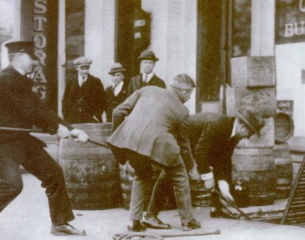
DC-area beer raid during Prohibition (Library of Congress)


Zogby polling data released today asked 1,028 likely voters, "If hard drugs such as heroin or cocaine were legalized, would you be likely to use them?" Ninety-ninety percent of respondents answered, "No." Only 0.6 percent said "Yes." The remaining 0.4 percent weren't sure.

The results are similar to usage rates occurring under today's "drug war," as measured by the federal government's National Survey on Drug Use and Health (formerly the National Household Survey). The 2006 NSDUH found 0.3 percent of the population had used heroin in the past month and 2.4 percent had used cocaine. Even for cocaine, the numbers are compatible, because Zogby surveyed persons aged 18 years and up, while NSDUH begins with age 12; and because of the poll's statistical margin of error of 3.1 percentage points.


A comparison of drug use rates in countries with criminal penalties for drug use with the drug use rates of countries that have decriminalized personal use also suggests that policy may play only a secondary role in determining use rates. For example, in the Netherlands, where marijuana is sold openly in the famous "coffee shops," 12 percent of young adults age 15-24 reported using marijuana during 2005, as compared with 24 percent in neighboring France, where marijuana is an arrestable offense, according to data compiled by the European Monitoring Center for Drugs and Drug Addiction.In the United States, where police make nearly 800,000 marijuana arrests each year, young adults age 18-25 in the 2004-2005 survey year reported past-year marijuana use at the rate of 27.9 percent.

David Borden, StoptheDrugWar.org's executive director, commented when releasing the Zogby data:

"Prohibition is sending hundreds of billions of dollars per year into the global criminal underground. That money fuels violence and disorder on the streets of our cities, while simultaneously helping to finance international terrorist organizations. Meanwhile, inflation-adjusted cocaine prices are a fifth of what they were 30 years ago, and any kid who wants to join the Mafia can sign up to deal it in his school. Addicts are harmed by the prohibition policy worst of all. It's time to stop shooting ourselves in the feet, and to control and regulate drugs through legalization."

The full Zogby poll results are available online at: http://stopthedrugwar.org/legalization

Wednesday, December 12, 2007

Dutch Government urged to open international debate about UN drug conventions

The Transnational Institute in the Netherlands, one of the worlds leading centers of drug policy scholarship, has today co-signed a letter and resolution sent to the Dutch Prime Minister and relevant parliamentary commissions, stressing the need for an active Dutch involvement in the UN's 10 year drug strategy review process and specifically to use the window of opportunity offered by the 10 year strategic review to open the discussion about the UN conventions that are an obstacle to further developments in Dutch cannabis policy - specifically the issue of legal production. The resolution has received massive media coverage in the Netherlands today in part because it has been signed by Van Agt (a former Dutch prime minister), a number of ex-ministers, five mayors and several police chiefs.

The letter presents the resolution that resulted from the October 31 invitational conference on Dutch cannabis policy in The Hague, chaired by Maastricht Mayor Leers.

The resolution calls for moves towards legal regulation of cannabis production which, anomalously, remains illegal despite the tolerance for and licensing of cannabis sales in 'coffee shops', the so called 'back door problem'. There has been a Parliamentary majority for such a move for a number of years but the Government has been reluctant to take the step as it would be in clear violation of the UN drug treaties, which the the existing policy of tolerance for small scale supply and use arguably is not.


Unfortunately an english translation of the resolution will not be available for a few days (It will be posted here when it becomes available - in the mean time a rather garbled babel fish translation is in comments). Dutch speakers can read the resolution and accompanying documentation here.

Friday, December 07, 2007

UNODC director (lamb) addresses the DPA (slaughter)

I'm in New Orleans at the Drug Policy Alliance 2007 International Drug Policy Reform Conference, and it was a fascinating opening day featuring as its center piece an address from Antonio Maria Costa, Executive Director,United Nations Office on Drugs and Crime, followed by a Q&A session.


The DPA conference in New Orleans


Transform blog regulars will have read about some of Costa's peculiar comments before (In the Independent on Sunday, on Swedish drug policy, and a particularly strange recent speech in Spain). In the context of some of his previous comments, and indeed his role overseeing the UN drug conventions that enshrine prohibition into the domestic laws of over 150 countries it may seem strange that he would accept and invitation to the worlds largest conference discussing the problems caused by prohibition and more just and effective policy alternatives. So his decision to attend must be applauded and is a historic first for the reform movement, but as he himself commented humorously there was an element of 'lamb to the slaughter' about proceedings.


Costa's speech the text of which is available on the UNODC site here) was well choreographed and superficially made some concessions to the critics of the broader UNODC approach. He implicitly conceded that supply side drug control efforts had been ineffective and that the best that could be claimed was 'containment' and 'stabilisation' of the problem, some way from the 1998 UNGASS commitment to a significant reduction by 2008. More significantly perhaps was an analytical perspective rarely if ever heard from the UNODC that unless demand was reduced, supply could not be prevented. He worded it, in the frank manner befitting an economist, like this:

I invite you all to imagine that this year, all drugs produced and trafficked around the world, were seized: the dream of law enforcement agencies. Well, when we wake up having had this dream, we would realize that the same amount of drugs - hundreds of tons of heroin, cocaine and cannabis - would be produced again next year. In other words, this first dream shows that, while law enforcement is necessary for drug control, it is not sufficient. New supply would keep coming on stream, year after year.

So let's dream a second time. Let's dream that, by some miracle, we can convince farmers around the world to eradicate the thousands of hectares of drug crops, replaced by the fruits of development assistance (in Afghanistan, Colombia, Morocco, and Myanmar). A great dream of course, but yet again one that would not on its own solve the world drug problem. Why? Because when we wake up after this second dream we would realize that other sources of supply would inevitably open up somewhere else on the planet, to satisfy the craving of millions of drug users around the world.


Whilst then proposing a the rather confusing argument (that because one prong - supply reduction - was futile, you therefore needed a two pronged approach - i.e .supply and demand reduction) it was a significant point for the head of the UNODC to concede.

He sought to distance himself from the notoriously stupid drug free world motto of 1998, and the phrase war on drugs, whilst also stating his support for effective treatment, prevention, eduction and harm reduction (although there was an unstated suggestion that these were policy elements that were the somehow the exclusive preserve of the prohibitionist position). But at least there was an unambiguous statement of support for harm reduction, which was welcomed after the embarrassments of the 'Dear Bobby' letter episode .

His response to the broad drug law reform / prohibition critique arguments were familiar, predictable and none could stand any sustained scrutiny (see the links above or Transform's 'After the War on Drugs, Tools for the Debate' for a more detailed deconstruction of the most of the points he makes). He conceded that prohibition fueled crime but that the health implications of abandoning it made the reform position untenable:
"I know your argument on this last point. Prohibition causes violence and crime by creating a lucrative black market for drugs: so, legalize drugs to defeat organized crime. Thus far, as an economist, I agree with you. But this is not only an economic argument. Legalization may reduce the profits to organized crime, but it will also increase the damage done to the health of individuals and society. Evidence shows a strong correlation between drug availability and drug abuse. Let us therefore reduce the availability of drugs - through tackling supply and demand - and thereby reduce the risks to health and security."

His comments received more detailed scrutiny in the Q&A session which followed, at which a number of leading drug law reformers, including Pat O'Hare (IHRA) Alex Wodak (Australian Drug Foundation) , Craig Reinarman (UC Santa Cruz), and Martin Jelsma (TNI Netherlands), offered a critical commentary on his speech.


lamb, slaughter etc.

At this point, faced with what were effectively un-answerable questions and observations, Costa slipped into evasive politician mode. A good example was when he was challenged, with the example of the Netherlands, on a comment he made about how availability correlates to prevalence of use. The point made to him was specifically that the Netherlands effectively had free cannabis availability, but average to low (European) levels of use. Costa's response was to accuse the Netherlands of 'poisoning the rest of Europe' with its amphetamine production. Whether this is true or not it had no bearing on the availability/prevalence question asked re cannabis. Costa preferred to reiterate his rather unpleasant sound bite that countries 'have the drug problem they deserve' (explored here).

Overall it was fairly predictable, and the significance really lies in the fact that it happened at all. How significant in the longer term is impossible to guess, but it does at least suggest that the movement is being taken seriously at the highest level and a decision has been made to develop and implement some sort of engagement strategy. That said, if this is the strongest factual and analytical defense of prohibition (and its institutions) that can be mustered then we can perhaps be a bit more optimistic, and we must assume they are very worried.

more detail and analysis at Drug War Rant and Reason Online

Tuesday, December 04, 2007

Prominient US think tank publishes pro- decriminalisation paper

The the Washington DC based think tank, the Center for Strategic and International Studies published a paper by Sidney Weintraub last month, titled 'The high cost of criminalizing drug use' that I have only just come across.


Sidney Weintraub from CSIS


His analysis is concise and useful - although specifically focused on economics. He notes that:
"The “war” on narcotics continues to be waged with little to show for it other than occasional successful skirmishes (like Mexico’s recent drug seizure) at great cost in self-destruction and deep damage to other countries."
and,
"Limiting drug usage after decriminalization would cost many billions of dollars a year for education and treatment, but markedly less than the costs of current policy."
The concluding paragraph:
"Decriminalization of drug use is a controversial recommendation. My reaction over the years was to reject the idea when it was proposed by others. What has turned me around is the reality that the current policy of criminalizing drug use is not working—and cannot be successful. If one drug shipment is interdicted, other shipments and substitute drugs are available. Burglaries and muggings by young offenders are motivated by the need for money to buy a fix. The rents to drug dealers are so high that there are no practical limits on their ability to bribe officials; and those who refuse to be bribed are often killed. In developing countries like Mexico and Colombia, the dealers can buy their own armies and outgun government enforcement personnel. My conclusion is that in a democracy—where drug offenders are not summarily put to death by the authorities—the only feasible approach is to eliminate the rents and treat and educate the addicts. This is no cure-all, but is preferable to efforts at prohibition of narcotics, something we learned years ago in the case of alcohol."


There are hundreds, if not thousands of think tanks in Washington and I don't know a great deal about the CSIS, but Sanho Tree (a colleague who is director of the Drug Policy Project at the Institute for Policy Studies, also DC based) describes CSIS as 'a center-right think tank' that is 'in many ways the voice of the Establishment'. CSIS certainly lists a who's who of political and corporate heavy hitters amongst its trustees (including, I noticed, Henry Kissenger). So whilst CSIS specifically notes that:
"CSIS does not take specific policy positions. Accordingly, all views, positions, and conclusions expressed in this publication should be understood to be solely those of the author"
it remains significant that they published this paper and is indicative of a new level of mainstream institutional engagement in the the broader critique of prohibition from across the political spectrum.

The full document is available here (pdf)

Monday, December 03, 2007

The Onion: Drug Czar Toppled By Drug Bolsheviks

Contrary to what you may have read from some opponents of progressive reform, this is not how it's going to happen.

Drug Czar Toppled By Drug Bolsheviks

Onion Radio News
(audio)

Sunday, December 02, 2007

ACMD attacks drugs strategy consultation

As reported in the Observer today: "The government was at loggerheads with its own advisers last night over its new drugs policy."

It continued:

"An influential Home Office-backed committee raised serious doubts about the consultation process behind the 10-year strategy which will be unveiled in April. The Advisory Council on the Misuse of Drugs (ACMD) described the process as 'self-congratulatory and generally disappointing' and questioned the credibility of much of the evidence presented to government."
The castigation appears in the Overall Comments (p3) to the ACMD's submission to Government on its strategy review. It is a withering attack in an otherwise fairly innocuous document.

There has been widespread condemnation from across drugs field of the strategy consultation p since it made its appearance in July this year. However, the significance of the Advisory Council reiterating this condemnation will not be lost on the Government.

This is a crucial time for the Advisory Council as it flexes its muscles in the upcoming review of cannabis reclassification in February next year. More importantly though the Council loses its incumbent Chair Sir Michael Rawlins next year and takes on six new members in the next few months (currently being appointed).

The Council's remit is to advise ministers on drug policy and law and specifically on the operation of the Misuse of Drugs Act 1971 (MDA). The ACMD's position was undermined in 2006 when the Science and Technology Select Committee called into question the entire scientific evidence base for the drug classification system, in their report 'Making a Hash of it'. Initially the Council acted as if they had given it a clean bill of health, but do now appear to be taking at least some of the criticisms on board.

Transform has been calling on ACMD for years to evaluate both the classification system and the operation of the entire MDA and indeed prohibition itself. As ACMD suggests in its comments, an adequate definition of 'harm' is required in order to develop an effective drug strategy. At the least the ACMD needs to publicly state which harms are caused by drugs and which are caused or exacerbated by the enforcement of the MDA.

If the Council is to reassert itself as the much needed bastion of evidence and rationality within Government, it will need to step up a gear and proactively begin its own work of exposing the MDA to scientific evaluation (if necessary demanding the required resources and capacity from the Home office). If it fails to do this then agencies in the NGO sector - including Transform - will need to step in to do their job for them.