Showing posts with label marketing. Show all posts

Thursday, June 07, 2007

Powdered alcohol for kids


*updated 16.02. see below* .

After a almost a week of booze hogging the blog we will hopefully be returning to good old fashioned illegal drug news soon. In the mean time......

The latest shocker comes from the Netherlands where some students have, according to Reuters, produced a powder, named Booz2go, which when water is added creates a fizzy lime flavoured beverage that is 3% alcohol. A bit implausible perhaps but not entirely beyond the realms of science. Worryingly the inventors are very specifically "aiming for the youth market. They are really more into it because you can compare it with Bacardi-mixed drinks".

So its a powdered alcopops for the nippers.

The inventors, who cooked up the new product for an end of year school project (on which course I have to wonder?) note that "Because the alcohol is not in liquid form, we can sell it to people below 16," and that as a non liquid it is also not liable to tax (in the Netherlands anyway, I have no idea how the law would view it in the UK or elsewhere).

So actually its a powdered alcopop that tastes like a lime Bacardi breezer, that you can sell to under 16's and don't have to pay tax.


bad enough in the more conventional liquid form


It is perhaps no surprise that the news story ends with the news that 'A number of companies are interested'. And why not; for the alcohol industry this is their DREAM PRODUCT. No tax, no pesky age restrictions, and no need for the pretence that 'alcopops are not produced to target underage drinkers, honest'. Maybe it can be snorted too. That could open up a whole new market....

UPDATE:

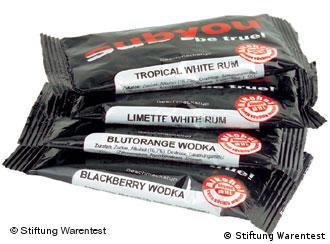
Having consulted some of my science boffin friends it would appear that this story is another example of bad reporting of a some non-news. This story from August 2005 bears an uncanny resemblence to the Reuters 'news' item; the Dutch student's product would apear to be neither an 'innovation' nor their 'invention'. A German product called 'subyou' apparently actually made it to the market, briefly (the website is now defunct)


Subyou sales website


the product

according to the original 2005 coverage on the dw-world German website:

“They look harmless enough, the inconspicuous packets often next to the cashier at gas stations, convenience stores, beverage stores and bars. But according to consumer protection officials, that’s what makes them all the more dangerous, since the powder inside contains alcohol, and a lot of it — about 4.8 percent by volume. That is the equivalent of one to one-and-a-half glasses of liquor.

“The product is called subyou, manufactured by a company in North Rhine-Westphalia, and is marketed squarely at teenagers with slogans like “taste for not much dough” and “gets a good buzz going.” Add the powder to cold water, and consumers have an alcoholic drink containing either vodka or rum. “These are just as dangerous as the alcopops that came in the bottles,” Birgit Rehlender, nutrition expert at consumer affairs organization Stiftung Warentest told Der Spiegel weekly.

“While authorities were able to curtail the consumption of alcopops with a special tax on the drinks last August — which put them out of the reach of many teenage budgets — these new alcopops in powder form cost between 1.65 and 2.40 euros ($2.06 and $3.00) per package. Subyou is able to get around the tax because its product comes in powder form. The powder was first sold over the Internet, and word spread quickly among teenage circles that those under 18 could order off the Internet without fear of being asked for proof of age. However, according to Andrea Schauff, a nutritional expert at Hesse’s consumer protection organization, in many stores the powder is being sold to under-age kids even though a warning is printed on the packets: “Alcohol can be addictive — no sales to minors.”

There is also some details about possible health issues:

“Besides the high alcohol content, youth advocates also worry about the powder’s other ingredients, including high levels of preservatives, sorbic acid, and dyes that have not been approved by health experts. ”
One person noted in a forum I have been discussing this issue on: "Most compounds that would easily release ethanol aren't particularly nice, e.g. diethylpyrocarbonate or diethylcarbonate".

I honestly thought this story was just some agency fluff, a daft 'and finally' story. If, as appears, it actually has some substance then the relevant authorities would need to have this nasty stuff regulated pretty quickly (as appears to have happened in germany) to prevent underage access, and if it is a dodgy as it appears to be, keep it off the market altogether. It seems highly unlikely this will ever trouble us in the UK but, strewth, as if there wasn't enough problems with regular booze.....


Tuesday, June 05, 2007

another alcohol strategy: fine words, but spineless

.
The new Alcohol strategy document is published today (approx 1 meg pdf):


Safe, Sensible, Sociable


There is alot of common sense in this document, lots of good ideas and good intentions, as in fact their was in the last one. But good intentions in an attractive document does not itself automatically translate into good policy making, or good policy outcomes.

There is also, regrettably, alot of the same spinning of policy failure as success that we have seen in policy on illegal drugs, mostly using the same trick: trumpeting largely meaningless 'process' successes, whilst playing down failures on those troublesome so-called 'outcome' measures. In today's Government press release for example, Home Office minister Vernon Coaker, master of the genre, gives good process:

"Since the previous alcohol strategy we have seen significant progress through the 'Know Your Limits' binge drinking publicity campaign, new enforcement powers in the licensing and Violent Crime Reduction Acts and the establishment of a new independent charity, the 'Drinkaware Trust', to promote sensible drinking. We are looking to build on these successes and for us all to pull together and call time on the way some of us drink"

The process-fest continues in the introduction of the strategy itself where we learn, fascinatingly, that as part of the success of the previous strategy:

"of the 41 actions in the original strategy, 26 have been delivered and a further 14 are underway."

Woohoo! On the outcome front we learn that 'levels of alcohol consumption no longer rising' , a fairly crap idea of 'success' if the goal is a fall in use. Stabilising at a level amongst the highest in Europe is nothing to crow about, just as the drug strategy celebrating heroin and cocaine use 'stabilising' (at a precipitous and unprecedented high, top of the Euro consumption league) is a bit lame given the goal of a 50% reduction (although, to be fair, they have till next March to achieve that).

you have to look far lower down the press release before you learn from the young people's Minister that:
"The evidence we've looked at suggests young people are drinking at a younger age and in greater quantities than before"
and plough through a couple of chapters beyond the exec summary of the report itself before you start to see miserable graphs like this one:


The other thing that strikes me is the feeling that the industry funded Portman Group PR front organisation is breathing down my neck as I read. Portman Group research is extensively quoted, and the industry funded drinkaware website is repeatedly highlighted (problem drinkers being presumably one of the populations least likely to access websites) , as is the industry funded drinkaware charity. Why should we rely on the alcohol industry to provide information to the public on alcohol and health? Er, conflict of interest anyone? By what factor, I wonder, does the industry marketing and advertising budget (none of which output contains any health warnings) eclipse the money spent on drinkaware? A hundred, a thousand, ten thousand?

We also have inexplicable calls for a public consultation on, of all things, alcohol pricing and promotion. Seriously, what do you think they will say? Odd that the Portman Group, (amonsgt lots of other process calls) should claim yesterday that:
“We welcome the independent review into whether price promotions contribute to harmful drinking. At the moment, the effect of such promotions is unknown. This review should collect the evidence before we can determine if any new restrictions are necessary."
Rubbish. Once again there is masses of evidence, undisputed by the WHO, the BMA, various royal colleges, Alcohol Concern etc. that low prices and promotions (the clue is in the word) 'promote' increased consumption. Again you have to wonder who the Government have been talking to, or rather, listening to. This stuff is obvious and well understood. Alcohol is relatively far cheaper than it was a few decades ago, and consumption has risen dramatically: the Government knows full well that increasing prices would dissuade use amongst key groups, and they are in the position to easily make the intervention. A public consultation will add nothing useful to this body of knowledge, it is simply an ingenious stalling tactic from the industry to protect its interests - which resolutely do not involve a reduction in consumption. It is symptomatic of our whole spineless alcohol policy that this Government has caved in to the industry, again, despite overwhelming evidence that they should listen to experts who are not also making money marketing potentially risky drugs to young people.

recent blogs on alcohol policy:

Why alcohol ads being pulled from kids replica kits is nowhere near enough.

Government complicity in the alcohol marketing scandal


Monday, June 04, 2007

meanwhile Japan deals with the issue of alcohol marketing to kids...

in its own inimitable way.....


yup, its fake kiddie beer made with grape juice and soda.

Why alcohol ads being pulled from kids replica kits is nowhere near enough.

.

It was only last week the blog was commenting on exactly this issue (I have also considered it in detail previously) and how it was an ongoing disgrace for football, the drinks industry and of course, the Government.

So all change then. Kids will no longer be used as, in the words of Mr Poley, chief executive of the alcohol industry PR organisation, The Portman Group: "walking billboards for alcohol". Good news this, in a small way, sort of. But several hugely important and un-ignorable issues remain to be addressed.


Beer branding for toddlers!
Using kids as 'walking billboards' will end (in a couple of years, hopefully)

First amongst these is concerned with the millions of 'walking billboards for alcohol' that will remain, in the form of 'adults'. These include the large majority of fans at football games, and of course crucially the players themselves on the drug promoting teams. The children may not be wearing the brands themselves for much longer (although I still occasionally wear my Saints replica kit from the 80's sponsored by Draper Tools), but the level of exposure to the branding messages will drop little, if at all . The posters in the kids bedrooms will still be plastered with the branding, so will the football stickers they swap in the playground, and the games they watch on TV will be too.

In fact, not only are the televised games saturated with alcohol advertising on the walking billboards that are the players and fans, but also the non-walking type, the animated advertising hoardings surrounding the pitch and peppering the stadium itself even when non booze-branded teams are playing. It’s not just for beers either, you can also see ads for Vodka-Kick (a rather revolting vodka-based alco-pop aimed at the youth market) on prominent display at World Cup Qualifiers, Champions League matches as well as at several Premiership, Championship, Division 1, Division 2 and SPL grounds. Astonishingly, given the ban on tobacco advertising, you also still see ads for Rizla rolling papers in televised games - given these are used exclusively for tobacco and/or cannabis, this seems like a ridiculous loophole. Elsewhere in sports we have our national teams sponsored by beer (UK cricket team) and whiskey (Scottish rugby union team), tennis tournaments sponsored by Stella Artois, and of course the blazingly moronic sponsorship of formula one, Nascar and a whole slew of high speed racing sports sponsored by the drug implicated 1000s of speeding related road deaths.

So lets be clear - even after this 'ban' (in fact a voluntary agreement, applying to new sponsorship deals after Jan 1 2008) any child watching a football game on tv, video, DVD or you tube, will still be aggressively bombarding with alcohol branding drug promotion. Going to or viewing a whole match (itself probably sponsored by Carling or Amstel) they will be exposed to literally hundreds if not thousands of individual alcohol branding/advertising messages.

The marketing folks know what they are doing: You catch'm young. Just like the McDonalds happy meal and cherry coca-cola deliberately target young consumers as a way of imprinting brand loyalty at a young age, so the beer marketers catch'm young as a way of securing the key market of young drinkers, significantly including the ritualised binge drinking associated with football that really pulls in the profits. That the Government kow-tows to this nonsense nothing short of a disgrace.

Mr Poley of the Portman Group has this to say about yesterday’s announcement:

"There is no evidence to link this marketing with under-age drinking"

You have to love the shamelessness of alcohol industry PR. He seems to be saying that advertising alcohol to young people doesn't effect consumption amongst young people. No doubt the multi trillion dollar global advertising industry and their clients would be fascinated to learn this. Its transparently rubbish - If advertising didn’t increase profits and consumption of their products, companies wouldn't pay for it. If anything, children are more susceptible to advertising and branding messages than adults - and contradicting Poley's industry sponsored opinion there is reams of evidence , yes reams of evidence, of how sport sponsorship effects alcohol consumption amongst young people (presumably why many individuals and organisations including the Royal College of Physicians, the European Commission and numerous NGOs have been calling for a ban on alcohol sport sponsorship for years).

This sort of industry claim is almost as preposterous as the 'smoking does not cause lung cancer' rubbish we had to put up with for decades from lying tobacco companies (who also made similar claims about tobacco advertising not affecting consumption). The Portman group have also claimed that alcohol sponsorship encourages sobriety by association with healthy sports participation in which precludes alcohol related ill health or drunkenness. Absolutely amazing – almost Orwellian in its twisted logic.

Mr Poley from the alcohol industry funded Portman group then tells us:

"Even so, drinks companies are concerned about the negative perception caused by their logos appearing on children's shirts."

Ah, so they don’t want the kids making their brands look bad. How very caring and considerate. We then learn that:

"Drinks companies are taking the lead even though this decision may lessen their commercial appeal as sponsors if clubs sell fewer shirts."

Aside from the barely credible altruism in this last statement, I would strongly question the statement 'taking the lead', given that the industry has been assiduously fighting any restrictions on alcohol marketing from day one. The alcohol industry will not take the lead on any public health initiative if their profits are jeopardised - end of story. This latest move is an exercise in tokenism in the run up to the publication of the new alcohol strategy in a few days time, targeting just the most overtly offensive strand of their youth marketing strategy - the vast majority of which, as discussed, will remain in place. Just as with last weeks announcement of health warnings and unit content on alcohol packaging, this is a half-arsed decision reluctantly taken years, if not decades, too late. It will have no significant impact on the tsunami of youth alcohol marketing - which will simply redirect it's energy elsewhere.

Given the growing public health crisis around youth binge drinking, alcoholism, and early onset cirrhosis, the Government should have heeded calls to ban for all alcohol advertising to non-adults years ago. In France alcohol sport sponsorship and all broadcast alcohol advertising is banned and, wouldn’t you know it, drinking and liver cirrhosis are falling, rather like smoking and related health problems are in UK since we banned tobacco sponsorship and advertising.

If the Government do not act they will be continuing to condone the aggressive promotion of drinking to young people, and through sports sponsorship, the association of an intrinsically risky drug with healthy pursuits and glamorous role models, the absolute polar opposite of their other very vocal anti-drug messages. We should not be persuaded by the tokenism of this latest sop to the critics, either by the industry or the Government. The suggestion from the PR bods is that ‘something is being done’ and everything will be fine now.

It wont. This is yet another a political ‘process’ announcement, pure PR in lieu of any actual policy 'outcome' success (just wait and listen to them parade these announcements when the new alcohol strategy comes out). A whole lot more needs to be done very rapidly and a ban on all sport sponsorship by alcohol brands would be a good first step.