Friday, March 30, 2007

Supercasinos, drugs and alcohol prohibition: more than a whiff of ministerial hypocrisy

.

The sex industry, the drugs industry, and the gambling industry: Governments have always struggled with how to regulate certain pleasure seeking behaviors, especially when they clash with religious concepts of sin, which sex, drugs and gambling usually do. In law they they tend to come under the general description of 'Vice', which addresses the big three 'morality crimes'.


Prohibiting 'vice' creates illegal markets, and great material for cop shows

The problem for governments is that these activities are not always harmful (even though they can be), and in one form or another, they are as old as civilization and haven't shown much sign of disappearing despite the best efforts of our moral stewards. People, it seems, like pleasure and seek it out regardless of whether it is frowned upon, or even specifically prohibited and criminalised, as gambling drugs and sex work have been and remain to varying degrees in different places around the world. In the UK some drugs are legal whilst others not, prostitution is legal but soliciting and brothels not (although 'mini brothels' may be soon), and gambling is legal and licensed in various forms but not others (high street bookies, for example, were legalised and regulated in the 1961).

It is fascinating to see how politicians can tie them selves in knots of hypocrisy when it comes to regulating 'vice', as has recently been brilliantly demonstrated by Tessa Jowell, the UK's Secretary of State for Culture Media and Sport, who is charge of casino policy. The Government is very much in favour of regulated gambling and on the subject Jowell is apparently very clear, and very pragmatic. Regards online gambling:

"Broadly speaking we have three choices: you can prohibit, like the US, do nothing or regulate, like we have”

"I firmly believe we have chosen the path that will do the most to protect children and vulnerable people and keep out crime."

"America should have learnt the lessons of prohibition. The Volstead Act
[which brought in alcohol prohibition in 1919] was meant to stop alcohol from causing harm, but in practice it forced otherwise law-abiding customers into the hands of the bootleggers”

"If it goes wrong , there is a real danger is that off shore sites based in poorly regulated countries will become the modern day equivalent of speakeasies, increasing the risk of exploitation and fraud."


Here she is specifically summoning up the failure of a drug prohibition as an example of why we need to legally regulate gambling, albeit alcohol prohibition in 1930s USA. This wasn't a one off quip either. Jowell and her team have obviously decided this prohibition parallel argument is their strongest card in the gambling debate. She made the same point in the House of Commons last October a few days before the above quote hit the news:

"our approach to gambling regulation is different: to avoid prohibition, to introduce regulation and to avoid the damage that the free market will do".

Indeed she was making the exact same argument back in 2004:

‘The House should recognise, however, that gambling is at the boundary between personal freedom and state intervention. On one side of the boundary is the reasonable expectation of adults who, within the law, exercise their right to live their lives as they choose. On the other is the role of the state: to recognise human frailty, and in particular to respect its duty to protect children and the vulnerable. As a Government and a society, we have three options in that respect: prohibition, a free-for-all or regulation. We have no doubt about choosing the regulatory route. The question for the House is how best to apply the regulatory framework for the benefit of society as a whole'
You may be able to guess where I'm going with this...

Is it not obvious that the same logic should apply to currently illegal drugs? Why have we 'learnt the lessons of prohibition' regards gambling and alcohol, but not with the prohibition of other drugs?

Remember that the 2002 updated National Drug Strategy actually refers to itself as a policy of 'prohibition' (page 6). Jowell's self righteous position on gambling and alcohol prohibition is dramatically undermined by the howling contradiction with her Government's own policy on other drug prohibitions. (Also see 'Why this? - but not this?' for another brilliant example of Government double standards). Let’s just change a couple of words in Jowell's above quote and see how it sounds:

"The House should recognise, however, that drug use is at the boundary between personal freedom and state intervention. On one side of the boundary is the reasonable expectation of adults who, within the law, exercise their right to live their lives as they choose. On the other is the role of the state: to recognise human frailty, and in particular to respect its duty to protect children and the vulnerable. As a Government and a society, we have three options in that respect: prohibition, a free-for-all or regulation. We have no doubt about choosing the regulatory route. The question for the House is how best to apply the regulatory framework for the benefit of society as a whole"

eh? EH? EH?

Back in 2004 Jowell wrote a piece for the Guardian titled 'Grown-up politics for an adult world'. She liked it enough to run it a second time earlier this year. In the article (apparently adapted from a Fabian society essay she wrote ages ago) Jowell makes the same prohibition/regulation argument in some considerable detail, again invoking the foolishness of prohibiting drugs to make her point:

“On issues like smoking, drinking and gambling, government has three basic choices: we can prohibit, regulate or leave it to the market. Prohibition does not work - it drives the activity underground ....... Only ideological extremists favour a free-for-all where only the laws of the market hold sway. So the third option is regulation - and regulation with as much emphasis on the quality of the debate as the policy outcome. 'Better regulation' has to mean government engaging people in the decisions that affect their lives and doing so in new and better ways”.



This Guardian article is subtitled 'Voters want choice, respect, dialogue and responsibility. The Government must learn to deliver '. Well Tessa, I am an grown up and I want some grown up politics. I want choice, respect, dialogue and responsibility – so why don't you stop being such a baby and lets apply your obviously sensible arguments to the evident failure of drug prohibition. You know, 'issues like smoking and drinking'.

Just to thrash this point a little further, the current big boss of UK drug prohibition is John Reid, who as health secretary appeared on the Jeremy Vine show (11.11.04) discussing tobacco policy, noting on the subject:

“Prohibition doesn’t work, as the US found out many years ago.”

Aside from this politically-selective analysis of prohibition’s failure, the other glaring problem for Jowell with the new supercasino legislation is that it goes way, way, beyond her alternative proposition of sensible legal regulation.

As the various minister's prohibition analysis correctly demonstrates with alcohol, when demand for illegal drugs exists, and where this demand isn't met legally, criminal supply inevitably fills the vacuum and mops up the extraordinary profits prohibition hands them. These are the inescapable economics of illegal markets, with disastrous effects for all to see; untaxed illicit profits, crime, violence and so on.

However, in contrast to drugs, demand for gambling is being more than met legally, in fact the market is being saturated. There are casinos all over the country and they are not overflowing and turning people away at the doors. People can also gamble online, on the lottery, in bookies on every high street (since 1961), at the horse races, at the dogs, on fruit machines in every pub and kebab shop, even with their mobile phone bookies, 24 hours a day, wherever they are. There is no excess demand for gambling that is not currently being met, which is precisely why there is almost no illegal gambling in this country, bar the occasional cock fight.

That is what is so completely mystifying about the super casinos plan: There was no public demand for them. Sure, once they were proposed and their number limited (initially to one) then certain interests started demanding a piece of the pie. The foreign investors (willing to throw tens of millions into their lobbying efforts) obviously want them, and no doubt some star-struck local government officials think they are good idea too. But before the Government floated the plan in the first place there were no NGOs, grass roots campaigns, policy analysts, or gamblers associations, calling for supercasinos to fill some leisure gap they were being so cruelly denied.

Supercasinos, one assumes, will be allowed to aggressively advertise in the same irresponsible way online casinos already do, including, I think disgracefully, to children via sports sponsorship. The multimillion pound casinos with their multimillion pound marketing budgets will be actively increasing the total amount of gambling that takes place. That is very much not responsible regulation any more than letting alcohol brands aggressively advertise to young people through sports sponsorship is (e.g. The Carling Premiership) when we have the highest youth drinking in the Western World and an exploding problem of alcoholism and liver cirrhosis.


Catch'm young. Totally inappropriate regulation in action: baby football kits sponsored by drug brands (Rangers), and online gambling (Villa)


The idea that these new casinos will help regenerate inner cities is a particularly perverse justification. They are going to be built in deprived areas, earning a significant proportion of their revenue from those low income populations. They wont be bringing money into these areas, they will be bleeding it away from the populations most vulnerable to their illusory promise of a quick buck. What's more, most of the the profits will largely be leaving these areas anyway, flying off to the overseas investors. Supercasinos bring the same level of culture and enhanced well being to communities as ‘The Mint’ phone-in ‘quiz’ brought to our television schedules.

I have to confess: I’ve visited some supercasinos in Vegas and Reno USA, for my sins, and I can report that (*personal bias warning*) they were pretty vile. Nothing like those swanky places in Bond films, these were grotesque industrialised / warehoused gambling spruced up with lots of tacky flashing lights and full of lonely rather glum looking people losing money. If I had a couple of hundred million pounds to spend on enhancing a deprived community I can think of a couple of hundred million better way to spend it than the financial, spiritual and cultural black hole that is a supercasino.

For organisations such as Transform, arguing for sensible legal regulation of currently illegal drugs, it all sets a strikingly bad precedent. The equivalent in drug terms would be to let Colombian cartels build a glitzy new heroin and crack mega-mart in the middle of Moss Side. And then let them sponsor Manchester city.

The Cocaine Premiership anyone?


No. Of course not. If you want to learn about how it should be done please read:

'After the War on Drugs - Options for Control' (2004) by Transform

'A Public Health Approach to Drug Control (2005) by the British Colombia Health Officers Council (Canada)

Effective Drug Control:Toward A New Legal Framework' (2005) by The King County Bar Association (USA)

.

Wednesday, March 28, 2007

A New Approach for Afghanistan

Pakistan's Daily Times here discusses a report from the German Spiegel that NATO governments are finally debating the legalisation of the Afghan opium trade which has so far flourished under attempts to prohibit it. The Taliban insurgency has drawn strength and popularity from Western attempts to eradicate this profitable crop and Western governments and NATO command are to be congratulated for belatedly debating their counter-productive eradication policies. Apparently critics of the legalisation plan fear that venal politicians who currently accept backhanders from the drug barons would only increase their income with legalisation although no reason is given as to why opium producers of sound mind would continue to pay politicians at all under legalisation.

Monday, March 26, 2007

Annual celebration of limited supply-side success

The Home Office’s ‘Annual Tackling Drug Supply Awards 2007’ were distributed to a number of hard working and relatively successful police forces recently. These units had managed to break up a few criminal drug gangs and seize millions of pounds (sterling) of illegal drugs, which in the world of prohibition is a measure of success.

By the sound of things they will have the drugs ‘problem’ sorted out by teatime. However, this is not the case. As we have documented in our Fact Research Guide drug seizure statistics are often misunderstood and misused:

Defenders of the drug war status quo frequently use increases in seizures as evidence of a successful enforcement policy or, conversely, that a decrease in seizures is evidence that drugs markets are reducing. Neither represents a correct interpretation of the statistics, and in reality drug seizure data are of little use for policy makers – aside from achieving arbitrary and equally un-useful seizure targets.

Drug seizures primarily reflect activity of the enforcement authorities and do not provide any useful indication of the scale of actual drug markets, as they can rise or fall entirely independently from drug availability or usage levels. A single large drug-bust can dramatically shape annual year on year stats. It is entirely inappropriate for seizures statistics to be used (as they are in the UK national strategy) as a measure of drug availability, as there is quite simply no correlation whatsoever.

Trumpeting seizures as a success on availability targets has been one of the more shameless and wilfully dishonest activities of Government in recent years
[1]; they know full well that drug availability is increasing and drug prices are falling and have acknowledged as much on the Home Office website and in other reports.[2]

The awards ceremony did uncover one real cause for celebration. It is important and encouraging to note that both Vernon Coaker (Home Office Minister) and Chief Constable Tim Hollis (Association of Chief Police Officers Chair of Drugs) emphasised the necessity of reducing harm and providing treatment. This is a very welcome step on the path towards a rational evidence-based drugs policy.

Sunday, March 25, 2007

The Independent's born-again drug war: Round Two

The Independent on Sunday have followed on last week's Cannabis panic front page splash with another front page splash. This time it is 'The Great Cannabis Debate'. Inside we get more news coverage revelling in the faux-controversy they have stirred up, scary brain scans showing how cannabis 'may' melt your brain, two opinion pieces; one by the head of the UN drug agencies Antonio Costa, another by child psychotherapist Julie Lynn Evans, and another leader defending their retraction of support for cannabis law reform (on the basis that it is more dangerous than they thought).


Jonathan Owen from the Independent on Sunday, who is apparently taking the lead on this latest salvo of cannabis coverage, rang me on Friday. He had read the Transform blog critique on last weekend's IOS cannabis 'apology' and wanted a response for this weeks 'Great Debate' follow up piece. This is what I sent in:

"The IOS makes the mistake of confusing their legitimate concern with the health impacts of cannabis misuse amongst a small group vulnerable young people, with support for the failed ideological policy of prohibition. Rather than supporting an evidence-led regulatory response based on public health and harm reduction principles, they advocate a policy that has not only failed to address the problems they describe (and has arguably created many of them), but also one that offers no prospect of sorting them out. The blanket criminalisation of millions of non-problematic occasional users that the IOS has now re-stated its support for, cannot be justified on the basis of a relatively tiny vulnerable population, especially of teenage heavy users, who have serious problems with the drug (even if this group has grown proportionally with the overall population of users over the last three decades). This is akin to prohibiting cars because of a small population of teenage joy-riders.

Cannabis use undoubtedly involves risk, as does all drug use, legal or illegal. But these risks have been well documented and well understood for generations. The debate around our response to cannabis use is not well served by hype and misrepresentation of statistics on potency, impact on mental health, or treatment and addiction – all of which last week’s IOS coverage was guilty of. This was scaremongering in the cause of an attention grabbing headline, very much in the pattern of many previous cannabis scares and precisely the sort of moral-panic the recent RSA report criticised for historically distorting policy priorities. The IOS also perpetuate the misunderstanding that the cause of cannabis law reform is predicated on the fact that cannabis is harmless. On the contrary – the exact opposite is true: Is precisely because drugs are dangerous that the need to be appropriately regulated and controlled by the State rather than be left in the hands unregulated criminal profiteers. This remains true however harmful a particular drug is shown to be.”

Whilst they have printed some similar-ish sensible comments from others in the follow up (in micro print, beneath the massive banner-headlined UN propaganda fest), they haven't included my comments in their 'great debate', which is mildly annoying since they actually asked for them.

Anyway, there's various things that jump out from the coverage deserving of some sort of response:
  • Owen refers to 'outrage on pro-cannabis websites and blogs' in response to the IOS's cannapology. Read our blog post: it is not outraged and it is certainly not pro-cannabis, any more than advocates of drug policy and law reform generally are 'pro-drug'. They are pro effective evidence-based public health responses to the obvious failings of prohibition. As the late Eddie Ellison, former head of the met drugs squad and Transform Patron, liked to point out, being anti-drug is entirely compatible with a rational pragmatic position on drug law reform (see here and here). Pro drug / anti drug is a false binary that the IOS deploys as part of its own self justification: drugs are bad, we are anti them, we must be right. Once again, they totally miss the point.
  • After last weeks 'drugs bad for you' scoop, the big scoop this week is that the UN agrees with them: 'The United Nations has issued an unprecedented warning to Britain about the growing threat to public health from potent new forms of cannabis, saying there is mounting evidence of "just how dangerous" the drug has become'. Actually this is in no way 'unprecedented', and to suggest so is just poor journalism. Costa, his predecessors, and the UN drug agencies saying exactly this, loudly and frequently, for years, especially since UK cannabis reclassification in 2004. Almost every comment in Antonio Costa's article is copy and pasted from these earlier statements.
  • It is hardly surprising that Costa would say what he does. The UN drug agencies oversee the UN drug conventions to which most countries in the world are signatories. These conventions (1961, 1971 and 1988) enshrine the IOS's beloved criminal penalties for drug production, supply and use into domestic law of over 150 states. They are the legal foundation and ideological bedrock of global drug prohibition. So its hardly surprising that Costa has come out in support of the IOS 's born again war-on-drugs stance. Costa is like prohibition's end-of-level-boss, he is literally the last person on earth you would expect to get a balanced position on drug policy from. Its a bit like an IOS scoop that the Pope sensationally backed their new position on the virgin birth. Indeed, Peter Cohen, in an essay for the International Journal of Drug Policy, titled 'The drug prohibition church and the adventure of reformation', makes a telling comparison between prohibition and religious dogma:
Whatever the origin of the UN Drug Treaties, and whatever the official rhetoric about their functions, the best way to look at them now is as religious texts. They have acquired a patina of intrinsic and unquestioned value and they have attracted a clique of true believers and proselytes to promote them. They pursue a version of Humankind for whom abstinence from certain drugs is dogma in the same way as other religious texts might prohibit certain foods or activities. The UN drug treaties thus form the basis of the international Drug Prohibition Church. Belonging to that Church has become an independent source of security, and fighting the Church's enemies has become an automatic source of virtue

  • Picking apart what Costa and prohibition's other high-level evangelists have to say has been done a million times. The UN drug agency's drug war propaganda is as tediously repetitive as it is economical with the truth. He repeats the myth that legalisation advocates claim cannabis is harmless, and blanket misrepresents all of the theory and practice of alternative policies to absolute prohibition as 'vague, laissez fare' or 'libertarian'. He uses a crackpot quote from a random online head-shop as a source of 'truth' regards the real dangers of cannabis, and has a charming line on not being swayed by 'misguided notions of tolerance'. Anything but tolerance!

  • We then get the utterly ridiculous: "People who drive under the influence of cannabis put others at risk. Would even the most ardent supporter of legalisation want to fly in an aircraft whose pilot used cannabis?" OK. Deep breath... Look, no one, literally no one calling for legal regulation and control of cannabis (or any other drug) is saying driving whilst competence is compromised by drug intoxication is OK or should also be legal. I'm also not aware of anyone ever suggesting that flying planes whilst stoned was acceptable. Decriminalising drug use does not give license for secondary offences committed whilst intoxicated - these will obviously remain criminal, as they should. To suggest different is pretty desperate, and from the rational reformers perspective actually quite offensive.
  • The most egregious nonsense in the Costa piece is where he claims: "drug control works. More than a century of universally accepted restrictions on heroin and cocaine have prevented a pandemic. Global levels of drug addiction - think of the opium dens of the 19th century - have dropped dramatically in the past 100 years. In the past 10 years or so, they have remained stable. The drug problem is being contained and our societies are safer and healthier as a result." Seriously, what can you say to that? How can you argue against that sort of statement that crosses the boundary from shaky institutional propaganda into full-blown Orwellian 'ministry of drug truth' delusion. At this point, I could produce a torrent of graphs, from official government and even UN sources, exposing this statement to be the polar opposite of reality, but hopefully if you are reading this blog, in fact if you can read at all, graphs wont be necessary as you will appreciate that such claims for the success of drug control over the past century are a total joke. It would actually be quite funny - if this man wasn't in charge of global drug policy. If the IOS is relying on this sort of analysis to bolster its case they really have blown it. To find out more about the UN drug policy see this excellent page of TNI publications on international drug policy. See also the recent blog: UN INCB is 'obstacle' to HIV prevention and drug treatment programs
  • The other prominent drug 'expert' the IOS pull in is none other than music / TV / airline /cola mogul Richard Branson. He talks about 'genetically engineered skunk' suggesting that skunk - the ill defined catch-all term for smelly indoor-grown cannabis - is in fact some sort of sinister new species of franken-pot. Actually it's no more 'genetically engineered' than any other farmed plant, flower or vegetable that has been bred to develop certain properties - i.e. everything in your fridge. Rosie Boycott on Radio Four's Today programme last week, despite elsewhere talking a lot of sense, got it even more wrong when she described 'skunk' as 'genetically modified', which is just flat out incorrect. Breeding plants is very different from inter-species DNA splicing. The worst thing about this is that both Branson and Boycott seem to be buying into the hype of the potency panic (explored in last weeks blog and also examined in this week's Guardian Bad Science column by Ben Goldacre). The Independent also seems to imply that Branson is backing their born-again prohibitionist stance when in fact he is not. He specifically only calls for a debate on the harms of cannabis, and also says that people with drug problems should get help on the NHS 'free from blame'.
I could pick more holes in the coverage but I grow weary. Apologies to Julie Lynn-Evans then; its not that your plan to make 'skunk' posession punishable with 14 years in prison, but legalise 'the old stuff' doesn't warrant annihilating, just that I think the point has been made well enough now, and I can't be bothered.

To be honest I'm incredibly bored with the endless recycling of the cannabis debate, the endless retreading of exaggerated claims about the drug itself (either its dangers or its safety). If there is one small mercy in the IOS coverage it is that they spared us the dreaded 'gateway theory'. Most of all I'm bored of the myths, misrepresentations and misunderstandings about people who call for reform of a policy that has manifestly failed on each and everyone of its stated objectives to reduce supply, use or harm associated with the drug.

This has all been going on for literally decades now, in fact generations; bear in mind the original reefer madness film was made in 1936, several decades before the 'good old days' of the flower power era (as Costa calls it) when cannabis was apparently a nice harmless drug used by hippies.


This endless tail chasing has been fuelled by lazy journalists looking for an easy headline and populist politicians looking for a way to score points against opponents. Its just too easy: hype the danger then sound all righteous by coming up with a tough new way to fight it - evidence of effectiveness not required.

At some point we will have to get off this pointless merry-go-round. If nothing else the cannabis debate is a massive distraction from far more pressing issues in drug policy around heroin and cocaine in particular, and the catastrophic impact that those illegal markets have here as well as in Afghanistan, Colombia and elsewhere.

the Independent have changed their position from 10 years ago, and will probably change it again when they realise how the call for a war on pot really isn't the answer to the problems they identify, even if they were half as bad as the make out. Maybe the cycle-time for them changing their minds again will be a bit less than ten years. Maybe next time they will not confuse the debate about drug dangers with the debate about how to deal with them. You live in hope, but this week's spade work suggests they are determined to dig themselves into an ever deeper hole.

It was only last month that the IOS leader was arguing:
"It is true that there is a growing body of opinion that says some of the varieties of cannabis available today, in particular "skunk", are more dangerous than they were in the past. But this does not alter the fact that heavy-handed prohibition is failing."
and
"There are strong signs that the public is far less one dimensional in its attitudes than parts of the media and the political establishment believe. Almost a third of adults in this country have taken some form of illegal drug. There is a growing awareness that present policies are not working."
Just three weeks ago stablemate, the (daily) Indepedent with whom the Sunday version shares a website, had a leader about the RSA drugs report which argued that:

"Of course, the reason ministers are clinging on to the crude policy of prohibition is that there is still a wide-spread mindset in this country, stoked up by the populist press, that all drugs are "evil" and that, by extension, so are those that take them. The summersaults performed by ministers over the downgrading of cannabis demonstrate just how in thrall to this popular prejudice they remain. The RSA report argues that: "The evidence suggests that a majority of people who use drugs are able to use them without harming themselves or others. The harmless use of illegal drugs is thus possible, indeed common." One can already predict the shrieks of alarm that will emanate from the prohibitionist lobby at this eminently reasonable statement."

Weeks later another leader makes big play of unambiguously calling specifically for prohibition (its an absolutist position, there is only one kind and its always heavy handed), and also stating that the present policy is 'about right'. Its all a bit confused, why, its almost a bit...schizophrenic. Actually I don't really know what they're thinking, and to be honest, I don't think they do either.

Saturday, March 24, 2007

The Lancet and drug harms: missing the bigger picture

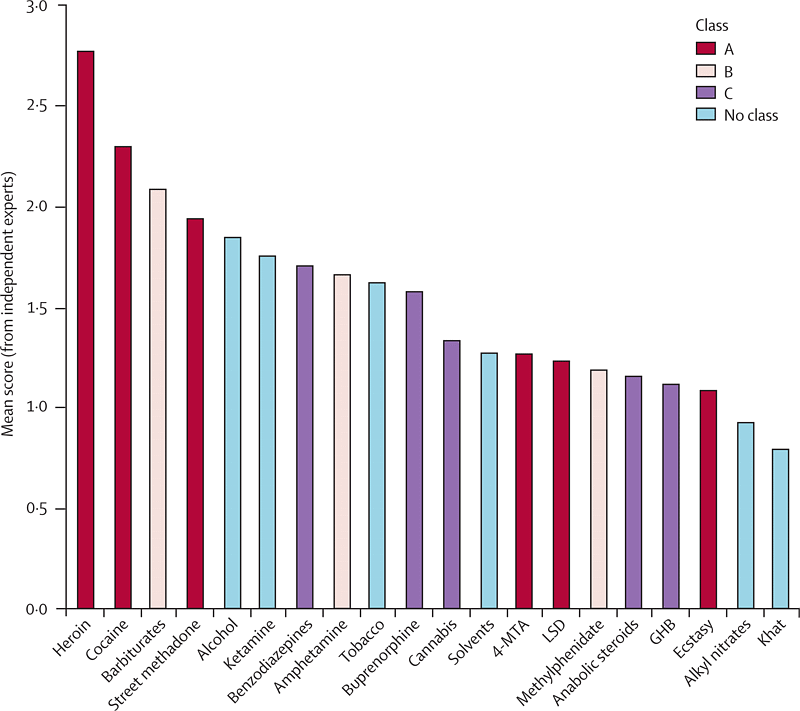
The Lancet this week published the long awaited paper on drug classification: ‘Development of a rational scale to assess the harm of drugs of potential misuse’ by David Nutt, Leslie A King, William Saulsbury, Colin Blakemore. Whilst the Lancet publishers will make you register to read it, those nice folks over at MAP have been good enough to put the complete text on their website for your reading pleasure.

This is the abstract:

Drug misuse and abuse are major health problems. Harmful drugs are regulated according to classification systems that purport to relate to the harms and risks of each drug. However, the methodology and processes underlying classification systems are generally neither specified nor transparent, which reduces confidence in their accuracy and undermines health education messages. We developed and explored the feasibility of the use of a nine-category matrix of harm, with an expert delphic procedure, to assess the harms of a range of illicit drugs in an evidence-based fashion. We also included five legal drugs of misuse (alcohol, khat, solvents, alkyl nitrites, and tobacco) and one that has since been classified (ketamine) for reference. The process proved practicable, and yielded roughly similar scores and rankings of drug harm when used by two separate groups of experts. The ranking of drugs produced by our assessment of harm differed from those used by current regulatory systems. Our methodology offers a systematic framework and process that could be used by national and international regulatory bodies to assess the harm of current and future drugs of abuse.

and this is the graph of harm rankings for the drugs they have considered:


The paper has had loads of media coverage focusing on the graph above (rather than the more interesting material about how they came up with it), mostly along the lines of 'alcohol more dangerous than ecstasy', or variations thereof. This minor media furore (‘Alcohol worse than ecstasy on shock new drug list’ blurted the Guardian on its front page) is a bit odd because it must be one of the most heavily trailed Lancet papers in history. Not only were the draft contents discussed in detail by the Science and Technology Select Committee drug classification inquiry report (see page 70), and ‘the graph’ published by them, but ‘the graph' has actually appeared as one of those jazzy front page tabloid splashes in the Independent. Last year. If you missed all that the Lancet paper was also discussed - in even greater detail - by the more recent RSA report which includes an entire section on ‘the Blakemore / Nutt hierarchy of harm’ (not sure what King and Salusbury think about that), and ‘the graph’, around which much of the recommendations are built. Some journalists either have short memories or they are banking on us having short memories - if you can get a 'shock' twice with the same story, why the hell not eh?

Anyway, the finished paper is undoubtedly a fine piece of work. It has very usefully put legal and illegal drugs on the same harm continuum (obvious really, but good to see it being said in the Lancet) and in doing so exposing the contradictions, lack of logic, and false assumption that underpin much drug policy thinking here and around the world. The matrix system they propose for ranking drug harms is definitely a good start. Clearly any system of regulation, be it sensibly based on established legal controls and public health principles, and stupidly based on criminal penalties and prohibitionist ideology, will require some sort of ranking system to make distinctions and policy decisions for different drugs.

I actually think it’s too simplistic, although to be fair, the authors do not claim it as the be all and end all. As discussed in more detail in the Transform briefing on drug classification:

Drug harms are mediated by the nature of the user, the dose of drug consumed and the method of consumption – making a system based upon broad sweep single classifications for each drug fundamentally unscientific, and meaningless in most practical terms.

So the whole idea that drug x is ‘more dangerous’ than drug y is only useful in the broadest population analysis. For an individual it’s fairly meaningless because, obviously, it depends how much of given drug you use, how often you use it, how you use it, whether you have a heart problem or mental health issues, and so on. There are still some oddities in the ranking (solvents, for example, seem too low to me), but it’s a massive leap forward from what we have at the moment which the authors politely describe as having ‘evolved in an unsystematic way from somewhat arbitrary foundations with seemingly little scientific basis’. If they were writing in a blog, not the Lancet, I suspect they would have said: 'it's a total joke'.

However, I take more substantive issue with the paper, not for what they covered, but for what they left out:

Firstly, the harms of a given drug will depend upon its legal status. The best way to demonstrate this point is with heroin, which is placed at the top of the Lancet-scale as the most harmful of all drugs. For street heroin this may well be the appropriate placing, but, if we are being scientific here, it is imperative to separate out the harms that follow from use of the drug per se, and the health and social harms exacerbated or created specifically by the drug's use within an illegal market. These, lets call them 'prohibition harms', include:

  • Contaminated/cut product (poisoning, infection risks)
  • Dirty/shared needles (Hep C / HIV risk)
  • Vast quantities of low level acquisitive property crime to support a habit: illegal markets inflate the cost of an essentially worthless agricultural product to one that is worth more than its weight in gold. People on prescriptions don't have to nick stuff.
  • Street prostitution (see above)
  • Street dealing, drug-gang violence and turf wars
  • Drug litter (needles in the gutter etc)

More useful would have been to rank both illegal street heroin, associated with the above harms which aren't going to help its ranking much, and prescribed pharmaceutical heroin, associated with none of the above harms. The latter would certainly be considerably further down the scale. Luckily, we can theoretically do this with heroin as both legal and illegal markets exist simultaneously in the UK, although the number of prescribed users (approx 400) is rather eclipsed by the number of illicit users (approx 250,000+). It’s a great shame the authors of this study failed to make that comparison (we do, confusingly, get 'street methadone' in the ranking, but not the prescription variety). It would have helped policy makers untangle the harms created by drug misuse from the harms created specifically by prohibition and had far wider implications for the future of the dominant criminal justice paradigm.

Some policy makers are wise to this legality/harm equation. During the Science and Technology Committee inquiry evidence sessions there is a revealing section where they are discussing the harm matrix with Proffessor Nutt and Sir Micheal Rawlins, Chair of the ACMD (at this point, 2006, it is still unpublished and available only in draft). Dr Harris MP raises the point that the classification a drug is given will impact on the level of social harms it is associated with:

Q188 Dr Harris: In this matrix you include under “social harms” intoxication, health care costs, and other social harms. Included under “other social harms” do you include the harm that stems from criminalisation itself?

Professor Sir Michael Rawlins: Yes.

Q189 Dr Harris: You do not spell that out but that is understood?

Professor Sir Michael Rawlins: Yes and whether it leads to acquisitive crime.

A couple of questions later…

Q 195 Dr Harris: Your recommendation recommending classification into a particular class creates social effects, does it not?

Professor Nutt: Indeed it does.

Q196 Dr Harris: Because obviously it brings criminal justice along with it and that affects the price and availability and so forth. Do you recognize that? Your own actions impact on the evidence. Did you feed that back in before you made the recommendation?

Professor Nutt: We know it might happen but you can never be sure how big an effect that might have.

When translated through the prism of the Misuse of Drugs Act the harm rankings become, to a significant degree, strangely self-fulfilling, as is evident in the case with heroin: The more you criminalise the drug (by moving it up the rankings) the more risky you make its use and more social harms you create associated with its illegal supply. Given there is no evidence that these increased harms are offset by any deterrent effect associated with classification the whole system seems even more bizarrely unscientific and unsustainable.

Colin Blakemore, one of the authors and chief executive of the Medical Research Council is quoted in the guardian saying:

"We face a huge problem. Drugs ... have never been more easily available, have never been cheaper, never been more potent and never been more widely used".

"The policies we have had for the last 40 years ... clearly have not worked in terms of reducing drug use. So I think it does deserve a fresh look”

This leads us to the second, arguably more serious problem with the paper. The rankings of drugs, with the anomalous exceptions of alcohol and tobacco, are defined within the Misuse of Drugs Act 1971 and primarily intended to determine the accompanying hierarchy of criminal penalties, and not to provide public health information to potential drug users.

The evident problem is that there is no meaningful evaluation of the outcomes of this unique criminal justice approach to public health regulation. We can have excellent science ranking drugs public health harms, as this paper presents, but then no science at all regards the outcomes of these rankings when they are implemented as criminal policy. As the authors have noted, the use and availability of illegal drugs has risen steadily under the current system. A more scientific ranking of harm is not enough: the whole prohibitionist legal framework needs to be reassessed as well. To immodestly quote myself in the oral evidence I gave to the Sci-tech Committee:

"I have been trying to think of a metaphor for this and the best one I can come up with is that it is like arguing over what colour to paint a square wheel. Even if all the experts agree it should be blue it does not matter because that wheel does not turn. The classification system does not do what it is supposed to do, it does not reduce harm, it does not reduce misuse, it does not reduce mental health problems. In fact it seems to do the exact opposite so the whole thing is an exercise in distraction"

In the short term I despair that anything at all will happen. The Government give the pretence of supporting evidence based policy on drugs, but when it clashes with their ‘political judgements’ or 'beliefs' that all goes straight out of the window.

In a follow up oral evidence session to the publication of the Science and Technology Select Committee’s devastating 2006 critique of the classification system, the committee re-interviewed Sir Micheal Rawlins, Proffessor Nutt, and the minister with responsibility for drugs, Vernon Coaker.

It’s a truly remarkable interrogation, with the Minister not having a leg to stand on when he is repeatedly challenged on the lack of evidence base for the classification system's effectiveness, or the justification for certain howling anomalies within the system. He falls back on evasion, changing the subject or the excuse of decisions being ‘political judgements’ , or worse, merely that it is his ‘belief’ that the system works. There is not even the pretence that the system is evidence based. I recommend you read it all (or look forward to other choice quotes popping up on the blog in the future), but for the time being here are some low-lights, just so you know what you're up against.

First is a section about the reclassification of ecstasy:

Q109 Mr Newmark: If the ACMD discovered new evidence when it undertook the review, would you consider reclassifying ecstasy?

Mr Coaker: We would consider their evidence. As I say, we have no plans to reclassify ecstasy. The ACMD is independent of government, we obviously respect what they say, and they will bring their report forward, but the Government has no plans and no intention of reclassifying ecstasy.

Q110 Dr Harris: You say that you do not propose to move ecstasy and it will remain a Class A drug. Is that an evidence-based policy?

Mr Coaker: That is a judgment the Government makes on the basis of what we believe to be something that is in the interests of the public at large to keep ecstasy as a Class A drug.

Q111 Dr Harris: Is it an evidence-based view?

Mr Coaker: It is a judgment that we make based on all the evidence we have had no recommendation from anybody to reclassify ecstasy from an A to a B. We think it is a drug which is harmful. There is no safe dose of it. We were talking about alcohol earlier on and one of the problems you have with alcohol is there probably is a safe dose. Like many here, I have a drink now and again, but there is no safe dose of ecstasy, we think it would send out totally the wrong messages and, as I say, we have no intention of reclassifying ecstasy.

Q112 Mr Newmark: Because it kills unpredictably?

Mr Coaker: As I say, there is no safe dose. This is the point, just half a minute—

Q113 Dr Harris: There is no safe dose of tobacco.

Mr Coaker: It just does make the point very well, the exchange that we have just had between two members of the Committee, quite rightly, about the difficulties that there are in this area and the different views and opinions that people have. I think what we all wrestle with is using evidence and using science and also trying to think about it from a non-scientific point of view in the social judgments and the individual judgments and the community judgments that we make. We wrestle with that and, as I say, as a Government we have no intention of doing anything with respect to ecstasy because we do not believe there is a safe dose, it is harmful, it kills unpredictably, as Brooks has said, and we just think that it is a very important way to use the classification system.

Q114 Dr Harris: If the ACMD reviewed the evidence and that review made recommendations to you, are you saying now it is not worth them doing it because your decision on this will not be evidence based, it will just be a reassertion of your "no intention to reclassify ecstasy"? Even if they said there will be fewer deaths, for whatever reason, if it is reclassified, are you saying that you will never consider an evidence-based decision on this drug?

Mr Coaker: I am not saying that at all. What I am saying is the ACMD, of course, can conduct research and look at whatever they wish to with respect to drugs and make recommendations to the Government. What I am saying quite clearly is that we have no intention of reclassifying ecstasy.

Q115 Dr Harris: I am keen to pursue this one. I understand you have no intention and I assume that is current because I do not think you could bind your successors if the evidence changed. Is it your view that all drugs for which there is no safe dose should be in Class A or is there something special about ecstasy which means it is one of the drugs for which you say there is no safe dose which means it must be in A?

Mr Coaker: In talking about ecstasy, it kills unpredictably, we do not believe that there is a safe dose; we will not reclassify ecstasy.

Q116 Dr Harris: Does that apply to all drugs that meet those criteria?

Mr Coaker: What we try to do where we have evidence and where people come to us with recommendations is make individual judgments, as we will do whenever people come to us. All I am saying with respect to ecstasy is that we have no plans and no intention of doing so.

Q117 Dr Harris: So do you think you are wasting your time, Professor Rawlins, if you end up doing a review in this area?

Professor Sir Michael Rawlins: No, I think we will give advice on whatever we feel is appropriate but perhaps in a way more importantly we will also be able to, I hope, give better advice on harm reduction, which is actually rather important, and on what further research is needed in order to understand the dangers of it.

Q118 Dr Harris: Will the fact that the Minister has said quite categorically that he is not going to change the classification have any bearing on whether you follow through and do a report?

Professor Sir Michael Rawlins: None at all because we are going to do it.

Now here is a second section from slightly earlier in the session. Creationism gets a mention in reference to the Minister's scientific discourse; it seems an appropriate comparison (and couldn't help but remind me of this).

Q45 Chairman: Vernon, in response to us, you said that the Government "fundamentally believes that illegality is an important factor when people are considering engaging in risk-taking behaviour . . . It believes that the illegality of certain drugs, and by association their classification, will impact on drug-use choices". Where is the evidence for that?

Mr Coaker: That is the belief and the judgment that the Government have.

Q46 Chairman: I did not ask you that. People believe in creationism and they are entitled to do that, though I do not agree with that, but I am asking you, where is the evidence?

Mr Coaker: To be fair to the response that we tried to make in response to the Committee where the Committee has challenged us, we have ourselves said that we need to do more research into the deterrent effect, that we need to establish a better evidence and research base for that, so we have accepted the point of the need to actually do something about it, but we do believe, and strongly believe, that the classification of drugs in the current system, A, B and C, with respect to Class A does act as a deterrent system. That is a judgment we make, it is a belief that we have and we have accepted that there is more to do with respect to that.

Q47 Adam Afriyie: If when you carry out and conduct this research the evidence shows that you are completely mistaken in that view, will change your view?

Mr Coaker: I cannot prejudge what any research is going to tell us. Clearly you make judgments about the research that you receive and that is obviously the point.

Q48 Chairman: Vernon, you have not commissioned any research and nor have the ACMD.

Mr Coaker: No, but what we have said in response to where the Committee challenged us and said, "Where is your evidence base for that?", as we have done with a number of other things, we said that we understand that point, we accept that point and we need to look at establishing a better evidence base for that, but it does not alter the fact or change the fact that the Government believes that the tripartite system, the classification system, does send out a strong message and does impact on, and affect, behaviour.


Thursday, March 22, 2007

UN INCB is 'obstacle' to HIV prevention and drug treatment programs

A report published today by the Canadian HIV/AIDS Legal Network (part of the Open Society Institute Public Health Program), titled 'Closed to Reason: the International Narcotic Control Board and HIV / AIDS' strongly criticises the INCB, the nominal enforcement body for the UN drug conventions. It accuses the INCB of becoming 'an obstacle to effective programs to prevent and treat HIV and chemical dependence' . The bizarre politics and machinations of this strange UN entity make for often shocking reading. The summary findings and recommendations are copied below. They should be of immediate and urgent concern to all members states:


Key findings and recommendations

The role of drug policy has been transformed since the era in which the International Narcotics Control Board (INCB), the 13-member body responsible for monitoring compliance with the United Nations drug conventions, was conceived. In a time when an estimated 30 percent of infections outside of Africa are due to injection drug use, drug policy is fundamental to the success or failure of the international response to HIV/AIDS. A significant body of scientific evidence has shown the importance of measures such as effective treatment for chemical dependence and provision of sterile syringes in preventing HIV. The INCB, which emphasizes its impartiality, independence and reliance on evidence, has an historic opportunity to help stop the injection-driven HIV epidemics now emerging and exploding in much of the world.

Instead, the Board has become an obstacle to effective programs to prevent and treat HIV and chemical dependence. INCB annual reports are rife with omissions and misrepresentations and lack both scientific documentation and justification for legal opinions. Country visits by INCB representatives fail to highlight law enforcement patterns that accelerate HIV transmission and represent clear human rights violations. Although the Board is responsible for ensuring the global availability of legal opiates, it has not acted to help countries accurately estimate their need for the opiate substitution treatment shown to be effective in reducing HIV risk and increasing adherence to antiretroviral medications.

The Board stresses the drug control aspects of its mandate. Its annual report for 2005, however, refers 18 times to the role of drug use in accelerating HIV transmission in various countries. Tellingly, that report, like other INCB documents, fails to urge countries to pursue proven strategies to reduce HIV transmission among people who inject drugs. While the UN drug conventions clearly mandate treatment for drug users, the INCB has remained silent on the shortage of effective chemical dependence programs, and the abuses committed in the name of drug treatment and rehabilitation.

The United Nations system as a whole is committed to reducing HIV among people who inject drugs, to safeguarding the human rights of people who use drugs, and to increasing accountability and civil society involvement. In this context, the INCB is an anomaly: a closed body, accountable to no one, that focuses on drug control at the expense of public health and that urges national governments to do the same.

INCB members contradict or seek to thwart evidence-based recommendations of other UN bodies and representatives.
  • INCB members have spoken out against sterile syringe programs and opiate substitution treatment, despite findings by the Joint United Nations Programme on HIV/AIDS (UNAIDS), the World Health Organization, the United Nations Office on Drugs and Crime (UNODC) and the INCB itself that these measures are effective and important components of HIV prevention.
  • In 2002, the president of the INCB claimed, erroneously, that distribution of sterile syringes contravened the UN drug conventions. In 2005, a memorandum signed by an INCB member from Russia included numerous misstatements of fact meant to discredit the use of methadone as a treatment for opiate addiction.
  • The Board has sought to silence UN representatives who support a fuller range of HIV prevention approaches. In 2006, for example, Stephen Lewis, the UN Secretary-General’s Special Envoy for HIV/AIDS in Africa, commented favorably on Canadian data showing that a Vancouver safer injection facility had reduced HIV risk. The next day, he received an angry telephone call from the INCB Secretariat and a promise that the Board would write to the Secretary-General to urge that Lewis be censured for support of “opium dens.” In that letter, the INCB president expressed disbelief that “any officer of the United Nation [sic] could have made such statements,” and demanded that Lewis recant.

INCB reports praise governments that violate human rights.

  • A Board delegation visited Thailand in 2004, several months after police forces began a “war on drugs” in which human rights experts documented extrajudicial executions, arrest quotas, use of blacklists, and the internment of tens of thousands of people, including many with no history of drug use. In its report issued after the visit, the Board did not condemn the mass arrests; instead, it expressed appreciation for the Thai government’s efforts to investigate the killings, despite findings by human rights groups that the government had failed to allow any independent investigations.
  • In 2004, after Bulgaria mandated imprisonment for possession of any amount of any illicit drug, fear of arrest caused rates of drug injection and syringe sharing to increase sharply. INCB representatives visited Bulgaria in 2005, but the Board’s report made no mention of the harsh drug law or its impact, noting instead that national drug control legislation was “well-developed.”
  • In Russia, authorities in 2005 moved to reverse a reform that had reduced the numbers imprisoned for very small amounts of drugs. Wholesale and prolonged incarceration had been recognized as contributing to both penitentiary overcrowding and the fact that Russia’s HIV epidemic was among the fastest growing in the world. INCB representatives visited Russia during this debate, but the Board’s subsequent report made no mention of any discussion of the issue or of concern about the human rights implications of the policy. Instead, the INCB expressed concern about the extent of drug abuse in Russia, and encouraged coordination and cooperation between HIV and drug treatment services.
  • Since 1990, China has marked the UN’s International Day Against Drug Abuse and Illicit Drug Trafficking with show trials in which drug dealers are sentenced to death, sometimes as crowds chant “kill, kill.” Scores have been executed. Despite professed support for sensitive policing, the INCB has failed to criticize either this practice or the police harassment of those seeking to obtain sterile injection equipment, whether in China or in other countries visited by the Board.

The Board stresses drug control at the expense of public health, expressing concern about diversion rather than praise for scientifically proven measures that reduce HIV and other harms.

  • While acknowledging that WHO added methadone and buprenorphine to its Model List of Essential Medicines in 2005, the Board has made no public effort to promote opiate substitution treatment (OST) in countries where large numbers of people inject drugs. It also has failed to highlight OST as an essential tool in HIV care or treatment. Although Ukraine, China, Malaysia and Iran have moved in recent years to expand OST programs and/or needle exchange programs to contain HIV, INCB reports have not expressed appreciation for or satisfaction with these developments. Instead, the Board has expressed concern about diversion of methadone and buprenorphine, and urged WHO to advocate for tightened controls on these medications.

The Board issues interpretations of law and pronouncements on harm reduction, despite a lack of expertise in international law and HIV policy.

  • According to their published biographies, none of the Board’s 13 members has formal training in international law, despite the importance of such credentials in interpreting treaty provisions. In the case of substitution treatment, needle exchange, and safer injection facilities, the pronouncements of INCB members have contravened the fi ndings of the Board’s own legal advisors and national experts.

  • Despite the centrality of drug use to HIV transmission, none of the Board members has published in peer-reviewed journals on HIV/AIDS, and few list any experience of HIV treatment or prevention in their biographies.

The Board conducts operations in secret, and without mechanisms for accountability.

  • INCB meetings are closed to observers, and no minutes are available.

  • INCB members have used their Board affiliation when making misstatements of fact, yet no public mechanism exists for member states or community organizations to contest claims, seek clarification, or offer amendments.

  • Sources are selectively and inconsistently documented in INCB reports.

  • The INCB does not publicize country visits in advance or convene public hearings or other opportunities for input.

  • Despite the UN Secretary-General’s call for greater transparency and interaction with civil society at the UN, the INCB’s website includes no information on the Board’s budget or staff.

  • The INCB Secretariat — paid for by the UN — is unresponsive to requests for information from affected communities or non-governmental organizations.


Recommendations

  • To improve accountability, address the HIV epidemic, and meet its mandate to assess compliance with the UN drug conventions, the INCB must change.

  • The INCB should regularly assess the supply and adequacy of treatment for chemical
    dependence. It should provide technical assistance to help countries accurately estimate the need for opiate substitution treatment, support governments that are striving to scale up such treatment, and encourage governments that have yet to provide these life-saving therapies to find safe and effective ways to do so.

  • The INCB should cite scientific evidence for its observations about drug use and health, and legal grounds for its interpretation of law. It should provide sources of information for its annual reports, and opportunities for UN member states and civil society groups to offer corrections or additional information.

  • The INCB should provide greater opportunity for exchange with UN member states, UN
    agencies with relevant mandates, civil society, and HIV/AIDS experts. INCB country missions should include greater opportunities for engagement with these groups.

  • The World Health Organization, the UN Economic and Social Council (ECOSOC) and UN member states should ensure that INCB members include persons with expertise in HIV/AIDS policy and international law.

  • The INCB should articulate, and ECOSOC should evaluate, public guidelines to clarify when INCB members are speaking for the Board, and how misstatements of fact can be corrected.

  • The UN Secretary-General should commission an independent evaluation of the INCB, including a scientific evaluation of the Board’s statements on health, and an examination of Board members’ independence and expertise, with particular attention to HIV, international law and human rights.

Wednesday, March 21, 2007

Bizarre 'Bong Hits 4 Jesus' case reaches US Supreme Court

File under: only in America

On Monday, March 19th, the Supreme Court of the United States heard oral arguments in the case informally known as "Bong Hits 4 Jesus." High school student Joseph Frederick was subjected to school suspension for his display of a homemade banner while standing across the street from school property, albeit during normal school hours.


clearly one for the highest court in the land


While initial court rulings held in favor of the Juneau, Alaska school district, the Ninth Circuit Court reversed in favor of Frederick. The Ninth Circuit determined that the school district did not have the right to unduly restrict the public demonstration by Frederick when he elected to unfurl and display his 14-foot banner with the words, "Bong Hits 4 Jesus."

The school district appealed to the Supreme Court. Their case is being led by none other than Kenneth Starr of Clinton impeachment notoriety. the US based Media Awareness project has already archived a number of news clippings covering Monday's oral arguments in Washington, as well as some opinion items. These, and additional clippings during the days ahead, can be found here.

thanks to drugsense

a short fim of news coverage of provided by Student for Sensible Drug Policy (US)

Tuesday, March 20, 2007

Prohibition 'not effective' claims Australian Crime Commission

This well written piece by The Age, reports on the Federal Parliamentary Joint Committee on the Australian Crime Commission. Their recent ‘Inquiry into the manufacture, importation and use of amphetamines and other synthetic drugs (AOSD) in Australia’ has a very interesting intro to the main conclusion: "prohibition, while theoretically a logical and properly intentioned strategy, is not effective".

This didn’t sit easy with the current Australian government. The Age suggests the sensationalised climate that politicians have to work within makes them fearful of entering a rational debate on drugs. A problem we’ve hit on time and time again.

However, there is a glimmer of hope. There is a train bound for a world based on reality and a growing number of politicians from across the political spectrum are happily taking luncheon in the dining carriage.

This is good news because coming soon is a major new document produced by Transform with the sole aim to aid rational debate on drug policy. ‘Tools for Debate’ will be a groundbreaking point-of-reference for anyone wishing to challenge non-rational policy positions, no matter how persuasive the rhetoric.

Watch this space.

Sunday, March 18, 2007

How the Independent on Sunday got it horribly wrong on Cannabis

The Independent on Sunday jumped on the skunk-panic bandwagon this weekend with a brash tabloid headline: 'Cannabis - An apology', above a figure of 10,000 in big red letters - which we are informed is the number of teenagers treated for 'cannabis addiction' last year, apparently ten-fold higher than back in 1997. Inside, along with almost five pages of news coverage, there are opinion pieces by Rosie Boycott (the IOS editor who launched their cannabis legalisation campaign 10 years ago) psychiatrist Robin Murray, and a leader in which the they retract their support for Boycott's legalisation campaign - hence the front page headline.


They've totally missed the point.

1. The facts are all over the place. On the front cover Jonathan Owen informs us that skunk today 'is 25 times stronger than the resin sold a decade ago'. In the main feature this has become 'can be 25 times stronger'. A few paragraphs later we later that a cannabis joint 'may contain 10 to 20 times more THC than the equivalent joint in the 1970's'. Rosie Boycott tells us a few pages later that it is 30 times stronger and Robin Murray that the traditional 2-3 % THC of herbal cannabis in the 70's compares to 15-20% (occasionally as high as 30) in today's skunk. Who should we believe?

Actually they are all wrong. In the 70's, as with today, there was a range of cannabis products - herbal and resin - available on the market and they varied in strength from very weak to highly potent. Drugscope reported just last week that most of what was being sold as 'skunk' today is around 10% and that the stronger varieties were comparatively rare because they took longer to grow (increasing production costs) but commanded the same street price. So compare the 'worst' weed from the 70s to the 'best' today and you'll get your scary '25 time stronger' headline. In reality however the average 'weed' from the 70's was probably more like a third to a half the strength of most of today's skunk.

But the true picture is more complicated than this. Skunk is by no means the entire UK market, a large proportion of which is still 'old school' imported weed of the 3-4% variety and a larger proportion being low grade resin (soap bar etc.) also of low single figure % strength. The strongest stuff from 'back in the day' was way stronger than the low grade resin still widely available today. It depends how you spin it.

So lets be clear - the idea that cannabis was weak and harmless in the old days, and has now morphed into super-potent deadly psychotabis today, is just not true. That is oversimplification and hype for sake of a juicy media or political soundbite. An almost identical misleading potency panic took place in the US in the late 1980's : 'Now perceived as a hard drug, marijuana has increased 1,400 percent in potency since 1970' proclaimed the 1986 flyer for a US national marijuana conference.

More potent hydroponically/indoor cultivated herbal cannabis was also already widely available in 1997 , and whilst it is now unarguably more prevalent, the fact that it is mostly UK grown today rather than imported makes no difference to the consumer (if anything the home grown skunk is actually weaker than the equivalent product formerly imported from Holland).

The change in the market over the last ten years is nowhere near as dramatic as the IOS report seems to suggest, and can certainly not account for the 10 fold increase in 'cannabis addiction' that they attribute to it. Indeed this is another extremely dubious statistic (not to mention the reckless and ill defined use of the term 'cannabis addiction'). Not only does the change from 1000 teenagers being treated for 'cannabis addiction' in 1997, to 10,000 last year all seem to deploy conveniently, almost suspiciously, rounded numbers - but as is acknowledged in the papers leader - this rise is significantly due to changes in service provision. It is also due to the way cannabis related problems are diagnosed and counted: of this supposed 10,000 'cannabis addicts' how many are being treated primarily for mental health problems or misuse of other drugs but have also noted cannabis use (practically universal to both groups), or are in treatment as a result of the new and massively expanded arrest referral schemes? We are not told.

2. They fail to understand how drugs are used. The implication of the repeated 'fact' that cannabis today is 10/15/20/25/30 (take your pick) times stronger than it used to be is that people are consuming an equivalent increase in the main active ingredient THC. This is also not the case. Robin Murray describes the comparison between the weed of old and modern skunk as similar to comparing lager and whisky (Owen makes a similar comparison with shandy and brandy). But people don't drink whisky or brandy in pints. If a drug is stronger they consume less, weaker they will consume more - to achieve the desired level of intoxication. In the case of stronger cannabis users will put less in the joint, take less drags, inhale less deeply, smoke less joints and so on. This is called auto-titration and is exactly the same effect seen with low nicotine cigarettes which it was found users smoked more of, inhaled more deeply and so on. The effect was discussed regarding cannabis during the last potency panic in a 1988 paper in the Journal of Psychoactive Drugs which concluded that:
"Observations of the real world of marijuana use, where autotitration is the norm, renders the scare tactics of the new marijuana proponents not only inaccurate but irrelevant. There is much published evidence about the availability of highly potent varieties of cannabis from the nineteenth century through the present day"

The idea that cannabis users, even teenagers, are incapable of making rational decisions about the dosage they consume is ridiculous, and the idea that they are getting 25 times more stoned than in the good old days is laughable. This is not to say that increased potency does not equate to any increase in risk, it does, but behaviours adapt surprisingly rapidly and hyping the potency panic or hyping the dangers associated with actual potency changes don't help us come up with rational public health responses that might actually help reduce overall harm. It needs pointing out for example that in Holland where cannabis is effectively (albeit not technically) legal, the licensed premises that sell it offer a wide range of cannabis varieties of differing potencies, and the strongest ones are far from the most popular. And they have a far lower level of youth cannabis use than here in the UK.


3. We haven't suddenly 'discovered' that cannabis is related to mental health problems. The IOS report doesn't 'Reveal' anything new at all. You can look at text books and commission reports from the as far back as the 1920s that document symptoms from cannabis use that are actually remarkably similar to those we have today. They say that for most people the risks of occasional use are low (certainly relative to most other commonly used recreational drugs) but that heavy use, particularly for a small sub-set of users with pre-existing mental health problems or certain other vulnerabilities, presents real dangers of exacerbating existing problems or potentially precipitating new ones. These problems include psychotic episodes (occasionally recurring), schizophrenia and so on. These are the same conclusions that have been reached by innumerable studies and reviews over the last hundred years, most recently two undertaken by the Advisory Council on the Misuse of Drugs which came before and after the drug's UK reclassification from B to C: For most people the risks are minimal, but for a few they are very real, particularly for certain vulnerable groups, and particularly when associated with high levels of use. Guess what? Drugs can be bad for you.

The research into cannabis has continued unabated and our understanding is getting increasingly sophisticated, even though establishing the causal links between certain patterns of use and certain conditions remains problematic. The impression that there has been a sudden emergence of new knowledge is more a reflection of the unprecedented attention focused on the cannabis issue since the cannabis reclassification debate kicked off in 2001. Many opponents of the Government or the reclassification have sought to highlight emerging research in the media, often misrepresenting ambiguous conclusions as direct causal links.

Even if it's all true - what exactly is the IOS recommending? Ignore all other tedious witterings above for a moment and let's assume that cannabis really is 25 time stronger than 10 years ago and this really has led to a ten fold increase in teen cannabis addiction (whatever that might be). What does the IOS then recommend in its leader as a response to the policy disaster under which this skunk apocalypse has emerged?

Nothing: They say the the current policy is 'about right'.


Do we get an exploration of policy alternatives or a consideration of progressive policy in other European countries where the problems are markedly smaller? No. Instead we are told that the 'the fact possession of cannabis - and other drugs - is illegal acts as a important social deterrent'. You have to wonder what they have based this on. Could it be the massive rise in use of all illegal drugs since 1971? Could it be the the Police Foundation report of 2000 that concluded:

"such evidence as we have assembled about the current situation and the changes that have taken place in the last 30 years all point to the conclusion that the deterrent effect of the law has been very limited"
maybe it was the 2006 Science and Technology Select Committee that concluded:

"We have found no solid evidence to support the existence of a deterrent effect, despite the fact that it appears to underpin the Government’s policy on classification"
Perhaps it was Professor David Nutt, Chairman of the ACMD Technical Committee when he said: "I think the evidence base for classification producing a deterrent is not strong"

Maybe it was the fact that when challenged by the Sci-Tech select committee the Government were unable to produce a single shred of evidence for such a deterrent effect, and have undertaken no research to find any. I could go on, but needless to say The IOS has similarly failed to produce anything to back this claim up.

This all points towards to the biggest mistake the IOS makes in this whole sorry piece, which is to confuse their legitimate concern with the health impacts of cannabis misuse amongst a small group vulnerable young people with support for a failed ideological prohibitionist policy - rather than support for an evidence-led regulatory response based on public health and harm reduction principles. They advocate a policy that has not only created many of the problems they describe (lets face it, hype), but also one that offers no prospect of sorting them out.

The IOS seem blind to the fact that the emergence of potent indoor cultivated cannabis is itself a manifestation of the illegal market they are now supporting. In a similar fashion to the prohibition-fuelled emergence of crack cocaine, stronger varieties of cannabis (whilst they have always been available) are more expensive and consequently more profitable for the increasing number of small to medium scale indoor growers.

The IOS, despite noting that: 'the rhetoric of the 'war on drugs' tended to distort priorities', then deems it appropriate to maintain the blanket criminalisation of millions of non-problematic occasional users, because of a relatively tiny population of vulnerable teenage heavy users who have problems with the drug. This is akin to banning cars because of a small population of teenage joyriders. It has no legal precedent or ethical basis, it's inconsistent and makes no sense. They don't call for the mass criminalisation of alcohol because of growing teen drinking issues, so what are they doing? If they are so convinced by the deterrent effect of enforcement and if the skunk problem is so awful, why not call for doubling of sentences or show these young'ns the error of their ways by throwing them all in jail?

The IOS also perpetuate the misunderstanding that the cause of cannabis legalisation/regulation is based on the fact that cannabis is harmless - a misunderstanding arguably due in part to the mistaken approach of Rosie Boycott's initial campaign and its rather romanticised view of cannabis use. No serious advocates for drug policy and law reform do so on the basis that any drug is safe (to her credit Boycott's opinion piece reflects the increasing sophistication of her argument ten years on). On the contrary - reformers argue on the basis that all drug use involve risks and that is precisely why they need to be appropriately regulated and controlled by the State, so as to minimise the harms they cause. The IOS apparently wants the multi-billion pound drug markets to remain in the hands of criminal gangs and street dealers. Because that should help protect the kids.

Nowhere in the IOS coverage do they mention the fact that the authors of the key recent studies linking cannabis and mental health problems are advocates of legal regulation for precisely the reason described above (see Transform's 'cannabis reclassification revisited' briefing for more detailed discussion and references on this point). Perhaps there wasn't room for this discussion because all the space had been taken up with noddy-science cross-sections of brains, and lists of unreferenced cherry-picked statistics.

Cannabis use is a real public health issue, and the growing culture of young people misusing it a real concern, even if total numbers seem to have levelled off or even fallen marginally since reclassification. Hyping the problem for the sake of good story, however, is totally unhelpful, and calling for more of the same when the current policy has been such a manifest failure is even less so.

This was a lazy piece of sensationalist journalism and a pathetically weak and ill thought out leader. Dissapointing and mystifying for a supposedly progressive thinking paper.

Read the follow up here: The Independent's born-again drug war: Round Two

Tuesday, March 13, 2007

RSA Drugs Report - so near and yet so far

The RSA published their long awaited drugs report last week to not a little fanfare. The report suggests that the current policy is based on ‘moral panic’, suggests that most drug use is relatively harmless, that tobacco and alcohol should be included in the drug policy making process and that prohibition cannot stop people using drugs – they are here to stay.


It will be seen as a watershed report in raising the level of debate on drugs and drug policy in the years to come. The Commissioners are to be congratulated for producing a groundbreaking report. You can read the press release , the exec summary, or the full volume here and judge for yourself.

In my op-ed for the Guardian online I argue that it is the politics of prohibition that makes it so difficult for politicians to engage with Reports like the RSA's.

And in the Mirror I ask whether we are adult enough to engage in a public debate on the efficacy of repealing prohibition and replacing it with legal regulation

The RSA analysis could easily be the basis for a Phd on the repeal of prohibition and its replacement with a far more effective system of legal regulation and control. But that is not quite where the RSA report takes us. I’ve identified a number of reasons why I think that the report fails to reach what should have been its natural conclusion.

A fundamental mistake: not nailing the problem

My experience of commenting on drug policy issues is that the failure to identify prohibition as the overriding problem leads to convoluted and internally inconsistent solutions. Unfortunately the Report fails to recognise that it is prohibition that is the radical and anomalous response to drugs and that regulation is the policy response that conforms far more closely to social and legislative norms.

Oddly, prohibition seems to be identified as not being ‘viable’ very early on in the report but the analysis is not developed. This is a quote from the report (p 29) that would lead us to believe that there is only place that the analysis could go:


“As readers of our report will quickly discover, all of our recommendations and suggestions are founded on two core beliefs. One is that drugs and other psychoactive substances are simply not going to go away. People have used them for thousands of years, widespread demand exists, supply is plentiful, and the illegal-drugs industry, not to mention the alcohol, tobacco and legal drugs industries, are among the best organized and most market-oriented in the world. Prohibition is no more a viable policy in Britain today than it proved to be in America during the 1920s and 1930s.With regard to illegal drugs, young people, in particular, are often told ‘Just say no’. That may sometimes be good advice. The only trouble is that there are, and always will be, large numbers of people who, for whatever reason, ignore that advice and choose to say yes. Drugs are a fact and, in our view, need to be accepted as a fact. We believe, as our choice of title suggests, that policy and the administration of policy should be based on a cool appraisal of the facts, not on fantasy and wishful thinking. In the words of Reinhold Niebuhr’s famous prayer:

God, give us the serenity to accept what cannot be changed;

Give us the courage to change what should be changed; and

Give us the wisdom to distinguish one from the other.”

But whilst no one claims it will be easy or happen overnight, history clearly shows that prohibitions can be changed. If drug prohibition is ‘no more a viable policy in Britain today than it proved to be in America during the 1920s and 1930s’ then the logical conclusion is surely that it should be repealed and replaced with something more viable. What it might be replaced with takes us to the next point.

A new Substance Misuse Act?

The failure to identify prohibition as the key problem leads to some confusion about what the legislative framework is for. The Report recommends that all drugs come under one new Misuse Act. Leaving aside the fact that the report suggests that most drugs are used rather than misused, what would be the point of putting all drugs into one piece of legislation if some are prohibited and some are legally regulated? It would end up being nothing more than a list.


Not dealing with supply side

In one of the their discussion documents (produced in the run up to the final report and available here) titled 'The supply of illegal drugs in the UK' , under the 'points to consider' section, the Commission notes:


"1. HM Revenue and Customs estimate that we spend 1 billion + per year trying to control the supply of drugs. Given the difficulties in the path of these efforts, can we really say that our enforcement policies are motivated by practical considerations, or are they moral ones? Are we pursuing a policy of supply reduction because we think it will work, or because we think drug dealing is wrong and should be punished?"
they then ask:


"Is legalisation of the drugs trade the only real way of controlling the supply of drugs? – (e.g. by creating a trade which could be regulated and taxed and could guarantee stable prices and safer drugs, which would not require a smuggling network that can be used for other illicit trades, which would not be surrounded by a gun culture, etc.)"

This question of supply seems to have been lost when it came to writing the final report. What is called for seems deliberately ambiguous, hinting at the obvious but terribly wary of being explicit about it:


"Drugs policy should, like our policy on alcohol and tobacco, seek to regulate use and prevent harm rather than to prohibit use altogether. Illegal drugs should be regulated alongside alcohol, tobacco, prescribed medicines and other legal drugs in a single regulatory framework."

Strangely the Commission opted for regulating use rather than supply. Perhaps it was a case of committee syndrome, where dissent forced a somewhat unsatisfactory and woolly compromise around the prohibition / regulation question? When asked at the launch event last week, Anthony King said the committee felt that it was for ministers and civil servants should be sorting out the specifics for each drug. Perhaps this is fair enough, yet it is at odds with the very specific recommendations in much of the rest of the report.

The committee received various reports from Transform, including our own (referenced by the RSA) aswell as reports from the Health Officers of British Colombia and the King County Bar Association - which provide very clear and detailed analysis of how legal regulation of different drugs would work - from a public health and legal standpoint respectively. This was a missed opportunity to introduce some clarity, nuance and sophistication into the debate about regulatory alternatives to prohibition - and the flirting around the issue without nailing it makes for frustrating reading when the much of the other analysis is so spot on.

Why no recommendation of cost-benefit analysis?

From the report (p 113):


"The most recent version of the strategy is the Updated Drug Strategy 2002. Its overall objective is ‘reducing the harm that drugs cause to society – communities, individuals and their families’. This objective is anchored in a philosophy of prohibition. The opening paragraph of the summary of the strategy states: ‘We have no intention of legalising any illicit drug. All controlled drugs are dangerous and nobody should take them.’ What is missing from all these accounts is a detailed analysis of the cost-effectiveness of the drug strategy itself. Basic calculations have been published of the ratios between the costs of drug interventions and their savings in terms of health and social costs. But Christine Godfrey, co-author of the key study of the economic and social costs of drug use mentioned above, has argued that a really robust and thorough-going cost-benefit analysis should be a priority for government.

Failure to complete this analysis makes it impossible for policy makers to consider alternatives to existing policy by comparing the costs of the current strategy with the estimated future costs of other options, whether these be decriminalization, legalization or zero-tolerance. We agree with Professor Godfrey.
It is dissapointing and inconsistent then that the report did not call for such a cost-benefit analysis (of current policy and alternatives) in its recommendations. Transform called for just such an audit in 2002.

The decision to keep the remit domestic rather than international

There is a significant problem in attempting to review and recommend change from a narrow domestic viewpoint. The UK is committed to international prohibition in the form of the three UN drug conventions to which we are signitories, and it is these that creates the vast globa lillegal drug markets and associated problems. The RSA report shows that the significant price hike in heroin and cocaine occurs between production and domestic wholesale. But calls only for enforcement to be focused on Mr Bigs. (p 13):


"The fight against the supply of illegal drugs should not stop, but it should be refocused so that it concentrates on organized criminal networks rather than on largely futile efforts to interdict supply."
Whilst no one is suggesting enforcement should ignore violent gangsters, unfortunately all the evidence shows that this is futile at interrupting drug supply too, on the basis that the trade is so lucrative that there is always a queue of gangsters waiting to make a killing by moving into the vacuum successful busts will occassionally create. Furthermore it is prohibition that creates the opportunity for gangsters in the first instance - just as it did with non-viable alcohol prohibition. Transform believes that it is impossible to truly understand domestic drug policy unless it is placed in its global context.

Weak analysis of drugs and crime link

The failure to ‘nail’ prohibition as the specific first cause of the link between drugs and crime appears to be a major fator in the Commission's avoidance of calling for its repeal. Although it cites the £16 billion annual crime costs committed by a few hundred thousand heroin and crack users fundraising to support a habit, it fails to identify prohibition as the culprit. The report does call for heroin prescribing (what is that if not legal regulation of a currently illegal drug?) for the usual familiar reasons including reduction in offending - but still fails to make the link explicit. Prohibition directly causes almost all 'drug-related crime' - they really needed to make the point much more clearly.

We are left with what is undoubtedly a thoughtful and throrough report, but also one that walks you to the door but isn't quite willing to suggest you walk through, that does all the hard work and then fails to quite see it through. It doesn't dare go the one step further than the similar reports from the Police Foundation (2000) or the Home Affairs Select Committee (2002), that would have marked it out as historic. Arguably, the HASC went further by at least recommending the Government 'initiate a debate' on 'legalisation and regulation' 'at 'UN level'.

Overall the thrust of the Report has created a significant window of opportunity to scrutinise the failings of current policy. It is now up to those with a vision of prohibition's replacement to use this opportunity to increase the momentum toward a more effective system based upon regulation and control of supply. Despite our criticisms, thanks must go to the RSA for opening up the debate once again.

Media comment on the report:


Alice Miles in the Times suggests that the Commission has been equivocal over its attitude to alcohol

Mark Lawson in the Guardian doesn’t quite get it


Telegraph leader


Guardian leader

Independent leader

Monday, March 12, 2007

Major new meta-analysis of public opinion polls on drugs and drug policy

A new information page has been added to the fact research guide (on the main Transform website), concerning ‘public opinion on drugs and drug policy’.

This new page has been made possible by the first ever published collection and analysis of opinion polls on drug policy and law from around the world. Titled 'Attitudes to Drug Policy and Drug Laws: A review of the international evidence' . This unique meta-analysis is the most comprehensive research yet undertaken on the subject, produced by Dr Russell Newcombe, who has been diligently (you might think obsessively – it clocks in at 91 pages, pdf format) compiling a huge range of studies from the past 15 years.

This report, published online exclusively by Transform, spans research on attitudes to drug policy and drug laws, covering America, Oceania, Asia, Europe, and the UK, as well as providing details of attitudes within key professions and demographic groups. It identifies important trends, suggesting that public opinion is becoming more informed about drugs and drug policy, and crucially, more open to reform.


This graph compares the poll results commissioned by different organisations because there is no centralised year on year data collected. It has been compiled by Dr Russell Newcombe as a supplement to the report linked above; ‘Attitudes to Drug Policy and the Drug Laws, A Review of the International Evidence’.

Sunday, March 11, 2007

Nursery School Children To Be Taught Dangers of Drugs

The Scottish council, West Dunbartonshire Council , has just paid £20,000 to a scheme called High 5 Lifestyle which is an anti-drugs message for children too young to write but presumably old enough to be inculcated with whatever it is that the High 5 Lifestyle preaches . The author of this scheme, Alistair Ramsay, previously worked for an anti-drugs organisation which the Scottish Executive has just scrapped. The article mentions not one jot of evidence that this scheme will be effective but then when did taxpayers ever get policy backed by evidence on the drugs issue? Luckily for Mr Ramsay.

Wednesday, March 07, 2007

No10 drug policy e-petitions: a total waste of time?

The Number 10 Downing Street web site’s experiment in participatory democracy - in the shape of the petition-the-Prime-Minister page - is now positively brimming with petitions on drug policy. As we shall see they range from the eminently sensible to the totally barking, from the eloquent to the really quite odd.

In an attempt to make it as participatory as possible it is incredibly easy to submit a petition. Too easy perhaps. A lot of the drug policy petitions read like entries on a chat site, clunky, ill thought out and full of typos, almost as if they were ranting responses to a newspaper column, which I suspect a lot of them are.

But even if they were all thoughtful and beautifully composed, and we got rid of the ranting and repetition, I still question the merits of the whole exercise. Hardly anyone is signing them – the highest one being for cannabis legalisation with 1400 odd signatures, most barely scraping into double figures. To put this in perspective the petition for Spandau Ballet’s ‘Gold’ to be the new national anthem has 5500 signatures. The road pricing petition got a million+ signatures with the help of an orchestrated tabloid campaign (somewhat distorting its relative value perhaps) and was ignored, although it did provide No.10 with a nice bunch of email addresses. You have to wonder whether, like 'the big conversation' or the current No10 forum with 60 'ordinary people' (er, patronising?) this is just another fruitless PR excercise.


a similar scene took place at the back door minutes later - in reverse

I suppose you could argue there’s no harm in it, as long as no one starts thinking it will make any difference, or that the Government pay it any attention. The Government barely consult on substantive drug policy changes at the best of times (the Drugs Bill 2005 being the obvious recent example), and they generally don’t listen to experts in the drugs field, Select Committees, or even the Govt appointed Advisory Council for the Misuse of Drugs and No.10 policy advisers - unless it happens to fit within their plans.

And anyway, for every petition stating a progressive drug reform position, there’s another one calling for drug dealers to be executed/used for medical experiments/jailed for life. Maybe that’s what democracy is all about, but I just can’t see any of this having the slightest impact. Drug policy reform requires an entirely more nuanced and sophisticated debate (petition anyone?) something we certainly dont have on this crude and polarising web page. There used to be open discussion forum on this site (my posts seemed to dissapear quite often)- thats seems to have now dissapeared altogether. Now we just have the almost completely pointless e-petitions page and a series of lectures from the Prime Minister

Oh well, for the record, here they all are. I have very democratically included links should feel moved to support any of them, and I have also included the full explanatory text along with the petition statements (copy and pasted directly to you). First up there are a set of petitions that are variations on the theme of ending drug prohibition and legally regulating currently illegal drug markets, some better than others (note: the first two have already closed)


We the undersigned petition the Prime Minister to Legalise all drugs.
Drugs are too dangerous to leave in the hands of criminals. Legalisation removes the need for people to procure their drugs through the criminal fraternity, thus drying up the cash flow to the suppliers and putting them out of business. If all drugs were legal then they could be sold through controlled licenced premisis (rather like alcohol), and the taxes that are gathered could be used for education and healthcare. The health benefits would be huge, as a large portion of the health issues experienced by users is related to deliberatly contaminated supplies. The war on drugs has been lost. Its time to draw up terms of surrender. We urge the prime minister to legalise all drugs immediately, under a scheme similar to alcohol, and to use the tax revenue for education.
(65 signatures)


We the undersigned petition the Prime Minister to legalise, sanitise, and control all recreational drugs and to make them safer.
notes N.A.
(67 signatures)

We the undersigned petition the Prime Minister to Initiate an effective counter measure against the illegal drugs trade.
To tackle the drugs problem requires military strategy against the energy of the illegal drugs trade, easy and vast profits. The target is to diminish such profits by drug dealers. Action. Make the selling of prescribed drugs government monopoly, selling to registered drug users at very low prices, decriminalising the use of drugs so obtained. Result. Drugs dealers would have no returns on their investment as the government agencies (hospitals, GPs, pharmacies etc) would take their markets away. Dealers would face fines by HM Customs and Excise, rendering the exercise futile and neutralised. Drug users would turn to government agencies for their supply who provide the drugs against controlled registration, allowing the authorities to know who the users are, where they are. In turn, to take control of the problem and help reducing the drug dependence for users. The need for users to commit criminal action to finance their habits would be reduced. (4 signatures)

We the undersigned petition the Prime Minister to Solve the prison crisis by legalising recreational drugs.
Two-thirds of the prison population are in jail because of drug related crime. By legalising recreational drugs we will take the drug industry out of the hands of violent criminals and kill off drug crime. Drugs would be safer and the tax collected would be used to treat addicts. We would reduce violent crime, burglary, robbery and prostitution. The streets would be safer, insurance premiums would come down and the economy would grow. Children are attracted to illicit drugs precisely because they are illicit, make them legal and the attraction wanes.
(7 signatures)

We the undersigned petition the Prime Minister to Treat all use of currently illegal drugs as a medical problem, by supplying them on prescription, with appropriate social, medical, and psychological support

To medicalise the current illegal drugs scene would immediately make drug dealers redundant, and remove a user's need to steal or prostitute themselves to support their habit. The reductions in violent crime would be a massive social benefit, and allow funds to be switched to increase the NHS services required. It would over time drastically reduce the prison population, where a majority of the inmates have an unresolved dependency problem. Let common sense take precedence over the perception of being "tough on crime". Try to be truly "tough on the causes of crime".
(8 signatures)


We the undersigned petition the Prime Minister to take proper control and exercise intelligent management of all recreational drugs and remove this control from the hands of criminals and the black market
Far more damage to the millions of recreational drug users in this country occurs due to the poor quality, Rubbish used in "cutting" and general product tampering than occurs from the drugs themselves. All because government policy puts there control into the hands of organised crime and criminals.
(25 signatures)

I wont hear a word said against this next one as it was a blog-xperiment undertaken by our very own Transform Blog maestro Alex.


We the undersigned petition the Prime Minister to To End The Prohibition of Drugs And To Regulate A Safer Marketplace For All Currently Illegal Drugs

To reduce the criminal and social harms associated with the prohibition of drugs, we the undersigned, petition the Prime Minister to end prohibition and to regulate strictly the sale and marketing of potentially dangerous and currently illegal substances perhaps via licensed pharmacists. The costs of prohibition far outweigh any benefits.
(260 signatures)

We the undersigned petition the Prime Minister to legalise heroin and cocaine and stop violent criminal gangs cornering and profiting from this $500 billion dollar market
we've tried prohibition and after many years it's obviously not worked. In Switzerland were they have legalised heroin, new drug user's fell by 85% and the 'cool' image of drugs has gone - instead drug addiction is seen as a medical illness. Other benefits would include controlling where the drugs come - not from Afganistan's Taliban! or from FARC terriots groups in Columbia
(26 signatures)

There are also a series of cannabis related petitions covering much the same ground:


We the undersigned petition the Prime Minister to let class C drugs be legal for over 18 year olds.
Sold by licensed retailers. A limited quatity can be purchased.
(42 signatures)

We the undersigned petition the Prime Minister to initiate a test program whereas cannabis users may purchase upto 5grams in a "coffeeshop".

Sold by licensed retailers. A limited quatity can be purchased.
(468 signatures)

We the undersigned petition the Prime Minister to remove cannabis and cannabis products from the Misuse of Drugs Act and associated laws.
This is a petition to remove cannabis (marijuana) from prohibition laws and thus enable consumer protection.
(1412 signatures)

And then, inevitably perhaps, there are a series of prohibition oriented petitions calling for exactly the opposite. Whilst the above are by no means going to win literary prizes, the prohibition ones are all a bit, well, wierd. First up, one calling for the illegal drug cannabis to be made more illegal:


We the undersigned petition the Prime Minister to Reclassify cannabis as a dangerous drug and clearly criminal to use or sell
.
Upgrade the classification of cannabis to a well defined crime as it is a dangerous drug on the strong evidence of its relationship to mental health breakdown, physical health breakdown,effect on drivers' judgement and addiction to itself and or other drugs. It is now a far stronger drug than before. Especially to protect the young it should be well upgraded.
(22 signatures)

Then a completely crackers one that should probably never have got through the vetting process for fairly obvious reasons:


We the undersigned petition the Prime Minister to Illegal Drug Users & dealers to be more Harshly Punished.
I believe users & dealers of Illegal drugs should be punished harsher thn ever before. Users should be forced to go "Cold Turkey" then USED for Medical experiments at Goverment Detention camps,with NO Civil Rights. At least then they serve a Public purpose. As for the dealers they should be either used in the same way as the user or sentenced to FULL LIFE TERM (NEVER to be released) in Prison/Detention camps.
(4 signatures)

This next one takes the prize for the most hopelessly argued case for prohibition :


We the undersigned petition the Prime Minister to Keep cannabis, ecstasy heroin etc illegal.
Why on earth would we want to make illegal drugs such as cannabis, ecstacy, cocaine and heroin legal. Keep these drugs illegal!
(15 signatures)

The token nasty death penalty advocating one (three strikes you're dead) :


We the undersigned petition the Prime Minister to introduce & apply the death penalty for persons caught in the act of selling narcotic drugs in the United Kingdom. To be implemented after two formal warnings issued by the Police to cease drug selling are found to have been ignored

Introduced in Singapore and reduced drug sales to almost nil. Introduced in China with the same effect. Drug pedlars are peddling death and misery and their activities should attract the harshest of punishment. The job of a government is to protect the people who elected it. This prime responsibility is being ignored by the government of the UK with respect to drug peddling, & our young people & the nation are suffering.
(8 signatures)

A sermon like call for 'zero tolerance':


We the undersigned petition the Prime Minister to Recognise that Crime and Drug Dependency are now out of control and that to protect our children and culture he will give 3 years notice to adopt a Zero Tolerance Policy to all users of Drugs and abusers of Alcohol backed by free treatment or Custody Till Clean
Successive Governments have failed to create unambiguous policies towards drug and alcohol abuse and the crime and degradation that follows. Our children now regard a "Spliff" as a right of passage and some advocate legalising drugs as the only policy.This simply adds to the confusion. We,the caring majority,know that,given time,resources,and resolve we can ensure that future generations grow up knowing that ALL DRUG AND ALCOHOL ABUSE IS UNACCEPTABLE IN THE UK. The 3 year notice will give addicts/dealers the choice of treatment and support OR custody. Custody will be no soft option and "Cold Turkey" the dish of the day to remind them of the reason to get clean. Yes, we will need more prisons and treatment centres in the short term but in the long term say 10 years society will reap the rewards. Less crime and delinquency,stable and supportive families,the hope of a caring society where its no longer hip to be high! We beg this to be YOUR legacy to OUR history.
(34 signatures)

Another zero tolerance tirade :


We the undersigned petition the Prime Minister to give criminals years and years to think about their crimes in prison. Big sentances like America.
Burglary 1st offence ~ 10 years. 2nd offence 100 years jail. Violent Murder 1st offence ~ life minimum 100 years Criminal damage 1st offence. Eg smashing car window. 10 years jail. Driving without insurance and license ~ £50,000 fine or 5 years jail. Drug addicts ~ 1 year jail forced to go cold turkey and trained in a profession to get a real job. Go back on the drugs and 100 years jail. No more life sentances for serious crimes with the minimum ammount of time to be served 4 years or anything stupidly small. Zero tolerence.
(3 signatures)

This next one shouldn’t have been passed, on the obvious basis that we don’t give illegal drugs to prisoners, but anyway:


We the undersigned petition the Prime Minister to Stop giving illegal drugs to prisoners.
It is rediculous that drug users should be able to continue their addiction whilst in prison & expect us to pay for it. Surely it would be better for everyone concerned if steps were taken to break the habit so that they are no longer addicts when they are realeased therefore removing one of the reasons for the original criminal behaviour.
(71 signatures)


If youve found all that a bit upsetting, there’s a certain amount of light relief to be had reading through the rejected petitions – where all the joke /inappropriate / repetious / totally loo-lah petitions are relegated, including my personal favorite legalisation call:"We the undersigned petition the Prime Minister to make it legal to push a saveloy in and out of a big bowl of blancmange whilst singing 'rock me amadeus' by falco "

A few of these, however, have managed to slip through the net:


We the undersigned petition the Prime Minister to ensure that music education in our schools teaches children that drugs do not need to be taken to either play or listen to progressive rock
Progressive rock music encourages a culture of drug taking to both play and listen to it, expressed by the overlong length and repetitive nature of the songs. We're concerned thats its recent revival amongst young people will promote drug use and we'd like school music teachers to try and inform pupils that drugs do not have to be taken to either listen to or play it.
(22 signatures)

Now that one I may just put my name to.

Tuesday, March 06, 2007

Lies, Damned Lies, Statistics, and 'Prohibition Works!'

Those attempting to defend the status quo to the media, usually those working in government or enforcement, frequently quote statistics that give the misleading impression that prohibition is working – when the exact opposite is true.

It is hard to think of another area of social policy where the waters are so muddied by statistical chicanery. This sort of misleading evidence, attempting to dress up failure as success, usually comes in one of five varieties. Below is Transform's handy pocket guide to identifying and challenging them:


1. Localised success – (cherry-picking part 1)

Example: “cocaine/heroin production in Colombia/ Afghanistan has fallen this year.”

These stats may well be true (they may not, but let’s assume they are). However, crucially, local production is irrelevant in a global market, as falls in production in one region will quickly be made up by rises in another. This pattern has been observed repeatedly in regional shifts in production of coca, opium and cannabis – so frequently that it has become known in official shorthand as ‘the balloon effect’ (if you squeeze a balloon on one side, it expands on the other). The key point here is that the trend in global production has always kept pace with global demand, which has risen steadily over the past 4 decades (see: why prohibition can never work p….). Illegal drug markets are not confined by geographical boundaries, and localised successes should not be allowed to disguise larger scale systematic failure to control global production. This is the worst form of cherry-picking. Keep the focus on the bigger picture – using official national and international statistics that are not in dispute .

2. Short term success – (cherry-picking part 2)

Example: “street drug dealing fell by 10% in the last 6 months in Birmingham”.

Again this may well be true – but short-term changes often mask longer-term trends. They can also be due to (non-policy related) external factors, changes in statistical collection or methodology, and sometimes a marginal change can be within statistical error parameters. This sort of cherry picking can also be countered by bringing the focus back to the bigger picture statistics on the failure of the policy nationally and internationally (be careful to make sure the blame is on the policy makers, not those who are implementing it – the police do their job as best they can, it just happens to be an impossible one). Also remind policy makers that it is the policy of prohibition that created the crime and illegal markets in the first place.

3. Process success

Examples: “We have set up a new agency, appointed a new Tsar, instigated a partnership project with Jamaican police, invested millions in a, b and c, announced ambitious new targets on x, y and z” etc. etc

These are an age-old exercise in distraction. Policy must be judged on outcomes, not inputs or process indicators. Challenge policy makers on their record: the outcomes of the policies they are supporting. Don’t let them get away with announcing yet more headline-grabbing new (sp)initiatives. Have the new changes made any difference to the bigger picture on supply, availability, crime, problematic use? The problems with prohibition are fundamental and cannot be solved with superficial tweaks to policy which at best will marginally reduce the harms created by the policy in the first place, and more likely will cost government and taxpayers more money for no results. This policy is essentially unchanged for two generations.

4. Success relative to previous disasters

Example: “crack use has fallen since last year”

When compared to a policy as disastrous as heavy-handed enforcement and large-scale incarceration, almost any change in intervention will start to look like progress. A good example is the improved outcomes from coercing drug-using offenders into abstinence-based ‘treatment’ as opposed to sending them to jail. The point here is that imprisonment is so expensive and counterproductive that literally any alternative would produce better results – burning the money, giving offenders juggling lessons, ANYTHING.

The crack example can also illustrate the important point that drugs come in and out of fashion largely independently of policy and law. Prevalence of one drug may fall after an epidemic (crack use in the US being a recent example) whilst another simultaneously rises (in the US this has been methamphetamine). Again the way to avoid this is to focus on the longer-term bigger picture –overall drug use has risen steadily for decades – especially of the most problematic drugs. If a ‘stabilisation’ has been ‘achieved’, this may be sold as a success but most likely simply reflects a saturated market demand. The UK government has, for example, been claiming success in the stabilisation of heroin use in the UK over the past 4 or 5 years – It needs to be pointed out that it has stabilised at the highest level in UK history, the highest level in Europe, and a level approximately 1000% higher than in 1971.

5. Success on completely meaningless indicators

Examples: ‘volume of drug seizures is up’, ‘number of dealers jailed has increased!’, ‘ we have ‘smashed’ record numbers of drug gangs’ etc.

These are measures that reflect the level of expenditure on enforcement and the size of the illegal market. They rarely, if ever, translate into the policy outputs that prohibition is striving for – i.e. reduced drug production, supply and use (let alone reduced harm). They sound great in the media; catching baddies, intercepting nasty drugs etc – but it gives the misleading impression of success when in reality the opposite is true. Again, challenge people using these sorts of statistics to show what impact they are having on meaningful indicators and keep to the bigger picture. Do not let statements from officials such as talking about ‘x quantities of drugs prevented from reaching the streets’ go unchallenged when they fully aware that such seizures have no impact on overall supply and that drugs are cheaper and more available than ever - a fact not disputed by the Home Office.

This guide is an extract from Transform's forthcoming guide: 'After the War on Drugs, Tools for the Debate'

For some further discussion on the dubious science of prohibition see Ben Goldacre's bad science Guardian column on Prohibition vs the Gold Standard :

Why are drugs such a bad science magnet? Partly, of course, it’s the moral panic. But more than that, sat squarely at the heart of our discourse on drugs, is one fabulously reductionist notion: it is the idea that a complex web of social, moral, criminal, health, and political problems can be simplified to, blamed on, or treated via a molecule or a plant. You’d have a job keeping that idea afloat.


Monday, March 05, 2007

The Reagans on drugs

I was outraged to see this seminal 'just say no' film from the triumphant Reagan 'war on drugs' era edited into a spoof pro-drug film (apparently back in 1988) only to re-emerge now posted on the internet as retro-satire for cheap laughs.

Nitrous - No laughing matter

In their press release today the Medicines and Healthcare products Regulatory Agency (MHRA) and LACORS, the Local Authorities Coordinators of Regulatory Services warned: Clubs warned that ban on gas is no laughing matter.


It laughably suggests that: "The ‘rush’ users experience is caused by starving the brain of oxygen." No, actually that would be the effect of the gas on the brain, why it is used in child birth and by dentists as a disassociative anaesthetic. Apparently nitrous can also "cause the user to collapse and injure themselves when falling", a problem, they fail to point out, that is solved fairly easily by what is technically known as 'sitting down'.

It all comes across as little more than the latest in a very long line of drug scare stories. Laughs aside, Transform would like to see better regulation of nitrous vending (a briefing on this very subject will be online very soon), but much more pressing, you would imagine, for UK Health agencies would be effective regulation of alcohol and tobacco in venues frequented by young people. Try reading the MHRA press release linked above with 'nitrous oxide' substitued with 'alcohol' (and a couple of other minor changes):

Clubs warned that alcohol is no laughing matter

Nightclubs and festivals that sell alcohol may face prosecution, the Medicines and Healthcare products Regulatory Agency (MHRA) and LACORS, the Local Authorities Coordinators of Regulatory Services have warned today.

Although alcohol can be legally purchased and used for food related purposes (i.e. tiramizu), the supply of alcohol for drinking (i.e. recreational drug use) is strictly illegal, as it can only be supplied in this form by a registered pharmacist.

Vendors, who supply alcohol for drinking purposes or allow it to be supplied, are committing an offence under Section 52 of the Medicines Act 1968 of selling and/or supplying a pharmacy medicine not under the control of a pharmacist.

LACORS has written to councils across the UK, recommending that they warn nightclubs, festival organisers, and bars in their municipality of the status of alcohol. Councils that find venues to be in breach of this warning would then report them to the MHRA, and potentially prosecute them.

Whilst the drinking of alcohol may be perceived by some as 'harmless activity' – there are a number of health risks associated with its ingestion. The 'rush' users experience is caused by alcohol. This can cause the user to collapse and injure themselves when falling. Repeated ingestion increases the risk.

There are also long-term dangers to health (including chirrosis, bowel cancer, liver failure and poisoning of the central nervous system). These risks are likely to be exacerbated if the drug is combined with other narcotics. The risks are particularly severe for pregnant women.

According to LACORS Chairman Cllr Geoffrey Theobald OBE, nightclubs and other public venues have an important duty-of-care to protect their customers.

"The recent deaths last year of 10 000 people in the UK underlines to the community just how dangerous alcohol can be when it is used inappropriately.

"Councils clearly have a mandate to protect the safety of the public, and notifying venues in their areas of the danger posed by alcohol is an important part of that.

"We expect that the majority of venues once they get this warning will take steps to immediately withdraw this gas from public consumption.

"However to the small number that may not be warned, not only do you risk being prosecuted by your local authority, you are also risking the health and long term wellbeing of the public."
enough said?

Telegraph op-ed starts the build up to RSA drugs report

A decent op-ed in today's Telegraph by Philip Jonston kicks off the build up to Thursday's publication of the drug policy report form the RSA, (titled: Is drug policy working? and if not, why not?) and what promises to be a feisty week of drug policy debate with an emphasis firmly on progressive refrom. The RSA report has been two years in its gestation with Transform amongst the many groups and individuals submitting information and analysis. It has set itself up as an 'unofficial royal commission' and Jonston, who sat on the report's committee gives some strong hints about what it is likely to contain. His analysis covers familiar ground;

Drugs policy has failed. Do not take my word for it. That was, essentially, the conclusion of the Prime Minister's strategy unit in a report published last year after initially being suppressed. The aim of drugs policy over the past four decades has been to reduce demand and curb supply. It has done neither. Crime associated with drug-taking is as rife as ever. A new way needs to be found.

The RSA report that he details will no doubt take a similar line, stopping short of calling for legalisation and regulation of any currently illegal drugs (perhaps with the exception of cannabis, and probably calling for a debate or leaving the door open in the future) but clearly acknowledging the failure of prohibtion and calling for a move away from failed criminal justice measures, suggesting a variety of sensible public health led interventions as alternatives.

Hopefully the report will go further, and distinguish itself from either the Police Foundation report (1999) or the Home Affairs Select Committee report on drugs (2001), its immediate predecessors. These previous reports made much the same points about the need for reform and a public health approach and we can expect a certain amount of overlap with the RSA, with calls for more heroin prescribing, safe injecting rooms, an overhaul of the classification system and so on. Potentially, as Jonston hints:
most of us felt, without being excessively libertarian about it, that if people are harming neither themselves nor others, the state has no reason to intervene.
..the significnat new call, going beyond the previous 'unofficial royal commissions', will be for the non-prosecution of individuals for personal possession of drugs. This would be a major step forward (without which it will potentially just be rehashing the conclusions of its forbears), but we will have to wait and see....

Sunday, March 04, 2007

Interview with Eddie Ellison, former head of the Met drugs squad

Below is a complete and unedited version of an interview with Eddie Ellison, long serving drug law enforcer, Transform friend and Patron, who died in January this year. You can read Transform's tribute to Eddie here . This interview is from the early days of Transform in 1999 and was printed in the member's newsletter 'the Transformer' which has now been replaced by a monthly email newsletter.

It is interesting looking back at this interview just how ahead of his time Eddie was, and his comments seem even more pertinent today as the criminal justice crisis has continued to worsen. His influence on the evolution of Transform's message and our growing confindence in the intervening years in clear to see. One of my favorite quotes is this one:

"thoughts of legalisation are not radical. To publish them is not radical. To discuss alternatives, with the general benefit of all of the population as an aim, is not radical - its being an active part of the community. To demand that government consider the effects of their legislation is not radical - its called democracy. To look for a reduction in crime through a change in policy is not radical - its logical. To look for a supportive and educational structure as opposed to condemnation and prosecution is not radical - its compassionate."


An interview with Eddie Ellison. the Transformer March 1999.

Eddie Ellison retired in 1993 as a Detective Chief Superintendent having served thirty years with the Metropolitan Police. He held senior CID posts at many London police stations including Paddington Green, Harrow Road and Brixton. He served mainly in Specialist Operations with two years at Heathrow Airport on drug smuggling, two years detecting drug importation and distribution in London and was the operational head of Scotland Yard's Drug Squad for the years 1982 to 1986. He concluded his career as head of Specialist Operations Department Crime Policy Unit and was on the ACPO Crime Committee Working Group that re-deployed the Regional Crime Squads and Drugs Wings, later the National Crime Squad, and gave birth to the National Criminal Intelligence Service. He has had a series of articles published in the national press advocating legalisation and has featured in a number of television and radio debates critically examining the government's drug policy. He is now a freelance writer.


When did you decide that legalisation was the way forward?

Transform have been good enough to give me a list of questions to answer and I'll grab this first opportunity to clarify that my 'legalisation' does not mean support or approval for drug use or abuse. I, and probably the majority of the public, want the lowest possible level of drug use and the least detrimental effect on all our lives by any policy aiming to achieve this. I find that a policy of prohibition fails to deliver reductions in drug use or supply, provides incentives for increased crime, profits for criminal endeavour and an environment of mistrust and ignorance that is socially and educationally counter productive. Legalisation provides a better policy to support, educate and reduce harm, eliminate the motive for over half society’s crime, reduce the profits, power and danger of the criminal supply chain, quality control the product and exchange condemnation and persecution for compassion and understanding.

My personal view started early. I went on the Drug Squad in 1971, replacing officers who were suspended on allegations of re-cycling and perjury. I had no previous drug work experience. It was a specialised field and a personal friend used her contacts to gain me access to Release, Phoenix House and a number of re-hab agencies who gave me a wider view. This research is not unusual when entering a specialism. It was done at different times in extradition, illegal immigration and even computerisation. From the outset I found it difficult to identify cannabis users (this was the early seventies) as criminals. Indeed many arrested distributors were at that time, astonishingly, almost philanthropic.

Much later, attempting to make plans to reduce crime within my areas, it was clear that there was evidence of growing crime rates motivated by drug costs. We know that illegality and enforcement are responsible for continuing price maintenance and criminal profit. It would be unethical not to consider any alternative that offered a better chance of success. My views were strongly held, and widely known, before I was invited to the operational command of the Central Drug Squad.

How did you cope with holding the views you do when you served?

There was no difficulty at all. The Squad is targeted at the higher level of importation and major distribution. Whether it be drugs, antiques, taxation, banking or any other aspect of legislation, there will always be individuals who see prohibition as a profit opportunity. Whatever your views on possession and use and ineffective policy, the reality today is that the majority of high level drug supply is dirty, dangerous, profitable, competitive and generally casual about quality control. The motives are anything but an approval of benign use or compassion. The motive is profit. I have never lacked motivation to curtail such activities.

Holding the position ensured more discussion of alternative policies, of co-operation with other agencies and refined targeting to those who clearly justified it. Support and training towards wider knowledge, more understanding, more integrity and better professional ability do have a direct effect on internal policy and squad behaviour. I hope somebody noticed a reduction in high profile but ineffective targets, pop stars, sportsmen, media personalities; a reduction in enthusiastic morning searches for possession charges; a reduction in complaints of overzealousness on the squad; a concentration on supply prevention; closer co-operation with Customs and an increase in admissions at Crown Court due to more professional presentation and evidence gathering. Personal views can support developments, they don't hinder.

During my later years I was delighted to be on the group that formally documented the guidelines of the 'possession' cautioning procedures, although cautioning was already growing as an alternative to prosecution.

What do you think the police's view of drug policy is now?

A heavy question deserves a heavy answer. If I use trite terms it's because I know none better. It is the job of government to bring in legislation and the job of policing to enforce that. Police do have flexibility to enforce or ignore legislation according to priorities but generally they reflect government and public opinion. There has always been a 'feedback loop' in the chain and police can, and do, feed back through the Home Office their difficulties in enforcement and their practical experiences. Breathalyser law, dangerous dogs law and even controls on football travellers have all been subject to feedback and appropriate changes. The dilemma this time is that it is simply not a matter of feeding back difficulties. The suggestion is that the legislation, and the background policy, is totally wrong in approach.

This presents a major difficulty. I, and probably most of you, don't wish to live in a country where the police decide on legislation. I rather prefer that police are seen as the servants of public and government. Most senior police officers also believe that this should be the balance and we have no precedent for a police service actually suggesting to the legislature that it got it wrong. The feedback loop carries discussion and opinion back through the Home Office. It requires little imagination to conclude that those discussions must be private. The appointment of a Drug Czar should allow more open discussion and more points of view to be heard.

What influence do the police have on policy review?

I think I've pretty well covered that. There is another way police actually influence the speed of policy change. An informed, responsive police service can bend to changing public opinion before any change in legislation. The growth of cautioning in respect of any particular crime reflects a number of factors, one being public opinion. When cautioning becomes the norm for any offence then the individual policeman takes the next step by verbally warning and finally by ignoring offences. Examples of this have been abortion, street betting, unlawful sexual intercourse and begging. In the field of drug possession, particularly cannabis, we are already travelling that road.

What do you think of the job that Hellawell has done so far?

I'm very biased. A senior police manager has many differing priorities and many factors influence the decisions. Drugs policing guarantees potential corruption, more and more resource demand and more perceived worries for the local population through media reports. Can you wonder that most managers fight shy of getting involved and minimise commitment. Hellawell chose to get fully involved, even at the top of his career tree and long before the government considered having a Czar. He inaugurated an ACPO national drug conference where the alternatives were nationally discussed, unheard of a decade earlier. He spoke in revolutionary terms to the media. The man has bottle and he a good head on his shoulders. I won't bore you with the work he did at previous constabularies but he has no reputation for avoiding confrontation, he achieves an end product.

The job description was not that of drug dictator. He was given no powers other than research, co-ordination and persuasion. He, and Mike Chance, have done all the expected liaisons, all the right press releases and all the responses to questions. They have done one action that defines their integrity in my eyes. They have set a series of performance measurements and indicators, more will come. To achieve consideration of any alternative you have to prove current failings. If you have any intention of totally retaining the status quo then you do not put measures into place that could indicate failings. Then again - I may totally have misjudged him!

John Grieve said, "If the drug problem continues advancing as it is at the moment, we're going to be faced with some frightening options. Either you have a massive reduction in civil rights or you have to look at some radical solutions. The issue has to be - can a criminal justice system solve this particular problem?"

I do not misjudge John. I know of nobody in policing more ethical, more able and more committed. For many years we debated the relative effects of prohibition and legalisation. When he made his presentation at the ACPO Drug Conference he placed a note on his office door, "I did not say legalise cannabis". He presented an imaginative and coherent debate about all the alternatives. Legalisation is an alternative. The police service can and does consider it, the media can and does consider it, the public can and does consider it - it appears a matter of shame that our elected representatives cannot. The party machines, of both major parties, are so afraid of it.

The basis of policing in this country is 'policing by consent'. If government and police do not have the consent of the majority of the public then the public cannot be policed and a law cannot be enforced. I can find no underlying reason other than this for the government's avoidance of debate. If the public were fully informed about the legalisation alternative then they would not continue to support prohibition with its damaging side effects. As for John's outstanding issue - no, a criminal justice system can only exacerbate this particular problem. UK policing is common sense and simple. The level of enforcement required to buttress the current policy into effectiveness is no style of policing recognised in this country.

Why don't more serving officers voice a radical view of drug policy?

Can you hear the laughter when I say "It's not proper!" If a policeman addressed the press and demanded the return of hanging, demanded tribunals instead of juries or the abolition of PACE then, as the noise of dissent died down, the refrain would be "It's not proper". Senior policemen, astonishingly, do actually care that the balance is kept between the legislature and the enforcement role. Private lobbying, changes of priorities and closer liaison with other remedial agencies are all proper routes to gentle changes of direction and are 'proper' within the constitution. My views were known and strongly held for about twenty years but unheard beyond internal debate and at the Police Staff College. Most policemen do think, they do care, they do have opinions, but most people would rather they stayed within their defined, and proper, role in society.

The Metropolitan Police and ACPO Crime Committee both formed working groups to identify the best policy in the field. Because views were strongly held supporting both major alternatives the debate proved inconclusive. In London the Commissioner lost patience and decided, properly, to lead and came down on the side of the status quo. Policing, by its very nature, is conservative.

Do you know many serving officers who hold radical views but don’t speak out?

I know an officer who believes he was abducted by aliens, one who is sure he is psychic, one who has been a foster parent to many serving prisoners' children, many radicals there. What's radical about legalisation? If your sole worry is a lack of policemen openly debating legalisation it probably reflects the few actually experienced in this field rather than any conspiracy of silence.

Do you think prohibition creates more problems for black people?

Ouch! This on top of being 'institutionally racist' if someone thinks I am. George Orwell thought it would be policemen who would be the 'thought police' but it transpires that they are the first group ever to be automatically convicted by subjective perception. This is John Grieve's current specialism and I'm five years out. Honesty demands recognition that records of 'stop and search' - the source of many arrest for possession charges - show that black youths are more likely to be stopped relative to their actual resident numbers than white. The equation is far from simple as many other factors come into play. We can all be sure, however, that prohibition does create more problems for all youth. The clearly identified antidote to drug use and abuse is to survive to the age of twenty-five. Prohibition is a friction between youth and police, more so between black youth and police. Its currently a friction between young and mature people and sometimes between individual rights and the rights of the community. My overseas experience is limited but I know in Barbados its a cause of friction between black youth and black policemen. Like so much in life, it isn't a choice of black or white as opposites, its a choice of the most comfortable grey bit.

Why is police corruption so regularly linked with drug work?

That's true the world over. Can you blame senior officers for doing less in this field than demanded by some virtuous sections of society? It's too obvious to identify all the money rocking around the drug supply route but it plays a part. I have a personal favourite reason. In all other crimes there are three interested parties. In theft, robbery, rape, fraud, etc., there are victim, police and baddie. If any two get together for whatever reason to bend the law the other interested party has a good chance of spotting it. If baddie and police agree a less active pursuit of justice the victim feels betrayed and complains. If baddie and complainant agree financial terms the police get uptight and look for conspiracy charges. But in drug work there are only two agencies. If money motivates baddie and policemen to agree on terms there is no third party to notice. It benefits a baddie to pay for non-prosecution and, if finance is the motivation for the policemen, then few outside observers would notice a lack of arrest or prosecution. The third party role has to be assumed by police management. A variety of leadership tactics can combat corruption potential but history has taught us that in drug policing, it is only a matter of time. Having briefed, questioned and selected appropriate officers for the drug squad their first training session was from me, on corruption and its personal and professional effects.

I'm sure that you would want me to touch on the corruption of planting, fitting up and such. In the sixties such activity motivated the birth of Release and trained many of today's best defence counsel. The world of policing, its professionalism and ethics, have changed over my career years. So has the social and legal awareness and expectation of the public. For any policemen wishing to produce arrest figures, and such officers do exist, I think we can all agree that finding someone actually in possession of a controlled drug requires very few grey cells. I personally don’t know of any corner of the UK where proper arrests would be difficult, indeed that proliferation is part of the argument for legalisation. Even at the top level of distribution I have to tell you that operational units are awash with intelligence and selection of targets is often done on a weighting factor system. You have to limit the numbers of police deployed in the field or nobody will be looking at other crimes. I can tell you that I view allegations of planting in today’s environment in a similar vein as suggestions that each and every unlucky E victim was dropping their very first tab. Its comforting to those who wish to believe it, but logically and statistically unlikely.

Should we have an amnesty on arrests for drug law offenders?

What do you think the process of change should be?

Sorry, I cheated and put two questions together. Remember my objective - ‘The least possible level of drug use with the least detrimental policy effect on the community’. Arguing for legalisation is easy, its logical, the data supports it, anyone giving more than a token thought to it would concur. I’m deliberately not repeating the arguments since Transform, and others, have documented them clearly. It’s getting widely heard and considered that’s the problem. The argument holds good across the board for all drugs up and until you actually consider implementing legalisation. At that stage you have to consider the individual drugs separately. To abandon current legislation, through amnesty, without providing the transfer of resources to support, harm reduction and education is a recipe for chaos.

There are two key provisos. Change must be multilateral, the UK cannot go without Europe. Resources moved from enforcement to prevention and education may be sufficient within the UK but would be a free handout to all the continent if we went alone. Change must be structured and monitored, drug by drug. This does not mean that the UK cannot lead the debate, cannot contribute to knowledge, cannot show integrity, tolerance and compassion.

Each drug requires a different means of legalisation. It’s a well rehearsed answer to say, cannabis - as alcohol, heroin and cocaine - treatment centres with mandatory education and testing, speed and E - age controls, etc.. Let me surprise you. Yes I would legalise cannabis without hesitation but my first priority would be heroin. Its a smaller target group, more measurable, less costs involved, more returns in relation to reductions in crime, more easy to portray as health education and prevention and less likely to be adversely portrayed as rampant liberalisation and support for drug use. It has the added benefit of less likelihood of dramatic increases in users after legalisation and we have the benefit of much research into effects, appropriate levels of purity and a ready alternative drug. It would be much easier to argue legalise heroin as a first policy change than cannabis. Success in that field would be more likely to presage other changes than the traditional ‘soft’ option of cannabis.

What would you do if you had the Czar’s job?

Figure out how to spend over four times my current income? I do strongly believe in legalisation as a better policy and cannot understand why the government and the public cannot tie together the crime rate directly attributed to the current policy and the failings of that policy.

As Czar I would initially document and publish the resources currently deployed in order to cost current and future options; document and publish the strands and aims of current policy; ensure that government openly agreed, supported and stood for the published strategy; identify, document and publish performance measures against the current aims; protect the integrity of the results and, if they indicate a measured failure of current acknowledged government policy, suggest costed logical alternatives that could be progressively implemented against the performance measures. I wonder if anybody has thought about doing that.

What do you think we should be doing to bring about positive change?

Change has been happening for over a decade. Change is not the initial objective now. There is a respectability in the legalisation argument. I’ve answered the questions as you set them out but they indicate a lack of confidence in what has been, and is being, achieved. Policemen think and have come to different conclusions than you imagined. The thoughts of legalisation are not radical. To publish them is not radical. To discuss alternatives, with the general benefit of all of the population as an aim, is not radical - its being an active part of the community. To demand that government consider the effects of their legislation is not radical - its called democracy. To look for a reduction in crime through a change in policy is not radical - its logical. To look for a supportive and educational structure as opposed to condemnation and prosecution is not radical - its compassionate.

Twenty years ago the only groups that voiced legalisation were the music industry and a 'drop out' libertarian clique. Today the arguments are supported by academics, by judges, by physicians, by 'heavy' newspapers, by organisations as diverse as the BMA and the WI, by the majority of the visual media (TV and the net), by the changing practices of the police service, by the sentencing changes of the courts and, not least, by your good selves. Please don’t object if I describe you as respectable but the argument is totally respectable. The objective is not continuing change, that’s already in hand. The two current objectives are the spread of accurate knowledge across the wider social spectrum and the build up of public opinion until government sees it as beneficial to emerge from the protective 'status quo' argument. We have no need to demand a change of law. If we achieve a change of public opinion does anyone doubt governments immediate ability to respond?

Any last thoughts?

Yes. Each Transformer carries an interview with the rolling title 'On Drugs' but today looks more like 'On Policing'. Only a tenth of police time is anything to do with crime, most is in service activities, from traffic to crowd control and from accidents to reassurance patrolling. Within that small crime activity hardly any is specifically devoted to drugs policing. The majority of officers see it as a total waste of time, as an invitation to the problems of complaints and an invitation to excessive paperwork on process and exhibits. Most managers see it as corruption potential and a bottomless bucket into which manpower can be sucked. The normal response is specifically to use a limited, trained manpower resource called a drug squad. This is not to give greater priority to drug work but to make sure that such work is limited to those few officers with tight supervision, control and leadership. That leadership generally targets supplies rather than possessors. Most police / drug activity is now organised with other co-ordinated agencies, referral, education and support are the key words. Don't get paranoid, most policemen do think and are very happy to avoid making drug arrests.